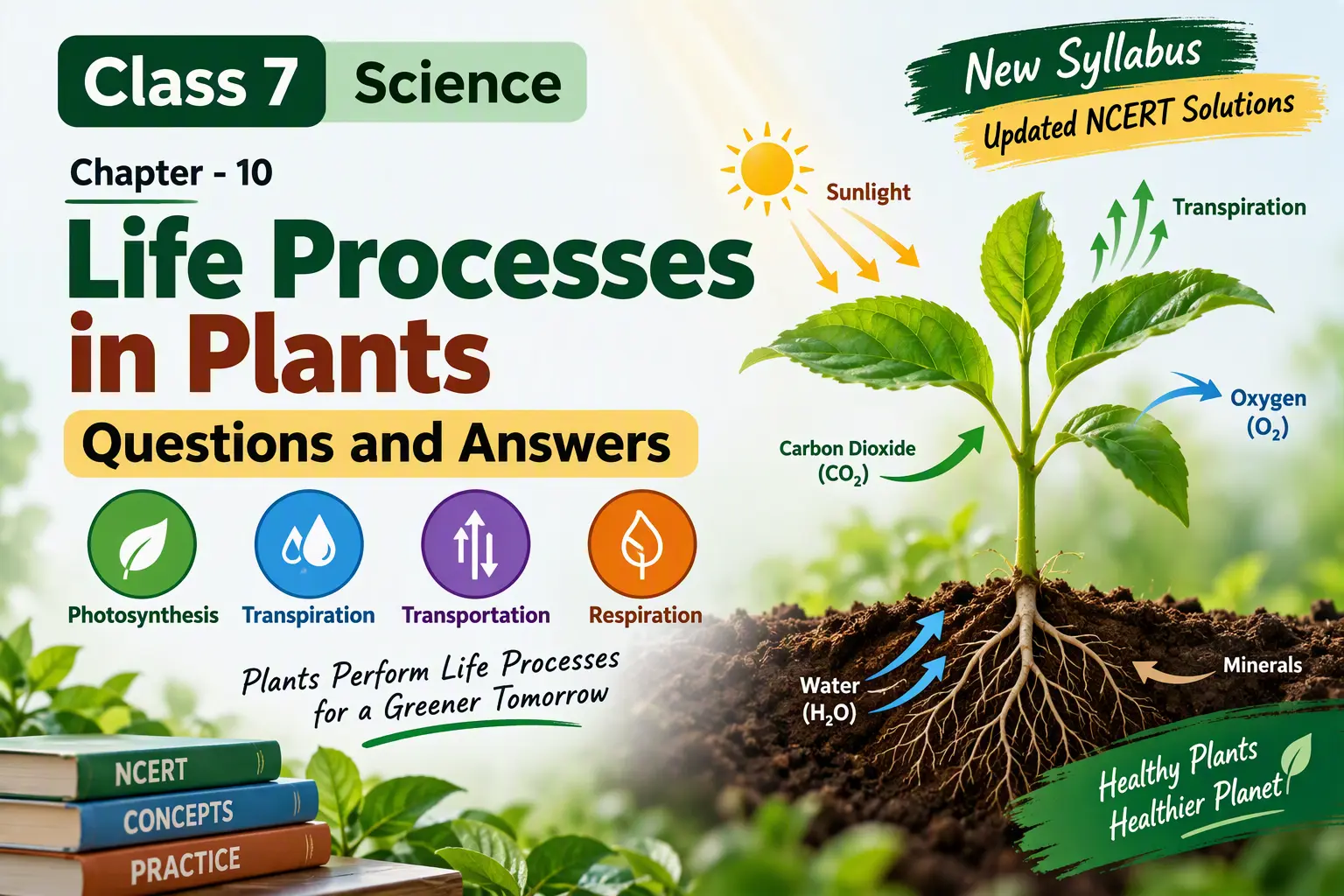
Class 7 Science Chapter – 10 Life Processes in Plants Questions and Answers
Let Us Enhance Our Learning Page no: 150
Question: 1. Complete the following table
Answer:
| S.No. | Feature | Photosynthesis | Respiration |
| 1. | Raw materials | Carbon dioxide, Water, Sunlight, Chlorophyll | Glucose, Oxygen |
| 2. | Products | Glucose, Oxygen | Carbon dioxide, Water, Energy |
| 3. | Word equation | Carbon dioxide + Water + Sunlight → Glucose + Oxygen | Glucose + Oxygen → Carbon dioxide + Water + Energy |
| 4. | Importance | Produces food (glucose) and oxygen, essential for plant growth | Releases energy for growth and metabolic processes in plants |
Question: 2. Imagine a situation where all the organisms that carry out photosynthesis on the earth have disappeared. What would be the impact of this on living organisms?
Answer: If all organisms that perform photosynthesis were to vanish from the Earth, the consequences would be profound and far-reaching. Here are some key impacts:
1. Loss of Oxygen Production: Photosynthesis and Oxygen: Photosynthetic organisms, primarily plants and certain algae, are responsible for producing oxygen as a byproduct of photosynthesis. The equation for photosynthesis is: Carbon dioxide+Water→SunlightGlucose+Oxygen
2. Food Chain Collapse: Herbivores would die out due to lack of food, leading to carnivore extinction.
3. Ecosystem Degradation: Loss of biodiversity and increased soil erosion.
4. Climate Change Acceleration: Higher carbon dioxide levels worsen global warming.
5. Human Survival Threat: Food shortages and economic collapse would endanger human life.
Question: 3. A potato slice shows the presence of starch with iodine solution. Where does the starch in potatoes come from? Where is the food synthesised in the plant, and how does it reach the potato?
– Where does the starch in potatoes come from?
Answer: The starch found in potatoes originates from the process of photosynthesis. During photosynthesis, plants convert carbon dioxide and water into glucose using sunlight and chlorophyll. This process primarily occurs in the leaves, which are often referred to as the “food factories” of the plant.
– Where is the food synthesized in the plant?
Answer: Food is synthesized in the leaves of the plant. The green pigment chlorophyll present in the leaves captures sunlight, which is essential for the photosynthesis process. The glucose produced during this process can be stored in the form of starch.
– How does the food reach the potato?
Answer: Once synthesized in the leaves, the glucose is transported to various parts of the plant, including the potato tubers, through specialized tissue called phloem. The phloem is responsible for transporting the food produced in the leaves to other parts of the plant where it can be utilized or stored. In the case of potatoes, the glucose is converted into starch and stored in the tubers for later use.
Question: 4. Does the broad and flat structure of leaves make plants more efficient for photosynthesis? Justify your answer.
Answer: Yes, the broad and flat structure of leaves significantly enhances the efficiency of photosynthesis. Here’s a detailed justification:
Key Reasons: –
1. Increased Surface Area: The broad and flat shape of leaves provides a larger surface area that can capture more sunlight. This is crucial because sunlight is a primary energy source for photosynthesis.
2. Maximized Light Absorption: A larger surface area allows for more chlorophyll to be present, which is the green pigment responsible for absorbing sunlight. The more chlorophyll available, the more light can be absorbed, leading to increased energy for the photosynthesis process.
3. Efficient Gas Exchange: The flat structure facilitates the presence of tiny pores called stomata on the leaf surface. These stomata are essential for the exchange of gases (carbon dioxide in and oxygen out), which is vital for photosynthesis and respiration.
4. Optimal Positioning: The broad leaves can position themselves optimally to receive sunlight throughout the day, reducing the shadowing effect that might occur if leaves were narrower or more upright.
5. Temperature Regulation: A larger leaf surface can help in regulating temperature through transpiration, which can cool the leaf and maintain optimal conditions for photosynthesis.
Question: 5. X is broken down using Y to release carbon dioxide, Z, and energy. X + Y Carbon dioxide + Z + Energy X, Y, and Z are three diff erent components of the process. What do X, Y, and Z stand For?
Answer: In the context of the respiration process in plants, the equation provided can be interpreted as follows:
- X represents Glucose. This is the sugar that is broken down during respiration to release energy.
- Y represents Oxygen. This is the gas required for the process of respiration to occur.
- Z represents Water. This is one of the by-products produced during the breakdown of glucose.
Thus, the complete breakdown of the equation can be summarized as:
Glucose+Oxygen→Carbon dioxide+Water+Energy
Explanation: –
- Glucose is a simple carbohydrate that serves as an energy source for plants.
- Oxygen is essential for the aerobic respiration process, where glucose is oxidized to release energy.
- The by-products of this process include carbon dioxide and water, which are released into the atmosphere and can be utilized by plants during photosynthesis.
This process is crucial for the growth and development of plants, as it provides the necessary energy for various life processes.
Page no: 151
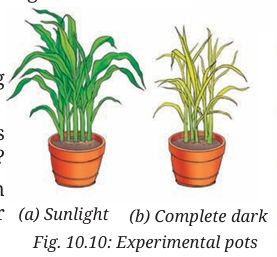
Question: 6. Krishna set-up an experiment with two potted plants of the same size and placed one of them in sunlight and the other in a dark room, as shown in Fig. 10.10. 151 Answer the following questions —
(i) What idea might she be testing through this experiment?
Answer: Krishna is likely testing the hypothesis that sunlight is essential for photosynthesis. By placing one plant in sunlight and the other in a dark room, she aims to observe the effects of light availability on the plant’s ability to produce food and grow.
(ii) What are the visible differences in plants in both the conditions?
Answer: The visible differences between the two plants will likely include:
- Plant in Sunlight:
- Growth: This plant will show healthy growth, with more leaves and possibly a taller height.
- Leaf Color: The leaves will be green and vibrant due to the presence of chlorophyll, which is essential for photosynthesis.
- Starch Presence: If tested with iodine, the leaves will turn blue-black, indicating the presence of starch, a product of photosynthesis.
- Plant in Dark Room:
- Growth: This plant may show stunted growth or may not grow at all.
- Leaf Color: The leaves may appear yellow or pale, indicating a lack of chlorophyll production due to the absence of sunlight.
- Starch Presence: If tested with iodine, the leaves will not change color, indicating no starch is produced.
(iii) According to you, leaves of which plants confirm the iodine test for the presence of starch?
Answer: The leaves of the plant kept in sunlight will confirm the iodine test for the presence of starch. This is because sunlight is necessary for photosynthesis, which produces starch in the leaves. The plant kept in the dark is unlikely to show a positive iodine test, as it would not have undergone photosynthesis due to the lack of light.
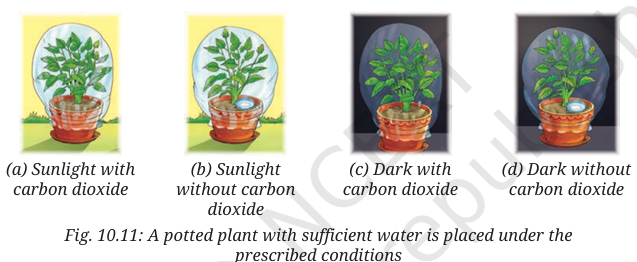
Question: 7. Vani believes that ‘carbon dioxide is essential for photosynthesis’. She puts an experimental set-up, as shown in Fig. 10.11, to collect evidence to support or reject her idea.
Answer:
Answer the following questions —
(i) In which plant(s) in the above set-up(s) will starch be formed?
- Starch will be formed in:
- Set-up (a): The plant receives both sunlight and carbon dioxide, allowing photosynthesis to occur, resulting in starch production.
(ii) In which plant(s) in the above set-up(s) will starch not be formed?
Starch will not be formed in:
- Set-up (b): The plant is in sunlight but lacks carbon dioxide, preventing photosynthesis.
- Set-up (c): The plant is in the dark, even though carbon dioxide is present, so photosynthesis cannot occur.
- Set-up (d): The plant is in the dark and lacks carbon dioxide, so no starch will be produced.
(iii) In which plant(s) in the above set-up(s) will oxygen be generated?
Oxygen will be generated in: Set-up (a): The plant can perform photosynthesis, producing oxygen.
(iv) In which plant(s) in the above set-up(s) will oxygen not be generated?
Oxygen will not be generated in:
– Set-up (b): Sunlight is available, but without carbon dioxide, photosynthesis cannot occur.
– Set-up (c): The plant is in the dark, so no photosynthesis takes place to produce oxygen.
– Set-up (d): The plant is in the dark and lacks carbon dioxide, preventing any oxygen generation.
Question: 8. Ananya took four test tubes and filled three-fourth of each test tube with water. She labelled them A, B, C, and D (Fig. 10.12). In test tube A, she kept a snail; in test tube B, she kept a water plant; in test tube C, she kept both a snail and a plant. In test tube D, she kept only water. Ananya added a carbon dioxide indicator to all the test tubes.
She recorded the initial colour of water and observed if there are any colour changes in the test tubes after 2–3 hours. What do you think she wants to fi nd out? How will she know if she is correct?
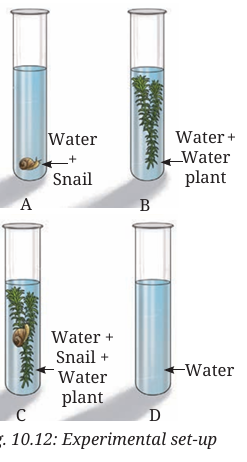
Ananya’s experiment involves four test tubes, each containing different combinations of a snail and a water plant, along with a carbon dioxide indicator. Here’s a breakdown of her objectives and how she can determine the outcomes.
Objective of the Experiment
Ananya aims to investigate the relationship between respiration and photosynthesis in aquatic environments. Specifically, she wants to find out:
- How the presence of a snail and/or a water plant affects the levels of carbon dioxide in the water.
- Whether the water plant can utilize carbon dioxide produced by the snail during respiration for photosynthesis, and how this affects the water’s color.
Expected Observations
- Test Tube A (Snail only):
- The snail will respire, producing carbon dioxide. The indicator may show a color change due to increased carbon dioxide levels in the water.
- Test Tube B (Water Plant only):
- The water plant will likely undergo photosynthesis if there is sufficient light, consuming carbon dioxide and potentially leading to a decrease in carbon dioxide levels. The indicator may show little to no change or a color indicating lower carbon dioxide levels.
- Test Tube C (Snail and Water Plant):
- Here, the snail will produce carbon dioxide while the plant will consume it for photosynthesis. The net effect on the indicator will depend on the balance between the carbon dioxide produced by the snail and the amount consumed by the plant. The indicator may show a slight color change, depending on the rates of respiration and photosynthesis.
- Test Tube D (Only Water):
- This test tube serves as a control. There should be no significant change in color since there are no organisms to produce or consume carbon dioxide.
How to Determine Correctness
To confirm her hypothesis, Ananya will compare the initial and final colors of the water in each test tube after 2-3 hours.
- Color Change:
- If the water in Test Tube A turns a color indicating high carbon dioxide levels, it supports the idea that the snail is respiring.
- If Test Tube B shows a color indicating low carbon dioxide, it suggests that the plant is effectively photosynthesizing.
- In Test Tube C, the color change will indicate the balance between respiration and photosynthesis.
- Test Tube D should remain unchanged, confirming that without any organisms, there is no respiration or photosynthesis occurring.
Page no: 152
Question: 9. Design an experiment to observe if water transportation in plants is quicker in warm or cold conditions.
Answer: To determine whether water transportation in plants is quicker in warm or cold conditions.
Materials Needed:
- Two identical potted plants of the same species and size (e.g., small bean plants)
- Two transparent glass containers or jars
- Water
- Ice cubes (for cold condition)
- Thermometer
- Stopwatch or timer
- Labels for the containers
Procedure:
- Preparation:
- Label one container as “Warm Condition” and the other as “Cold Condition.”
- Fill both containers with an equal amount of water (e.g., 500 ml).
- Setting Up the Plants:
- Place one potted plant in the “Warm Condition” container.
- Place the second potted plant in the “Cold Condition” container.
- Creating Temperature Conditions:
- For the “Warm Condition” container, place it in a warm area with ample sunlight or use a heat lamp to maintain a warm temperature (around 25-30°C).
- For the “Cold Condition” container, add ice cubes to the water to lower the temperature (around 10-15°C). Ensure the ice does not directly touch the plant.
- Observation:
- Start the timer and observe the plants for a specific duration (e.g., 1 hour).
- During this time, monitor the plants for any visible changes, such as wilting or leaf color changes.
- Measuring Water Uptake:
- After the observation period, measure the amount of water absorbed by each plant. This can be done by checking the soil moisture level or by weighing the pots before and after the experiment.
- Record the data in a table for comparison.
- Repeat the Experiment:
- To ensure accuracy, repeat the experiment multiple times and average the results.
| Condition | Initial Water Level (ml) | Final Water Level (ml) | Amount Absorbed (ml) |
| Warm Condition | 500 | 450 | 50 |
| Cold Condition | 500 | 480 | 20 |
Explanation of the Data : –
– Warm Condition: The initial water level was 500 ml, and after the observation period, the final water level was 450 ml. This indicates that the plant absorbed 50 ml of water.
– Cold Condition: The initial water level was also 500 ml, but the final water level was 480 ml, showing that the plant absorbed only 20 ml of water.
Question: 10. Photosynthesis and respiration are essential to maintain balance in nature. Discuss.
Answer: Introduction Photosynthesis and respiration are two fundamental biological processes that play a crucial role in maintaining the ecological balance on Earth. They are interconnected and support life by regulating the flow of energy and matter in ecosystems.
1. Photosynthesis
- Definition: Photosynthesis is the process by which green plants, algae, and some bacteria convert light energy into chemical energy in the form of glucose. This process occurs primarily in the leaves, where chlorophyll captures sunlight.
- Equation: The general equation for photosynthesis can be summarized as:
- Carbon dioxide+Water+Sunlight→ChlorophyllGlucose+Oxygen
Importance:
- Oxygen Production: Photosynthesis releases oxygen as a byproduct, which is essential for the survival of aerobic organisms, including humans.
- Food Source: It provides the primary source of energy for all living organisms. Plants produce glucose, which can be used immediately for energy or stored as starch for later use.
2. Respiration
- Definition: Respiration is the process by which living organisms break down glucose in the presence of oxygen to release energy. This process occurs in all cells, including those of plants.
- Equation: The equation for respiration can be expressed as:
- Glucose+Oxygen→Carbon dioxide+Water+Energy
Importance:
- Energy Release: Respiration provides the energy required for various cellular activities, growth, and maintenance of life processes.
- Carbon Dioxide Production: It releases carbon dioxide, which is then utilized by plants during photosynthesis.
3. Interdependence of Photosynthesis and Respiration
- Cycle of Matter: The products of photosynthesis (glucose and oxygen) are the reactants for respiration. Conversely, the products of respiration (carbon dioxide and water) are the reactants for photosynthesis. This cyclical relationship ensures a continuous supply of energy and nutrients.
- Balance in Ecosystems:
- Oxygen and Carbon Dioxide Levels: Photosynthesis helps to maintain atmospheric oxygen levels, while respiration contributes to the carbon cycle by returning carbon dioxide to the atmosphere.
- Food Webs: Plants (producers) form the base of food webs, supporting herbivores (primary consumers) and, subsequently, carnivores (secondary consumers). This interconnectedness highlights the importance of both processes in sustaining life.