Class 7 Science Chapter – 11 Light: Shadows and Reflections Questions and Answers
Let Us Enhance Our Learning page no 165
Question: 1. Which of the following are luminous objects?
Mars, Moon, Pole Star, Sun, Venus, Mirror
Answer: Luminous objects are those that emit their own light. Based on the list provided:
- Mars: Non-luminous (reflects sunlight)
- Moon: Non-luminous (reflects sunlight)
- Pole Star: Luminous (emits its own light)
- Sun: Luminous (emits its own light)
- Venus: Non-luminous (reflects sunlight)
- Mirror: Non-luminous (reflects light but does not emit its own)
Luminous Objects: Pole Star, Sun
Question: 2. Match the items in Column A with those in Column B.
Answer:
| Column A | Column B |
| Pinhole camera | Forms an inverted image |
| Opaque object | Blocks light completely |
| Shadow | The dark region formed behind the object |
| Transparent object | Light passes almost completely through it |
Summary of Matches: –
1. Pinhole camera → Forms an inverted image
2. Opaque object → Blocks light completely
3. Shadow → The dark region formed behind the object
4. Transparent object → Light passes almost completely through it
Page no 166
Question: 3. Sahil, Rekha, Patrick, and Qasima are trying to observe the candle flame through the pipe as shown in Fig. 11.16. Who can see the flame?
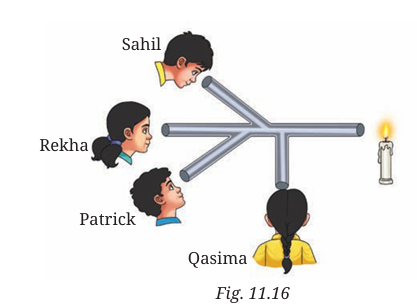
Answer: In the scenario where Sahil, Rekha, Patrick, and Qasima are attempting to observe the candle flame through a pipe, the ability to see the flame depends on the alignment of their positions relative to the straightness of the pipe.
Key Points:
- Straight Pipe Visibility: If the pipe is straight, only those positioned directly in line with the pipe can see the flame. This is because light travels in straight lines, and any obstruction or bending in the pipe would prevent the light from reaching the observer.
- Bending Pipe Visibility: If the pipe is bent, none of them would be able to see the flame, as light cannot navigate through bends.
Question: 4. Look at the images shown in Fig. 11.17 and select the correct image showing the shadow formation of the boy.
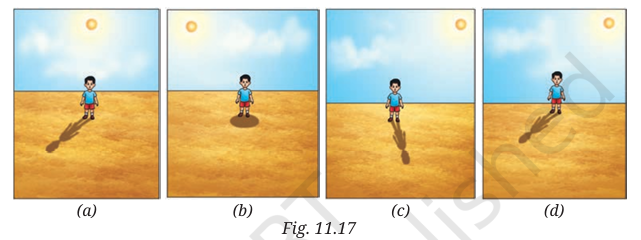
Answer: In the context of shadow formation, the correct image showing the shadow of the boy would depend on the position of the light source (like the Sun or a lamp) relative to the boy and the surface on which the shadow is cast.
Key Points to Consider:
- Light Source Position: Shadows are formed in the opposite direction of the light source. If the light is coming from the left, the shadow will be cast to the right.
- Object’s Position: The distance of the boy from the light source and the surface also affects the size and sharpness of the shadow. Closer objects cast larger and sharper shadows, while those farther away cast smaller and more diffused shadows.
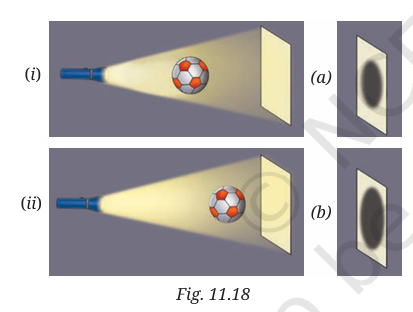
Question: 5. The shadow of a ball is formed on a wall by placing the ball in front of a fixed torch as shown in Fig. 11.18. In scenario (i) the ball is closer to the torch, while in scenario (ii) the ball is closer to the wall. Choose the most accurate representation of the shadows formed in both scenarios from the options provided (a and b).
Answer: In the context of shadow formation, the position of the light source (in this case, the torch) and the object (the ball) plays a crucial role in determining the size and clarity of the shadow cast on a surface (the wall).
Scenario Analysis: –
- Scenario (i): The ball is closer to the torch.
- Expected Outcome: The shadow of the ball will be smaller and sharper because the light rays diverge as they move away from the torch. The closer the object is to the light source, the more concentrated the light is, resulting in a smaller shadow.
- Scenario (ii): The ball is closer to the wall.
- Expected Outcome: The shadow of the ball will be larger and possibly less defined. As the ball moves away from the light source, the light rays spread out more, causing the shadow to enlarge and become less distinct.
Question: 6. Based on Fig. 11.18, match the position of the torch in Column A with the characteristics of the ball’s shadow in Column B.
| Column A | Column B |
| If the torch is close to the ball | The shadow would be larger |
| If the torch is far away | The shadow would be smaller |
| If the ball is removed from the set-up | A bright spot would appear on the screen |
| If two torches are present in the set-up on the left side of the ball | Two shadows would appear on the screen |
Page no: 167
Question: 7. Suppose you view the tree shown in Fig. 11.19 through a pinhole camera. Sketch the outline of the image of the tree formed in the pinhole camera. 8. Write your name on a piece of paper and hold it in front of a plane mirror such that the paper is parallel to the mirror. Sketch the image. What difference do you notice? Explain the reason for the difference.
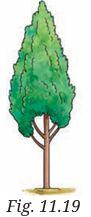
Answer: When viewing a tree through a pinhole camera, the image formed on the screen will be inverted (upside down) due to the way light travels through the pinhole.
Sketch Outline:
- The outline of the image will show the tree’s trunk and branches, but it will be flipped vertically. For instance, if the tree has a wider canopy at the top, it will appear narrower at the bottom in the image.
Explanation:
- This inversion occurs because light rays from the top of the tree pass through the pinhole and strike the bottom part of the screen, while rays from the bottom of the tree hit the top part of the screen.
Question: 8. Write your name on a piece of paper and hold it in front of a plane mirror such that the paper is parallel to the mirror. Sketch the image. What difference do you notice? Explain the reason for the difference.
Answer: When you hold your name in front of a plane mirror, the reflection you see will be laterally inverted. For example, if your name is “ALICE,” it will appear as “ECILA” in the mirror. This lateral inversion occurs because the mirror reverses the left and right sides of the image. The reason for this is that light reflects off the mirror, creating an image that appears to be behind the mirror, but it is flipped horizontally.
Question: 9. Measure the length of your shadow at 9 AM, 12 PM, and 4 PM with the help of your friend. Write down your observations:
(i) At which of the given times is your shadow the shortest?
Answer: At 12 PM, the shadow is the shortest.
At 9 AM and 4 PM, the shadows are longer.
(ii) Why do you think this happens?
Answer: Explanation: The length of shadows changes throughout the day due to the position of the sun in the sky. At noon, the sun is at its highest point, resulting in the shortest shadows. In the morning and late afternoon, the sun is lower on the horizon, causing longer shadows.
Question: 10. On the basis of following statements, choose the correct option.
Statement A: Image formed by a plane mirror is laterally inverted.
Statement B: Images of alphabets T and O appear identical to themselves in a plane mirror.
(i) Both statements are true
(ii) Both statements are false
(iii) Statement A is true, but statement B is false
(iv) Statement A is false, but statement B is true
Answer: The correct option is (iii) Statement A is true, but Statement B is false.
The image formed by a plane mirror is indeed laterally inverted, while the letters T and O do not appear identical when reflected; T appears reversed, while O remains the same.
Question: 11. Suppose you are given a tube of the shape shown in Fig. 11.20 and two plane mirrors smaller than the diameter of the tube. Can this tube be used to make a periscope? If yes, mark where you will fix the plane mirrors.
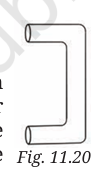
Answer: Yes, the tube can be used to make a periscope. You would fix one mirror at a 45-degree angle at the top end of the tube and the other mirror at a 45-degree angle at the bottom end. This arrangement allows light to reflect from the top mirror to the bottom mirror, enabling you to see objects that are not directly in your line of sight.
Question: 12. We do not see the shadow on the ground of a bird flying high in the sky. However, the shadow is seen on the ground when the bird swoops near the ground. Think and explain why it is so.
Answer: The shadow of a bird flying high is not visible on the ground because the light from the sun is coming from a high angle, and the bird is too far away for its shadow to reach the ground. When the bird swoops down closer to the ground, it blocks more sunlight, and the angle of the light allows its shadow to be cast on the ground, making it visible.
FAQs
Question: 1. What is lateral inversion?
Answer: Lateral inversion is the phenomenon where the left and right sides of an image are reversed when viewed in a mirror.
Question: 2. Why do shadows change length throughout the day?
Answer: Shadows change length due to the position of the sun in the sky, which affects the angle of light hitting the object.
Question: 3. How does a periscope work?
Answer: A periscope works by using two mirrors at angles to reflect light from an object to the viewer’s eye, allowing them to see over obstacles.
Question: 4. Can all objects cast shadows?
Answer: Only opaque objects can cast shadows, as they block light from passing through.
Question: 5. What factors affect the size of a shadow?
Answer: The size of a shadow is affected by the distance of the object from the light source and the surface on which the shadow is cast.