Page: 143
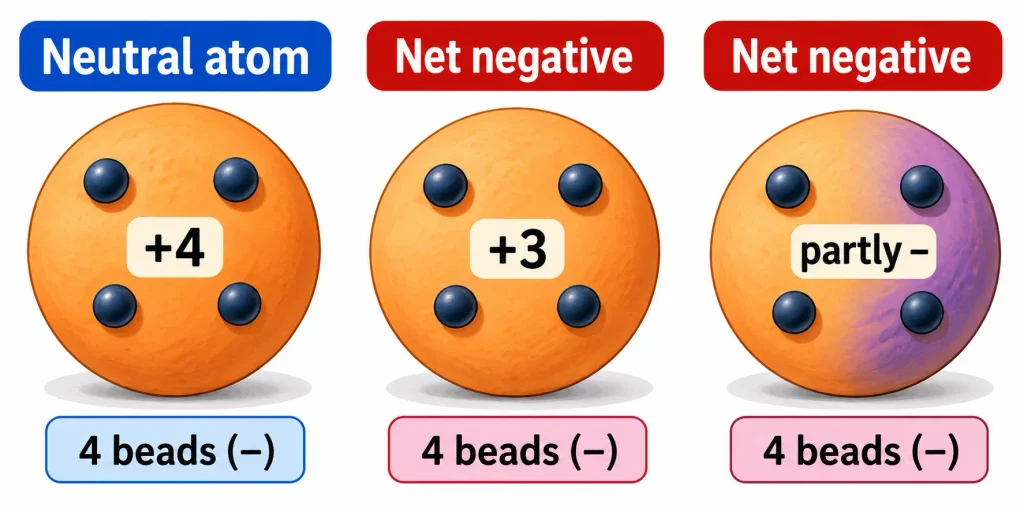
Q1. Suppose you made up your own ‘atom’, as Thomson described, using clay for the positive charge and small beads for the electrons spread through it. What will happen if: (i) the positive charge on the clay is lesser than the total negative charge of the beads? (ii) by mistake, the clay itself carries a bit of negative charge? Would your model still represent a neutral atom?
Ans: (i) Positive charge less than the total negative charge: In Thomson’s model, the sphere of positive charge exactly balances the total negative charge of the electrons, making the atom neutral. If the clay’s positive charge is less than the beads’ total negative charge, the negative charges are no longer fully cancelled. The model would then represent a negatively charged particle (a negative ion), not a neutral atom.
(ii) The clay itself carries a bit of negative charge: If the clay is partly negative, its effective positive charge is reduced. The total positive charge would then be less than the total negative charge of the beads, so again the charges would not balance. The model would not represent a neutral atom — it would behave like a negatively charged object.
Key idea: A neutral atom requires the total positive charge to be exactly equal in magnitude to the total negative charge. Any mismatch makes the model an ion rather than a neutral atom.
Q2. Could an orange or a lemon, which also contain seeds inside soft pulp, be a good comparison? In what ways does it match Thomson’s idea and where does it fall short?
Ans: Where it matches: Like the watermelon comparison, an orange or lemon has soft pulp (representing the positively charged sphere) with seeds scattered throughout it (representing the electrons embedded in the positive charge). So it captures the basic idea of electrons distributed inside a positive sphere.
Where it falls short:
- In a real fruit, the seeds sit in fixed spots, while in Thomson’s model the electrons are distributed throughout the positive charge (the model does not fix exact positions, but the fruit suggests a static, seed-like arrangement).
- The pulp and seeds in a fruit have no actual electric charge — the comparison is only about arrangement, not about charge.
- A fruit has most of its mass in the pulp; in a real atom, most of the mass is not spread with the positive charge in the way Thomson’s model implied (later work by Rutherford showed the mass is concentrated in a tiny nucleus).
So an orange or lemon works as a rough visual analogy, but it cannot show the electrical nature of the atom.
Q3. Why did Thomson conclude that electrons are present in all atoms?
Ans: Thomson studied the conduction of electricity through gases at very low pressure using a cathode ray tube. He observed rays (cathode rays) travelling from the cathode to the anode, and by examining them in electric and magnetic fields he showed they were streams of negatively charged particles — electrons — with a mass much smaller than that of atoms.
The crucial observation was that the nature of these cathode rays was independent of the material of the cathode and the type of gas in the tube. Since the same electrons were emitted no matter which electrode material or gas was used, Thomson concluded that electrons must be a fundamental component present in every atom, in all elements. This made the electron the first subatomic particle to be identified.
Page: 144
Q4. What do you think would happen if α-particles were replaced with negatively charged particles in Rutherford’s gold foil experiment?
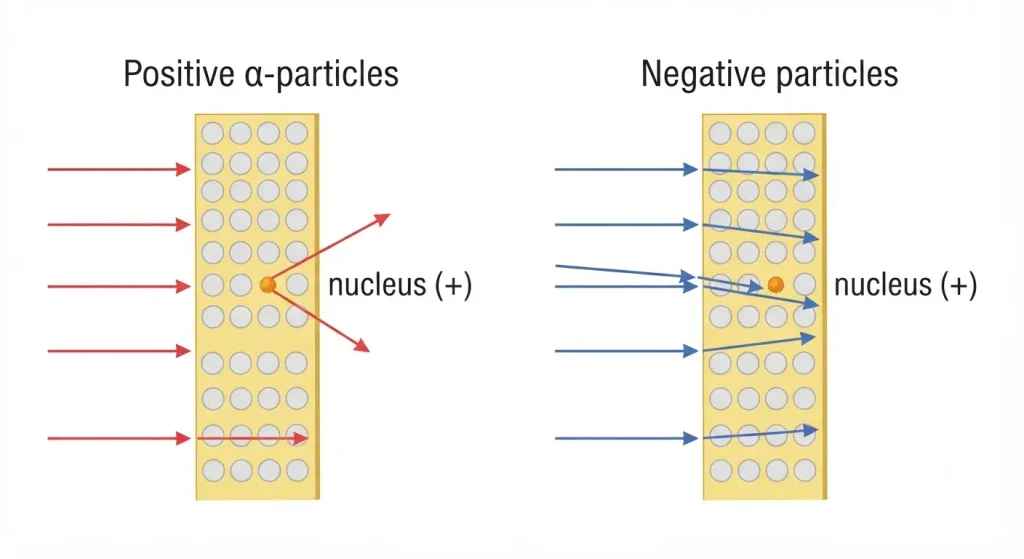
Ans: Alpha particles are deflected sharply only because they are positively charged and are repelled by the concentrated positive charge of the nucleus. If we replaced them with negatively charged particles, the observations would change completely:
- Most particles would still pass straight through, because the atom is mostly empty space — this part of the result depends on the emptiness of the atom, not on the charge of the incoming particle.
- There would be no large-angle repulsion from the nucleus. A negatively charged particle would not be repelled by the positively charged nucleus; if anything, it would be weakly attracted towards it.
- The particles would be only slightly affected by the electrons scattered in the atom, since electrons are very light compared to atoms and carry only a small negative charge.
So the dramatic scattering and bounce-back — the very observations that revealed the nucleus — would disappear. This thought experiment highlights that the large deflections in the original experiment were evidence of a dense, positively charged centre: only a strong positive charge concentrated in a tiny region could push positive alpha particles away so sharply.
Q5. Rutherford found that a few α-particles bounced back sharply. How does this single surprising result completely rule out Thomson’s ‘plum pudding model’ of the atom?
Ans: According to Thomson’s model, the positive charge of the atom is spread evenly throughout the sphere, with electrons embedded in it. If that were true:
- The positive charge encountered by any alpha particle would be diluted — spread over the whole volume of the atom, so no single region could exert a strong enough repulsion.
- An alpha particle passing through such a diffuse positive charge would experience only small, gradual deflections, or pass straight through.
But in the actual experiment, a few alpha particles bounced back sharply — some at angles greater than 90°, essentially reversing direction. Rutherford famously found this as surprising as a shell bouncing off tissue paper. A bounce-back of this kind is possible only if the alpha particle hits something extremely dense and massively positive concentrated in a very tiny region. A uniformly spread-out positive charge simply cannot produce such a strong, localized repulsion.
Since the plum pudding model predicts that large-angle deflections are impossible, and the experiment showed they actually happen, the model is completely ruled out. This single observation forced scientists to accept that the positive charge and most of the mass sit in a tiny central nucleus — the foundation of Rutherford’s nuclear model.
Q6. If you could ask Rutherford one question about his work, what would it be?
Ans: This is an open-ended question, so there is no single correct answer — the idea is to show curiosity about his discovery. A thoughtful sample question could be:
“When you saw that a few alpha particles bounced back, how did you move from being surprised to being confident that the atom has a tiny, dense, positively charged nucleus — and what made you sure there wasn’t some other explanation?”
Other good examples include:
- “How did you design an experiment to test a model you expected to be correct — and how did you react when the results contradicted it?”
- “Why did you choose gold for the foil, and how thin did the foil need to be for the experiment to work?”
A good question here shows that you understand the experiment’s logic — the connection between the unexpected scattering and the conclusion that a dense nucleus exists.
Page: 145
Q7. Assertion (A): Rutherford concluded that most of the mass of an atom is concentrated in
a small region at the centre called the nucleus.
Reason (R): According to Thomson’s model, electrons are embedded in a uniformly
distributed positive charge sphere.
Choose the correct option:
(i) Both A and R are true, and R is the correct explanation of A.
(ii) Both A and R are true, but R is not the correct explanation of A.
(iii) A is true, but R is false.
(iv) A is false, but R is true.
Ans: Correct option: (ii) Both A and R are true, but R is not the correct explanation of A.
From the gold foil experiment, Rutherford observed that while most alpha particles passed straight through the gold foil, a few were deflected at large angles and some bounced back sharply. This is possible only if the positive charge and most of the mass of the atom are packed into an extremely small, dense region at the centre — the nucleus. So Assertion (A) is true.
Thomson’s model indeed described the atom as a sphere of uniformly distributed positive charge with electrons embedded throughout it (the plum pudding model). So Reason (R) is a true statement about Thomson’s model.
Rutherford’s conclusion about the nucleus came from his own gold foil experiment — specifically, the large-angle scattering and bounce-back of alpha particles. Thomson’s description of electrons embedded in a positive sphere is simply a statement of the older model that the experiment went on to disprove. It played no role in explaining why Rutherford located the mass at the centre.
Since both statements are true but the Reason does not explain the Assertion, option (ii) is correct.
Quick Tip for Assertion–Reason Questions
- First verify each statement independently as true or false.
- Then ask: does R give the cause or evidence for A? If R merely states a related but unrelated fact, choose option (ii).
- Here, the evidence for A is the alpha-particle scattering results — not Thomson’s model — so (ii) fits.
R is not the explanation: Rutherford’s conclusion came from alpha-particle scattering, not from Thomson’s model. Answer: option (ii).
A is true: The gold foil experiment showed mass and positive charge are concentrated in a tiny nucleus.
R is true: Thomson’s model does place electrons in a uniform positive sphere.
Page: 149
Q8. Imagine you are a scientist who has discovered a new element. Name this element after yourself and justify that the symbol you have chosen follows the IUPAC rules.
Ans: This is an open-ended creative question, so any correctly formed example works. Here is a sample answer:
Suppose I have discovered a new element and named it “Sharmite” (after myself). I propose the symbol Sh.
My symbol follows the IUPAC rules because:
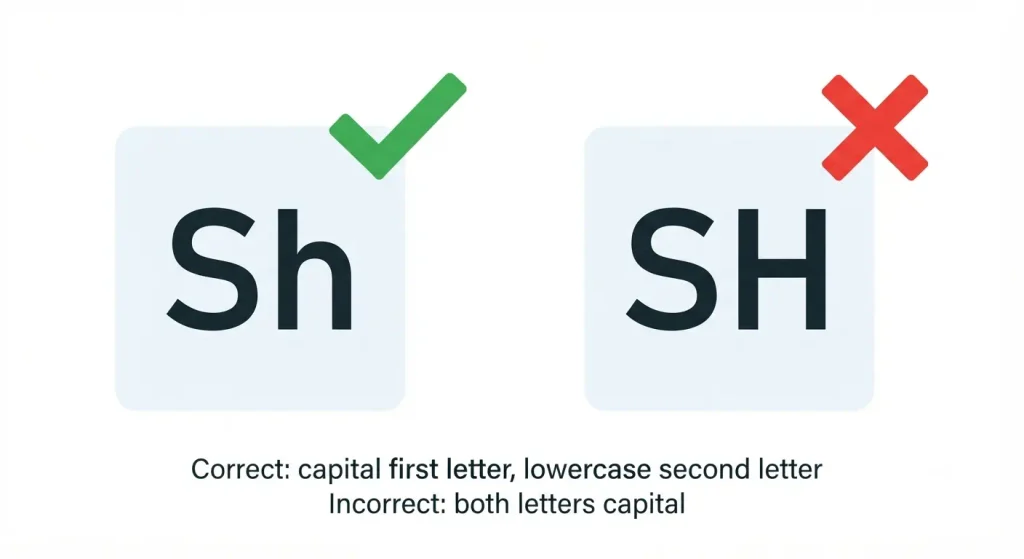
- First letter is a capital (uppercase) letter: “S” in “Sh” is uppercase.
- Second letter is a small (lowercase) letter: “h” in “Sh” is lowercase. Writing “SH” would be incorrect — just as aluminium must be “Al” (not “AL”) and cobalt “Co” (not “CO”).
- The symbol uses the first letters of the element’s English name: many symbols take the first letter or first two letters of the name (hydrogen → H, silicon → Si), and “Sh” takes the first two letters of “Sharmite”.
- The symbol does not clash with an existing element’s symbol: Sh is not already used by any known element (unlike, say, S for sulfur or Si for silicon).
You could equally invent a symbol from a Latin-style name, since some official symbols come from Latin, Greek, or German roots — iron is Fe (from ferrum), mercury is Hg (from hydrargyros), and tungsten is W (from wolfram). What matters is that the capital–lowercase rule and uniqueness are respected.
Q9. What problems could arise if every scientist used different symbols for the same element?
Ans: If scientists invented their own personal symbols for elements, chemistry would quickly become chaotic:
- Miscommunication across the world: Science is international. A scientist in one country might write iron as “Fe”, another as “Fe+”, another with a completely personal symbol — and readers could not tell which substance was meant.
- Errors and confusion in research: Chemical formulas, equations, and reaction descriptions would be misread, leading to wrong calculations, wrong measurements, and even dangerous mistakes in laboratories and industry.
- Wasted effort in learning: Every student and researcher would have to memorise multiple symbol systems for the same elements instead of one universal set.
- Difficulty publishing and sharing knowledge: Scientific papers, databases, and textbooks rely on shared notation; without it, results could not be reliably compared or verified.
This is exactly why Dalton’s pictorial symbols were replaced by Berzelius’s alphabetic symbols in 1813, and why IUPAC today approves one standard name and symbol for every element. A common symbol system lets scientists worldwide communicate clearly, regardless of language.