Class 10 SST (Contemporary India) Chapter- 5 Minerals and Energy Resources Questions and Answers
EXERCISES Page no: 55
Question: 1. Multiple choice questions.
(i) Which one of the following minerals is formed by decomposition of rocks, leaving a residual mass of weathered material?
(a) coal
(b) bauxite
(c) gold
(d) zinc
Correct Answer: (b) bauxite.
Explanation:
Bauxite is formed through the weathering and decomposition of rocks rich in aluminum silicates. This process leaves behind a residual mass that is rich in aluminum, making bauxite the primary ore for aluminum production.
(ii) Koderma, in Jharkhand is the leading producer of which one of the following minerals?
(a) bauxite
(b) mica
(c) iron ore
(d) copper
Correct Answer: (b) mica
Explanation:
Koderma, located in Jharkhand, is renowned for its significant production of mica, which is a vital mineral used in various electrical and electronic applications due to its excellent insulating properties.
EXERCISES Page no: 56
(iii) Minerals are deposited and accumulated in the stratas of which of the following rocks?
(a) sedimentary rocks
(b) metamorphic rocks
(c) igneous rocks
(d) none of the above
Correct Answer: (a) sedimentary rocks.
Explanation: Minerals are primarily deposited and accumulated in sedimentary rocks, where they form through processes such as deposition, accumulation, and concentration in horizontal layers. This is in contrast to igneous and metamorphic rocks, where minerals may occur in different forms but are not typically deposited in strata.
(iv) Which one of the following minerals is contained in the Monazite sand?
(a) oil
(b) uranium
(c) thorium
(d) coal
Correct Answer: (c) thorium.
Explanation: Monazite sand is primarily known for containing thorium, which is a radioactive element used in nuclear energy applications. It is also a source of rare earth elements. Monazite is not associated with oil, uranium, or coal.
Question: 2. Answer the following questions in about 30 words.
(i) Distinguish between the following in not more than 30 words.
(a) ferrous and non-ferrous minerals
Answer: Ferrous minerals contain iron, essential for steel production (e.g., iron ore). Non-ferrous minerals do not contain iron and include metals like copper, aluminum, and gold.
(b) conventional and non-conventional sources of energy
Answer: Conventional sources include fossil fuels like coal and petroleum, widely used for energy. Non-conventional sources are renewable, such as solar, wind, and geothermal energy, promoting sustainability.
(ii) What is a mineral?
Answer: A mineral is a naturally occurring, homogeneous substance with a defined internal structure, formed from specific combinations of elements, exhibiting various physical and chemical properties.
(iii) How are minerals formed in igneous and metamorphic rocks?
Answer: In igneous rocks, minerals crystallize from molten magma as it cools. In metamorphic rocks, minerals form through heat and pressure altering existing rocks, resulting in new mineral compositions.
(iv) Why do we need to conserve mineral resources?
Answer: Conserving mineral resources is crucial because they are finite and non-renewable. Sustainable use ensures availability for future generations and minimizes environmental degradation caused by excessive extraction.
Question: 3. Answer the following questions in about 120 words.
(i) Describe the distribution of coal in India.
Answer: Coal in India is primarily found in the eastern and southern regions, with significant reserves located in the Damodar Valley (West Bengal and Jharkhand). Major coalfields include Jharia, Raniganj, and Bokaro in Jharkhand, which are known for high-quality bituminous coal. Other important coal-producing states are Chhattisgarh, Odisha, and Madhya Pradesh, with the Godavari, Mahanadi, and Son valleys also containing coal deposits. The northeastern states, including Meghalaya and Assam, have tertiary coal deposits. India relies heavily on coal for energy generation, making its distribution critical for industrial and domestic energy needs.
(ii) Why do you think that solar energy has a bright future in India?
Answer: Solar energy holds immense potential in India due to its geographic advantages, receiving abundant sunlight throughout the year. The government is actively promoting solar energy through initiatives and investments, aiming to reduce dependence on fossil fuels and enhance energy security. Technological advancements in photovoltaic systems have made solar energy more efficient and cost-effective.
Additionally, solar power can significantly contribute to rural electrification, providing clean energy to remote areas. As India strives to meet its energy demands sustainably, solar energy is poised to play a crucial role in the country’s energy landscape, aligning with global efforts to combat climate change.
ACTIVITY
Fill the name of the correct mineral in the crossword below:
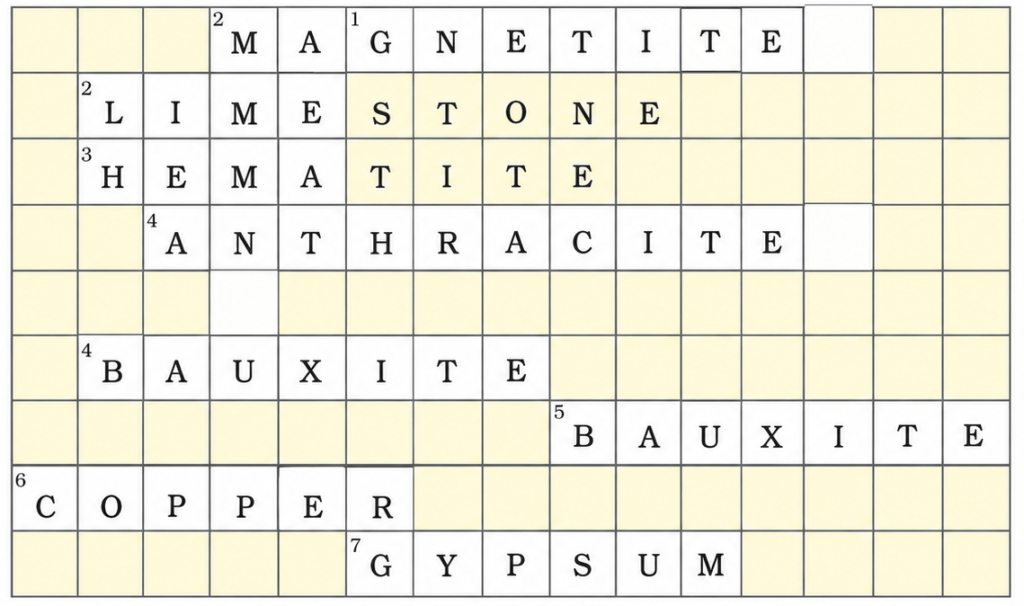
Answer: Answer of this Puzzle
ACROSS
FERROUS (A ferrous mineral – 9 letters)
LIMESTONE (Raw material for cement industry – 9 letters)
MAGNETITE (Finest iron ore with magnetic properties – 9 letters)
ANTHRACITE (Highest quality hard coal – 10 letters)
BAUXITE (Aluminium is obtained from this ore – 7 letters)
COPPER (Khetri mines are famous for this mineral – 6 letters)
GYPSUM (Formed due to evaporation – 6 letters)
DOWN
GOLD (Found in placer deposit – 4 letters)
HEMATITE (Iron ore mined in Bailadila – 8 letters)
MICA (Indispensable for electrical industry – 4 letters)
TERTIARY (Geological Age of coal found in north east India – 8 letters)
ORE (Formed in veins and lodes – 3 letters)