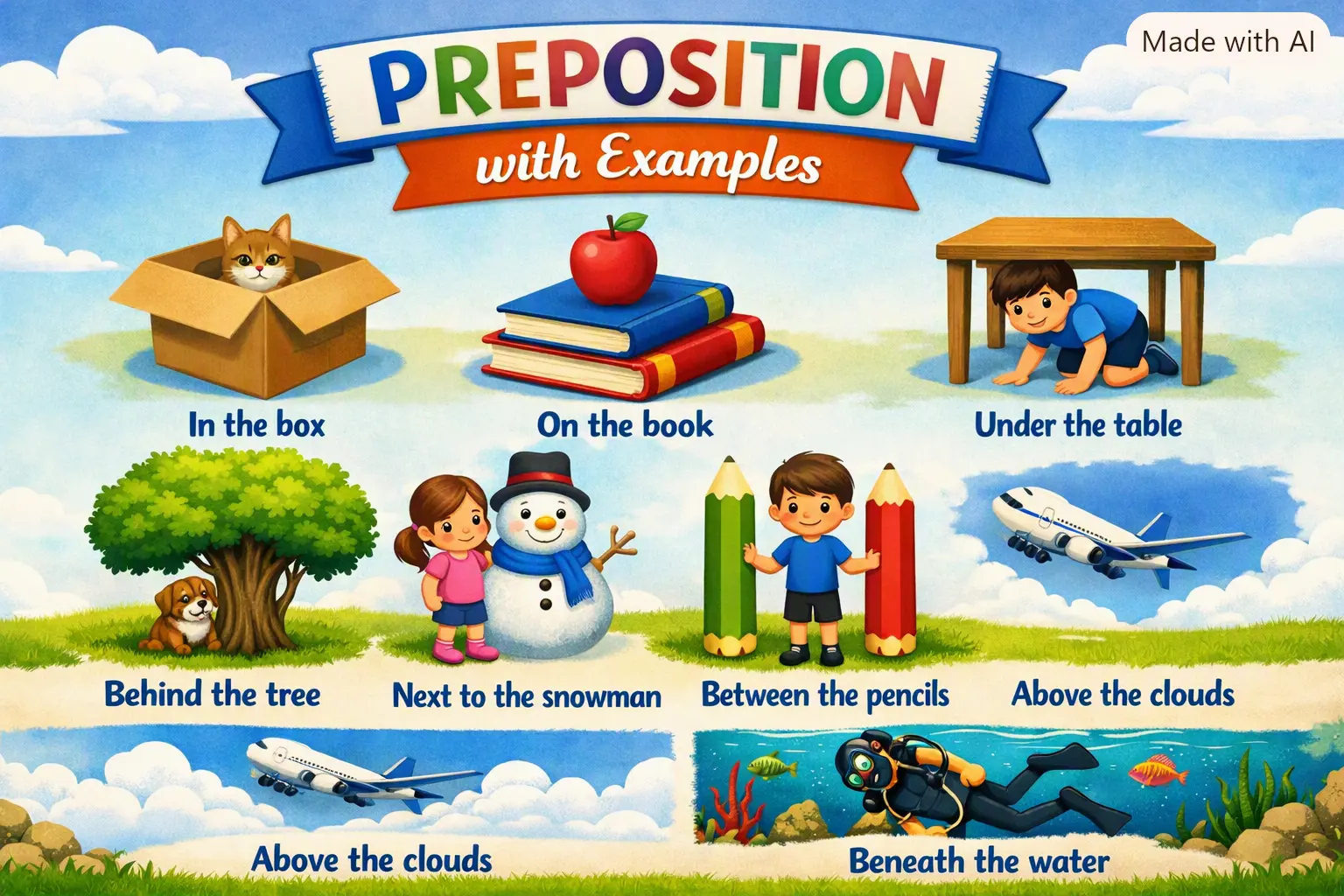
Preposition with Examples
Introduction to Prepositions
- Definition: A preposition is a word or group of words that links nouns, pronouns, or phrases to other words in a sentence.
- Examples: Common prepositions include in, at, on, of, to, by, with, and phrases like in front of, next to, instead of.
- Usage: Prepositions often follow fixed expressions and are used idiomatically with certain verbs.
Rules for Usage
- Prepositions define relationships between nouns and indicate time or place.
- The term “position” is embedded in “preposition,” highlighting their role in indicating location or time.
Prepositions of Time
| Preposition | Usage | Example |
| in | Months, years, time of day, centuries | in August, in 1985, in the evening |
| at | Specific times, mealtimes, ages | at 2:30, at breakfast, at 12 |
| on | Days of the week | on Friday |
| since | From a starting point to the present | since 2004 |
| for | Duration of time | for 2 years |
| from…to… | Beginning and end of a period | from 13:30 to 14:00 |
| until | Up to a specific point in time | until I finish |
| by | At the latest | by April 21st |
Prepositions of Place (Location and Direction)
| Preposition | Usage | Example |
| in | Inside a place | in class, in the car |
| at | Specific location | at the library, at a concert |
| on | On a surface | on the table, on the bus |
| to | Moving toward a place | to campus |
| from | Origin or starting point | from my garden |
| towards | Direction of movement | towards me |
| across | Movement from one side to another | across the street |
| through | Movement within something | through the kitchen |
| between | In the middle of two | between my friend and his parents |
| among | Surrounded by more than two | among the countries |
Prepositions of Connection
| Preposition | Usage | Example |
| of | Shows belonging or part of | the keyboard of my computer |
| with | Indicates a feature or togetherness | studying with Tara |
| by | Describes an action generally | saved my life by killing the spider |
Prepositions in Academic Writing
- about: Topics (e.g., books about history)
- for: Purpose (e.g., important for understanding)
- from: Origin or cause (e.g., meaning from individual words)
- in: Inclusion or position (e.g., in works by authors)
- on: Basis for something (e.g., assumption on digital age)
- of: Belonging or relation (e.g., results of investigation)
- by: Direct cause or agent (e.g., killed by strangulation)
Tips for Learning Prepositions
- Avoid Direct Translation: Prepositions in English may not correspond directly to those in other languages.
- Use Dictionaries: Consult English learner’s dictionaries for guidance.
- Read Regularly: Identify prepositions in texts to understand their usage.