Class 9 Science Chapter – 9 Atomic Foundations of Matter Questions and Answers
Revise, Reflect, Refine page no: 181
Question: 1. A particular element (A) has one electron in its third shell. There is another element (B) with six electrons in its second shell.
(i) How many electrons does A tend to give or take to become stable?
Answer: Element A has one electron in its third shell. To achieve stability, it tends to give away this electron.
(ii) What kind of ion would it form?
Answer: By losing one electron, element A forms a cation with a charge of +1 (A⁺).
(iii) How many electrons does B tend to give or take to become stable?
Answer: Element B has six electrons in its second shell. To become stable, it tends to gain two electrons.
(iv) What kind of ion would it form?
Answer: By gaining two electrons, element B forms an anion with a charge of -2 (B²⁻).
(v) If A and B were to combine, what kind of bond would be formed?
Answer: When A and B combine, they form an ionic bond due to the electrostatic attraction between the positively charged cation (A⁺) and the negatively charged anion (B²⁻).
(vi) What would be the formula for the compound thus formed?
Answer: The formula for the compound formed would be AB₂, indicating that one cation of A combines with two anions of B to balance the charges.
Question: 2. An element X has six electrons in its outer shell and forms a diatomic molecule.
(i) Why would that be so?
Answer: Element X has six electrons in its outer shell and forms a diatomic molecule because it needs to share electrons with another atom to achieve a stable octet configuration.
(ii) What kind of bond would it form?
Answer: Element X would form a covalent bond by sharing electrons with another atom of the same element (X).
(iii) Draw the structure of the molecule it would form.
Answer: The structure of the diatomic molecule formed by element X (let’s say X is oxygen) would be represented as: X=X
(iv) A certain other element Y has two electrons in its second shell.
Answer: If element Y has two electrons in its second shell (let’s say Y is magnesium), the structure of the molecule formed between X and Y would involve X sharing electrons with Y. The representation would look like: X+Y→XY
Here, X shares one electron with Y, and Y gives one electron to X, forming a stable compound.
Draw the structure of the molecule that X would form with Y.
Question: 3. You want to design a new ionic compound, where the total positive charge is 6+ and the total negative charge is 6 –. Which of the following combinations gives the correct number of ions?
(i) 2 Al³⁺ and 3 Cl⁻:
Answer: Total positive charge = 2×3=6
Total negative charge = 3×1=3 (Not balanced)
(ii) 3 Mg²⁺ and 1 PO₄³⁻:
Answer:Total positive charge = 3×2=6
Total negative charge = 1×3=3 (Not balanced)
(iii) 2 Fe³⁺ and 3 O²⁻:
Answer: Total positive charge = 2×3=6
Total negative charge = 3×2=6 (Balanced)
(iv) 3 Ca²⁺ and 2 SO₄²⁻:
Answer: Total positive charge = 3×2=6
Total negative charge = 2×2=4 (Not balanced)
Correct Combination: The correct combination that gives the required charges is (iii) 2 Fe³⁺ and 3 O²⁻.
Question: 4. Choose the correct statement(s) and correct the false statement(s).
(i) Elements are made up of molecules and compounds are made up of atoms.
Answer: This statement is false. Elements are made up of atoms, while compounds are formed from two or more different atoms bonded together.
(ii) The molecule of a compound is always made up of two or more atoms of the same kind.
Answer: This statement is false. A molecule of a compound consists of two or more different atoms. For example, water (H₂O) is made up of hydrogen and oxygen atoms.
(iii) One molecule of nitrogen gas contains three nitrogen atoms.
Answer: This statement is false. One molecule of nitrogen gas (N₂) contains two nitrogen atoms.
(iv) Water is made of two hydrogen atoms, covalently bonded with one oxygen atom.
Answer: This statement is true. Water (H₂O) consists of two hydrogen atoms and one oxygen atom bonded together by covalent bonds.
Question: 5. Write the chemical formulae for the following compounds.
(i) Aluminium nitrate
Answer: The chemical formula for aluminium nitrate is Al(NO₃)₃.
(ii) Calcium oxide
Answer: The chemical formula for calcium oxide is CaO.
(iii) Ferric oxide
Answer: The chemical formula for ferric oxide is Fe₂O₃.
Question: 6. Write the formulae of the compounds formed from the following pairs of ions.
1. Ca²⁺ and Br⁻
Answer: The formula for the compound formed is CaBr₂.
2. Al³⁺ and CO₃²⁻
Answer: The formula for the compound formed is Al₂(CO₃)₃.
3. K⁺ and SO₄²⁻
Answer: The formula for the compound formed is K₂SO₄.
4. NH₄⁺ and Cl⁻
Answer: The formula for the compound formed is NH₄Cl.
Page no: 182
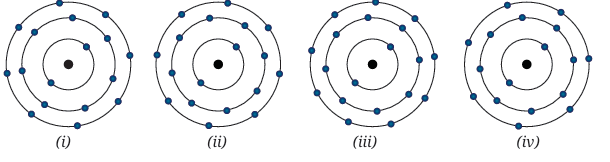
Question: 7. Which of the following, in Fig. 9.18, correctly represents Cl– ion (Atomic number of chlorine = 17).
Answer: Atomic Number: 17
Electron Configuration: The neutral chlorine atom has 17 electrons, which are arranged as follows:
– 2 electrons in the first shell
– 8 electrons in the second shell
– 7 electrons in the third shell
When chlorine gains one electron to form the chloride ion (Cl⁻), it now has a total of 18 electrons. This additional electron completes its valence shell, giving it a stable electronic configuration similar to that of noble gases.
Characteristics of Cl⁻ Ion
– Total Electrons: 18 (17 protons + 1 extra electron)
– Charge: -1 (indicating it has gained one electron)
Visual Representation:-
In the figure options, the correct representation of the Cl⁻ ion should show:
– 2 electrons in the first shell
– 8 electrons in the second shell
– 8 electrons in the third shell (indicating the extra electron gained)
Conclusion
Without seeing the actual figures in Fig. 9.18, the correct representation of the Cl⁻ ion will be the one that shows 18 total electrons distributed as described above. Look for the figure that depicts this arrangement to identify the correct representation of the chloride ion.
Question: 8. Determine the formula unit mass of the following substances.
(i) Ammonium nitrate (NH₄NO₃), used as a nitrogen fertiliser, which is essential for plant growth.
Answer: Atomic Masses:
- Nitrogen (N) = 14 u
- Hydrogen (H) = 1 u
- Oxygen (O) = 16 u
– Calculation:
- For NH₄:
- 1 Nitrogen = 14 u
- 4 Hydrogens = 4 × 1 u = 4 u
- Total for NH₄ = 14 u + 4 u = 18 u
– For NO₃:
- 1 Nitrogen = 14 u
- 3 Oxygens = 3 × 16 u = 48 u
- Total for NO₃ = 14 u + 48 u = 62 u
– Total Formula Unit Mass:
- Total = 18 u (NH₄) + 62 u (NO₃) = 80 u
(ii) Phosphoric acid (H₃PO₄), used to make phosphate fertiliser and detergents.
Answer: Atomic Masses:
- Phosphorus (P) = 31 u
- Hydrogen (H) = 1 u
- Oxygen (O) = 16 u
– Calculation:
- For H₃:
- 3 Hydrogens = 3 × 1 u = 3 u
- For PO₄:
- 1 Phosphorus = 31 u
- 4 Oxygens = 4 × 16 u = 64 u
- Total for PO₄ = 31 u + 64 u = 95 u
– Total Formula Unit Mass:
- Total = 3 u (H₃) + 95 u (PO₄) = 98 u
(iii) Sodium hydrogencarbonate (NaHCO₃), used to relieve acidity and helps in digestion.
Answer: Atomic Masses:
- Sodium (Na) = 23 u
- Hydrogen (H) = 1 u
- Carbon (C) = 12 u
- Oxygen (O) = 16 u
– Calculation:
- For NaH:
- 1 Sodium = 23 u
- 1 Hydrogen = 1 u
- Total for NaH = 23 u + 1 u = 24 u
- For CO₃:
- 1 Carbon = 12 u
- 3 Oxygens = 3 × 16 u = 48 u
- Total for CO₃ = 12 u + 48 u = 60 u
– Total Formula Unit Mass:
- Total = 24 u (NaH) + 60 u (CO₃) = 84 u
Summary of Formula Unit Masses
- Ammonium Nitrate (NH₄NO₃): 80 u
- Phosphoric Acid (H₃PO₄): 98 u
- Sodium Hydrogencarbonate (NaHCO₃): 84 u
These calculations illustrate how to determine the formula unit mass by summing the atomic masses of the constituent elements in each compound.
Question: 9. Write the formulae for the compounds formed by the reaction of:
(i) Magnesium and nitrogen
Answer: Reaction: Magnesium (Mg) reacts with nitrogen (N) to form magnesium nitride.
Formula: Mg3N2
Explanation: Magnesium has a valency of +2 and nitrogen has a valency of -3. To balance the charges, three magnesium ions (Mg²⁺) combine with two nitride ions (N³⁻).
(ii) Lithium and nitrogen
Answer: Reaction: Lithium (Li) reacts with nitrogen (N) to form lithium nitride.
Formula: Li3N
Explanation: Lithium has a valency of +1 and nitrogen has a valency of -3. Therefore, three lithium ions (Li⁺) combine with one nitride ion (N³⁻).
(iii) Sodium and sulfur
Answer: Reaction: Sodium (Na) reacts with sulfur (S) to form sodium sulfide.
Formula: Na2S
Explanation: Sodium has a valency of +1 and sulfur has a valency of -2. Thus, two sodium ions (Na⁺) combine with one sulfide ion (S²⁻).
(iv) Aluminium and oxygen
Answer: Reaction: Aluminium (Al) reacts with oxygen (O) to form aluminium oxide.
Formula: Al2O3
Explanation: Aluminium has a valency of +3 and oxygen has a valency of -2. To balance the charges, two aluminium ions (Al³⁺) combine with three oxide ions (O²⁻).
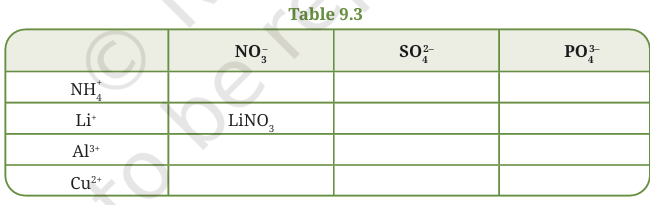
Question: 10. Complete the Table 9.3 by writing the formulae of the compounds formed by the cations on the left and the anions at the top. LiNO3 is given as an example.
Answer:
| NO₃⁻ | SO₄²⁻ | PO₄³⁻ | NH₄⁺ | |
| Li⁺ | LiNO₃ | Li₂SO₄ | Li₃PO₄ | LiNH₄ |
| Al³⁺ | Al(NO₃)₃ | Al₂(SO₄)₃ | AlPO₄ | Al(NH₄)₃ |
| Cu²⁺ | Cu(NO₃)₂ | CuSO₄ | Cu₃(PO₄)₂ | Cu(NH₄)₂ |
Explanation of the Formulae:
1. Li⁺ and Anions:
– LiNO₃: Lithium nitrate is formed by combining one lithium ion (Li⁺) with one nitrate ion (NO₃⁻).
– Li₂SO₄: Two lithium ions are needed to balance the charge of one sulfate ion (SO₄²⁻).
– Li₃PO₄: Three lithium ions are required to balance one phosphate ion (PO₄³⁻).
– LiNH₄: Lithium combines with one ammonium ion (NH₄⁺).
2. Al³⁺ and Anions:
– Al(NO₃)₃: One aluminum ion combines with three nitrate ions to balance the charge.
– Al₂(SO₄)₃: Two aluminum ions combine with three sulfate ions.
– AlPO₄: One aluminum ion combines with one phosphate ion.
– Al(NH₄)₃: One aluminum ion combines with three ammonium ions.
3. Cu²⁺ and Anions:
– Cu(NO₃)₂: One copper ion combines with two nitrate ions.
– CuSO₄: One copper ion combines with one sulfate ion.
– Cu₃(PO₄)₂: Three copper ions combine with two phosphate ions.
– Cu(NH₄)₂: One copper ion combines with two ammonium ions.
Question: 11. 5.3 g of sodium carbonate and 6.0 g of acetic acid react to produce 2.2 g of carbon dioxide, 0.9 g of water, and 8.2 g of sodium acetate. Verify whether the law of conservation of mass is valid.
Answer: To verify whether the Law of Conservation of Mass holds true for the reaction between sodium carbonate and acetic acid, we need to compare the total mass of the reactants with the total mass of the products.
Given Data:
- Mass of Sodium Carbonate (Na2CO3): 5.3 g
- Mass of Acetic Acid (CH3COOH): 6.0 g
Total Mass of Reactants:-
Total Mass of Reactants=Mass of Sodium Carbonate+Mass of Acetic Acid=5.3 g+6.0 g=11.3 g
Products:-
- Mass of Carbon Dioxide (CO2): 2.2 g
- Mass of Water (H2O): 0.9 g
- Mass of Sodium Acetate (CH3COONa): 8.2 g
Total Mass of Products:-
Total Mass of Products=Mass of CO2+Mass of H2O+Mass of Sodium Acetate= 2.2 g+0.9 g+8.2 g=11.3 g
Conclusion:-
- Total Mass of Reactants: 11.3 g
- Total Mass of Products: 11.3 g
Since the total mass of the reactants equals the total mass of the products, this confirms that the Law of Conservation of Mass is valid in this chemical reaction.
Matter is neither created nor destroyed during the reaction, which aligns with the principle proposed by Antoine Lavoisier.
Question: 12. If a species has 11 protons, 12 neutrons and 10 electrons then
(i) what is its atomic number and mass number?
Answer: Atomic Number: The atomic number is determined by the number of protons in the nucleus of an atom. In this case, the species has 11 protons, so its atomic number is 11.
Mass Number: The mass number is the sum of protons and neutrons in the nucleus. Here, the species has 11 protons and 12 neutrons. Therefore, the mass number is:- Mass Number=Number of Protons+Number of Neutrons=11+12=23
(ii) is it neutral, a cation or an anion? Explain.
Answer: To determine whether the species is neutral, a cation, or an anion, we look at the number of protons and electrons:
– Protons: 11
– Electrons: 10
Since the number of protons (11) is greater than the number of electrons (10), this species has a positive charge. Therefore, it is a cation. Specifically, it has a charge of +1 because it has one more proton than electrons.
(iii) write its electronic configuration.
Answer: The electronic configuration describes the distribution of electrons in the atomic orbitals. For an atom with 11 electrons, the configuration can be written as: 1s² 2s² 2p⁶3s¹
This configuration indicates that:-
1. The first shell (1s) has 2 electrons.
2. The second shell (2s and 2p) has 8 electrons (2 in 2s and 6 in 2p).
3. The third shell (3s) has 1 electron.
(iv) name the species.
Answer: The species with 11 protons is Sodium (Na). Therefore, the name of the species is Sodium ion (Na⁺) when considering its cationic form due to the loss of one electron.
Page no: 183
Question: 13. Two elements, A and B, have the following configurations — A: 2, 8, 5 B: 2, 8, 7
(i) Which element is more reactive?
Answer: Element B is more reactive.
Explanation:-
1. Element A has 5 electrons in its outer shell and needs to gain 3 electrons to achieve a stable octet configuration.
2. Element B has 7 electrons in its outer shell and needs to gain only 1 electron to complete its octet. Elements that require fewer electrons to achieve stability tend to be more reactive. Therefore, Element B is more likely to react to gain that one electron.
(ii) Will A and B form ionic or covalent bonds when they combine? Explain using electron transfer or sharing.
Answer: They will form an ionic bond.
Explanation:-
1. Element A, with 5 valence electrons, is more likely to lose electrons to achieve a stable configuration. When it loses 3 electrons, it will become a positively charged ion (cation).
2. Element B, with 7 valence electrons, is likely to gain 1 electron to complete its octet, becoming a negatively charged ion (anion).
3. The transfer of electrons from A to B results in the formation of an ionic bond due to the electrostatic attraction between the positively charged cation and the negatively charged anion.
(iii) Predict the formula of the compound they would form.
Answer: The formula of the compound formed by A and B would be AB₃.
Explanation:-
1. If Element A loses 3 electrons, it forms A³⁺.
2. If Element B gains 1 electron, it forms B⁻.
3. To balance the charges, one A³⁺ ion will combine with three B⁻ ions, resulting in the formula AB₃.
Question: 14. Assertion (A): Copper sulfate conducts electricity in the molten state but not in the solid state. Reason (R): Copper and sulfate ions are fixed in the lattice in molten state, while in solid state they can move freely. Choose the correct option:
(i) Both A and R are true, and R is the correct explanation of A.
(ii) Both A and R are true, but R is not the correct explanation of A.
(iii) A is true, but R is false.
(iv) A is false, but R is true.
Answer: (iii) A is true, but R is false.
Analysis:-
1. Assertion (A) is true: Copper sulfate does conduct electricity when molten because the ions are free to move, allowing electrical current to pass through.
2. Reason (R) is false: In the solid state, copper sulfate does not conduct electricity because the ions are fixed in a rigid lattice structure and cannot move freely. However, when it is molten, the lattice breaks down, allowing the ions to move freely.
Question: 15. The species 27Al, 80Br– and 201Hg2+ have 13, 35 and 80 protons, respectively. How many electrons and neutrons do they have?
Answer: To determine the number of electrons and neutrons in the species
27Al,80Br−, and 201Hg2+, we can use the following information:-
1. Electrons:-
- For neutral atoms, the number of electrons equals the number of protons.
- For ions, the number of electrons is adjusted based on the charge:
- A negatively charged ion (anion) has more electrons than protons.
- A positively charged ion (cation) has fewer electrons than protons.
- Neutrons:-
- The number of neutrons can be calculated using the formula:
- Neutrons=Mass Number−Number of Protons
Calculations:-
1. For 27Al :-
– Protons = 13
– Since it is neutral, Electrons = 13
– Mass Number = 27
– Neutrons = 27−13=14.
2. For 80Br− :-
– Protons = 35
– As it is an anion (Br⁻), Electrons = 35+1=36
– Mass Number = 80
– Neutrons = 80−35=45
3. For 201Hg2+ :-
– Protons = 80
– As it is a cation (Hg²⁺), Electrons = 80−2=78
– Mass Number = 201
– Neutrons = 201−80=121