Class 7 Science Chapter- 4 The World of Metals and Non-metals Questions and Answers New Updated NCERT Solutions
Let Us Enhance Our Learning Page no: 55
Question: 1. Which metal is commonly used to make food packaging materials as it is cheaper, and its thin sheets can be folded easily into any shape?
(i) Aluminium
(ii) Copper
(iii) Iron
(iv) Gold
Answer: (i) Aluminium.
Explanation: Aluminium is widely used for food packaging due to its affordability and malleability, allowing it to be easily shaped into thin sheets.
Question: 2. Which of the following metal catches fi re when it comes in contact with water?
(i) Copper
(ii) Aluminium
(iii) Zinc
(iv) Sodium
Answer: (iv) Sodium.
Explanation: Sodium is highly reactive with water and can ignite upon contact, making it a unique case among metals. This property necessitates that sodium is stored in kerosene to prevent reactions with moisture and air.
Question: 3. State with reason(s) whether the following statements are True [T] or False [F].
(i) Aluminium and copper are examples of non-metals used for making utensils and statues. [ ]
Answer: False [F]
Reason: Aluminium and copper are both metals, not non-metals. They are commonly used in making utensils and statues due to their properties such as malleability and conductivity.
(ii) Metals form oxides when combined with oxygen, the solution of which turns blue litmus paper to red. []
Answer: False [F]
Reason: Metals typically form basic oxides when they react with oxygen. Solutions of these metal oxides do not turn blue litmus paper red; instead, they may turn red litmus blue, indicating their basic nature.
(iii) Oxygen is a non-metal essential for respiration. [ ]
Answer: True [T]
Reason: Oxygen is indeed a non-metal and is crucial for respiration in living organisms. It is necessary for the process of cellular respiration, which provides energy for biological functions.
(iv) Copper vessels are used for boiling water because they are good conductors of electricity. [ ]
Answer: False [F]
Reason: While copper is a good conductor of electricity, the primary reason for using copper vessels for boiling water is its excellent thermal conductivity. This allows for efficient heat transfer, making it suitable for cooking.
Question: 4. Why are only a few metals suitable for making jewellery?
Answer: Only a limited number of metals are deemed suitable for crafting jewellery due to several key properties:
- Lustrous Appearance:
- Metals like Gold and Silver: These metals possess a natural shine and lustrous quality, making them visually appealing for jewellery. Their lustre enhances the aesthetic value of the ornaments.
- Malleability and Ductility:
- Malleability: Metals such as gold and silver can be easily shaped into thin sheets or intricate designs without breaking. This property allows jewellers to create detailed and delicate pieces.
- Ductility: These metals can also be drawn into fine wires, which is essential for making chains and other intricate designs.
- Resistance to Corrosion:
- Durability: Metals like gold do not tarnish or corrode easily, ensuring that jewellery maintains its appearance over time. This resistance to oxidation is crucial for items that are worn regularly.
- Hypoallergenic Properties:
- Skin Compatibility: Some metals, such as nickel, can cause allergic reactions in some individuals. Therefore, metals that are less likely to cause skin irritation, like gold and platinum, are preferred for jewellery.
- Cultural Significance:
- Certain metals hold cultural or symbolic importance, which influences their use in jewellery. For example, gold is often associated with wealth and prosperity in many cultures.
Conclusion
In summary, the suitability of metals for jewellery making is determined by their aesthetic appeal, physical properties (like malleability and ductility), corrosion resistance, and cultural significance. This is why metals like gold, silver, and platinum are favored over others that may not possess these desirable characteristics.
Question: 5. Match the uses of metals and non-metals given in Column I with the jumbled names of metals and non-metals given in Column II.
Answer:
Here is the table matching the uses from Column I with the corresponding jumbled names in Column II:
| Column I | Column II | Matched Item |
| (i) Used in electrical wiring | (d) T E N G O I N R | Copper |
| (ii) Most malleable and ductile | (e) O G D L | Gold |
| (iii) Living organisms cannot survive without it. | (a) E N X Y G O | Oxygen |
| (iv) Plants grow healthy when fertilisers containing it are added to the soil. | (b) N E C O H I R L | Nitrogen |
| (v) Used in water purification | (c) P E P O R C | Chlorine |
- (i) Used in electrical wiring → Copper
- (ii) Most malleable and ductile → Gold
- (iii) Living organisms cannot survive without it. → Oxygen
- (iv) Plants grow healthy when fertilisers containing it are added to the soil. → Nitrogen
- (v) Used in water purification → Chlorine
Question: 6. What happens when oxygen reacts with magnesium and sulfur? What are the main differences in the nature of products formed?
Answer: Reaction of Oxygen with Magnesium and Sulfur
When oxygen reacts with magnesium and sulfur, different products are formed due to their distinct chemical properties.
1. Reaction with Magnesium:-
– Reaction: When magnesium is burned in the presence of oxygen, it reacts vigorously to form magnesium oxide.
– Chemical Equation: 2Mg+O2→2MgO
– Characteristics of Product:
1. Appearance: Magnesium oxide is a white powder.
2. Nature: It is basic in nature. When dissolved in water, it forms a basic solution.
2. Reaction with Sulfur:-
– Reaction: Sulfur, when burned in oxygen, produces sulfur dioxide.
– Chemical Equation: S+O2→SO2 S+O2→SO2 .
– Characteristics of Product:
1. Appearance: Sulfur dioxide is a colorless gas.
2. Nature: It is acidic in nature. When dissolved in water, it forms sulfurous acid, which turns blue litmus paper red.
Main Differences in the Nature of Products
– Type of Product:
- Magnesium forms a basic oxide (magnesium oxide).
- Sulfur forms an acidic oxide (sulfur dioxide).
– Behavior in Water:
- Magnesium oxide reacts with water to produce a basic solution.
- Sulfur dioxide dissolves in water to produce an acidic solution.
Summary
In summary, the reaction of oxygen with magnesium produces a basic oxide (magnesium oxide), while the reaction with sulfur yields an acidic oxide (sulfur dioxide). This fundamental difference in the nature of the products highlights the contrasting chemical behaviors of metals and non-metals when they react with oxygen.
Page no: 56
Question: 7. Complete the following flow chart
Answer:
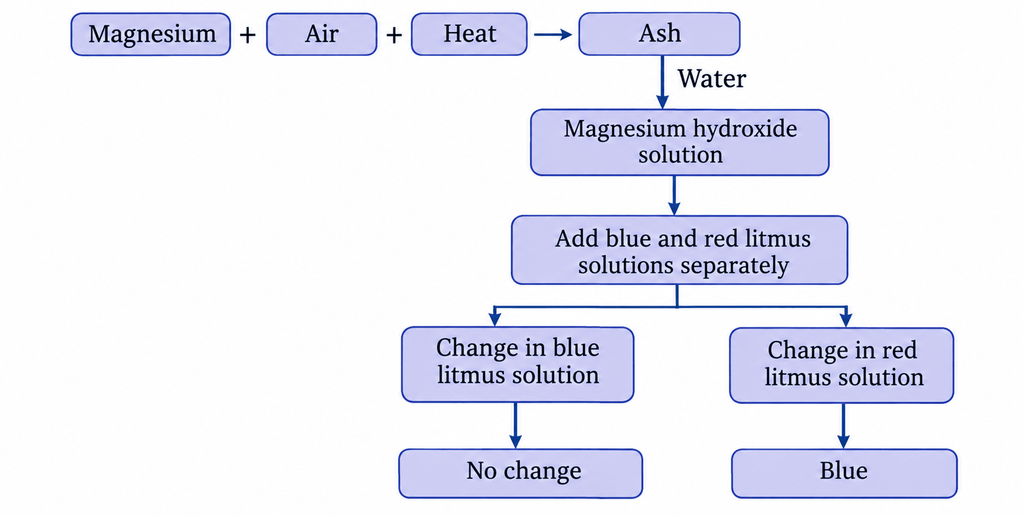
The reason is that magnesium burns in air to form magnesium oxide (ash). Magnesium oxide reacts with water to form magnesium hydroxide, which is basic. A base does not change blue litmus but turns red litmus blue.
Question: 8. You are provided with the following materials. Discuss which material would be your choice to make a pan that is most suitable for boiling water and why?
Iron copper sulfur coal plastic wood cardboard
Answer: Choice of Material: Copper
- Reasoning:
- Excellent Heat Conductor: Copper heats up quickly and distributes heat evenly, making it ideal for cooking.
- Durability: Copper pans are durable and can withstand high temperatures without warping.
- Non-reactive: When lined with stainless steel, copper does not react adversely with food, ensuring safe cooking.
Other Materials:
- Iron: Good heat conductor but prone to rusting when exposed to moisture.
- Aluminium: Lightweight and a good conductor, but may react with acidic foods.
- Sulfur, Coal, Plastic, Wood, Cardboard: These materials are unsuitable for cooking pans due to poor heat conductivity or flammability.
Question: 9. You are provided with three iron nails, each dipped in oil, water and vinegar. Which iron nail will not rust, and why?
Answer: Nail Dipped in Oil:-
- Reason: The nail dipped in oil will not rust because the oil creates a barrier that prevents moisture and air from contacting the iron. Rusting occurs when iron is exposed to both moisture and oxygen, which is avoided in the oil-dipped nail.
Other Nails:
- Nail in Water: This nail will rust due to direct contact with moisture.
- Nail in Vinegar: Vinegar is acidic and can accelerate the rusting process, leading to corrosion.
Question: 10. How do the different properties of metals and non-metals determine their uses in everyday life?
Answer: Properties of Metals:-
- Lustrous: Metals like gold and silver are used in jewelry for their shiny appearance.
- Malleable and Ductile: Metals can be shaped into various forms, making them suitable for tools, wires, and utensils.
- Good Conductors of Heat and Electricity: Metals like copper and aluminum are used in electrical wiring and cooking utensils due to their excellent conductivity.
– Properties of Non-Metals:-
- Non-lustrous: Non-metals like sulfur and phosphorus are used in fertilizers and chemicals.
- Poor Conductors: Non-metals do not conduct heat or electricity well, making them suitable for insulation materials.
- Reactivity: Non-metals like oxygen and nitrogen are essential for life processes, such as respiration and plant growth.
Conclusion: The distinct properties of metals and non-metals guide their applications in various fields, from construction and technology to health and agriculture. Metals are typically used where strength and conductivity are required, while non-metals are utilized for their chemical properties and insulating capabilities.
Question: 11. One of the methods of protecting iron from getting rusted is to put a thin coating of zinc metal over it. Since sulfur does not react with water, can it be used for this purpose? Justify your answer.
Answer: No, sulfur cannot be used as a protective coating for iron to prevent rusting. Here’s why:
1. Nature of Protection: The primary purpose of coating iron with zinc (a process known as galvanization) is to provide a barrier that prevents moisture and air from coming into contact with the iron. This is crucial because rusting occurs when iron reacts with both water and oxygen in the air.
2. Properties of Sulfur: Although sulfur does not react with water, it does not provide the same protective qualities as zinc. Sulfur is a non-metal and does not form a strong, protective layer on the surface of iron. Instead, it can lead to the formation of acidic compounds when it reacts with moisture in the air, which could potentially corrode the iron rather than protect it.
3. Corrosion Potential: The oxides of sulfur are generally acidic in nature, which means that if sulfur were to come into contact with moisture, it could create an acidic environment that would promote corrosion rather than prevent it.
Conclusion
In summary, while sulfur’s lack of reactivity with water might seem beneficial, it does not provide the necessary protective properties to prevent rusting of iron. Therefore, zinc remains the preferred choice for protecting iron from rusting due to its ability to form a robust barrier against moisture and air.
Question: 12. An ironsmith heats iron before making tools. Why is heating necessary in this process?
Answer: Heating iron before shaping it into tools is a crucial step in the process of metalworking. Here are the primary reasons why heating is necessary:
1. Increased Malleability: When iron is heated, it becomes malleable, meaning it can be easily shaped or molded without breaking. This property allows the ironsmith to hammer and form the iron into various shapes, such as tools or utensils.
2. Easier Shaping: Hot iron is softer and more pliable compared to cold iron. This softness enables the craftsperson to manipulate the metal more effectively, allowing for intricate designs and precise shapes.
3. Improved Workability: Heating reduces the hardness of the iron, making it easier to work with. This is particularly important when creating tools that require specific shapes and edges, such as axes or spades.
4. Uniform Heating: Heating the iron evenly ensures that the entire piece can be shaped consistently. This uniformity is essential for the structural integrity of the finished tool.
– Example in Practice:-
For instance, when an ironsmith is making an axe, they heat a block of iron until it glows red. This indicates that the iron is at a temperature where it can be easily hammered into the desired flat shape of the axe head. Without heating, the iron would be too hard and brittle, making it difficult to shape and potentially causing it to break during the process.
In summary, heating iron is a fundamental step in metalworking that enhances its malleability and workability, allowing for the efficient creation of tools and other items.