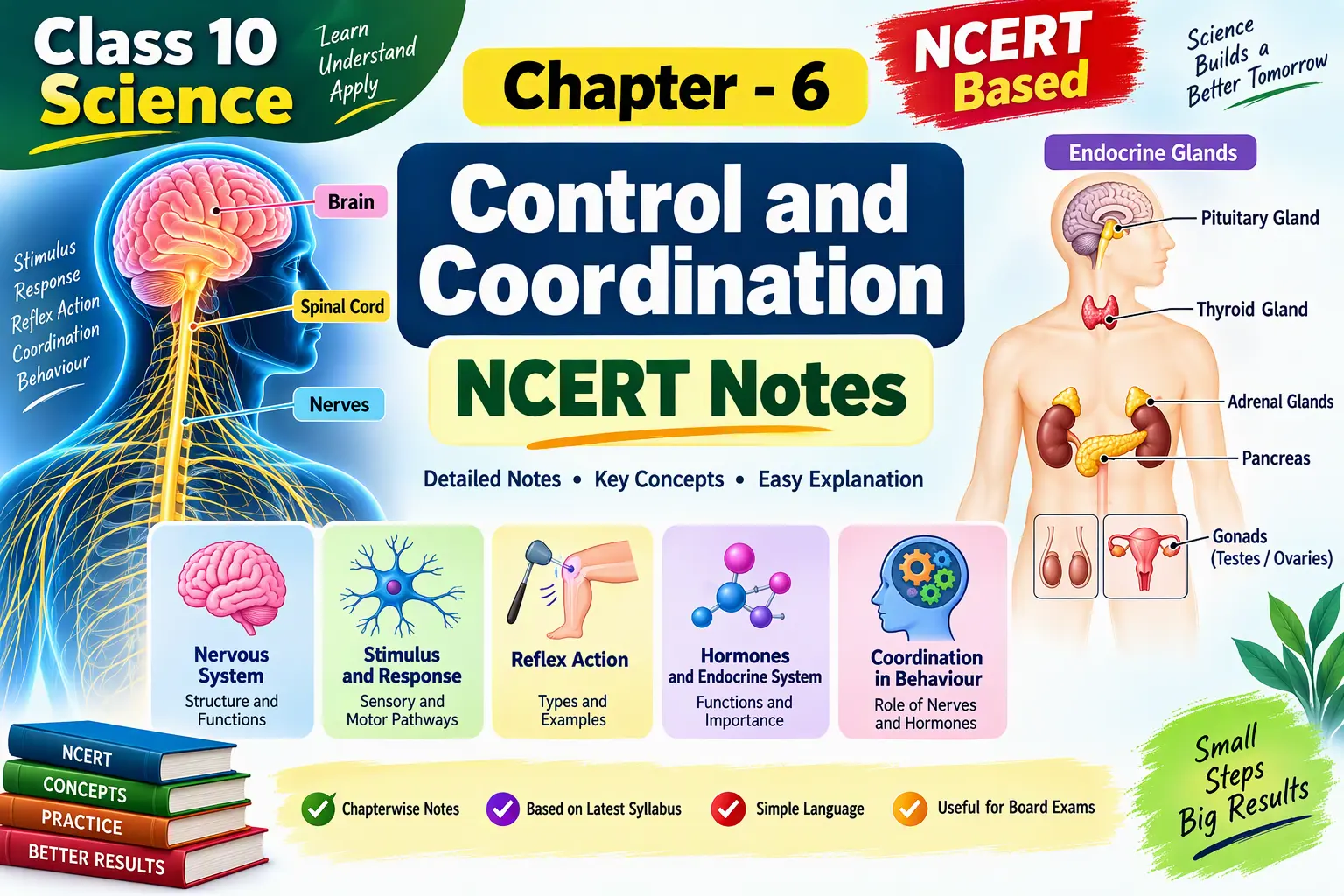
Study Notes by Class of Achievers : Control and Coordination
Topic 1: Introduction to Control and Coordination
– Movement in living organisms can be due to growth (e.g., plants) or responses to environmental changes (e.g., animals).
– Control and coordination are essential for appropriate responses to stimuli.
Topic 2: Nervous System in Animals
– Control and coordination in animals are provided by nervous and muscular tissues.
– Receptors in sense organs detect environmental changes (e.g., taste, smell).
– Nerve Impulses:
Information travels via electrical impulses through neurons.
Impulses are transmitted across synapses using chemical signals.
2.1 Reflex Actions
– Reflex Action: An involuntary and immediate response to a stimulus (e.g., pulling back from a flame).
– Reflex Arc: The pathway taken by nerve impulses during a reflex action, typically involving the spinal cord.
2.2 Human Brain
– The brain is the main coordinating center, consisting of:
Fore-brain: Responsible for thinking and processing sensory information.
Mid-brain: Involuntary actions like breathing and heart rate.
Hind-brain: Coordinates balance and voluntary movements.
Topic 3: Coordination in Plants
– Plants lack a nervous system but respond to stimuli through growth and movement.
– Types of Plant Movement:
Immediate Response: Quick movements (e.g., sensitive plants folding leaves).
Growth-Dependent Movement: Directional growth in response to stimuli (e.g., phototropism).
3.1 Tropisms
- Phototropism: Growth towards light (shoots) or away from it (roots).
- Geotropism: Growth in response to gravity (roots grow downwards).
Topic 4: Hormones in Animals
- Hormones: Chemical messengers that regulate various functions in the body.
- Adrenaline: Increases heart rate and prepares the body for fight or flight.
- Insulin: Regulates blood sugar levels.
- Thyroxin: Regulates metabolism and growth.
Quick Revision Points
- Nervous System: Fast, electrical impulses for immediate responses.
- Hormonal System: Slower, chemical signals for longer-term regulation.
- Reflex Actions: Quick, involuntary responses bypassing the brain.
- Tropisms: Directional growth in plants responding to environmental stimuli.
Remember These!
– Mnemonic for Brain Functions: Fore-brain (thinking), Mid-brain (involuntary actions), Hind-brain (balance).
Hormones and Functions:
– Growth hormone – stimulates growth.
– Thyroxin – regulates metabolism.
– Insulin – regulates blood sugar.
Table: Comparison of Nervous and Hormonal Control
| Feature | Nervous System | Hormonal System |
| Speed of Response | Fast (milliseconds) | Slow (minutes to hours) |
| Type of Signal | Electrical impulses | Chemical signals (hormones) |
| Duration of Effect | Short-lived | Long-lasting |
| Pathway | Neurons and synapses | Bloodstream |