Class 10 English | First Flight | Chapter 2
Page 18 — Oral Comprehension Check (Comprehension)
Q1. Where did the ceremonies take place? Can you name any public buildings in India that are made of sandstone?
Ans: The ceremonies took place in the sandstone amphitheatre formed by the Union Buildings in Pretoria. In India, public buildings made of sandstone include the Red Fort, Rashtrapati Bhavan and Hawa Mahal.
Q2. Can you say how 10 May is an ‘autumn day’ in South Africa?
Ans: South Africa lies in the Southern Hemisphere, so its seasons are opposite to those in the Northern Hemisphere. 10 May falls in autumn there, while it is early summer in India.
Q3. At the beginning of his speech, Mandela mentions ‘an extraordinary human disaster’. What does he mean by this? What is the ‘glorious … human achievement’ he speaks of at the end?
Ans: By “an extraordinary human disaster” Mandela means the apartheid system of racial discrimination imposed on the dark-skinned people, one of the harshest and most inhumane societies the world has ever known. The “glorious human achievement” is the birth of South Africa’s first democratic, non-racial government, in which everyone was given equal rights and freedom.
Q4. What does Mandela thank the international leaders for?
Ans: He thanks the distinguished international guests for coming to take possession with the people of South Africa of what is, after all, a common victory for justice, peace and human dignity.
Q5. What ideals does he set out for the future of South Africa?
Ans: He pledges to liberate all South Africans from the continuing bondage of poverty, deprivation, suffering, gender and other discrimination, and vows that the beautiful land shall never again experience the oppression of one by another — letting freedom reign.
Page 21 — Oral Comprehension Check (Comprehension)
Q1. What do the military generals do? How has their attitude changed, and why?
Ans: The military generals saluted Mandela and pledged their loyalty to him. Earlier, they would have arrested him instead of saluting; their attitude changed because a new democratic, non-racial government had been freely and fairly elected, and the military now showed its loyalty to democracy.
Q2. Why were two national anthems sung?
Ans: Two national anthems were sung — whites sang ‘Nkosi Sikelel-iAfrika’ and blacks sang ‘Die Stem’, the old anthem of the Republic — as a symbol of the new unity between the two races.
Q3. How does Mandela describe the systems of government in his country (i) in the first decade, and (ii) in the final decade, of the twentieth century?
Ans: (i) In the first decade, white-skinned people created a system of racial domination over the dark-skinned people — one of the harshest, most inhumane societies the world has ever known. (ii) In the final decade, that system was overturned and replaced by a democratic, non-racial government based on equality.
Q4. What does courage mean to Mandela?
Ans: Courage is not the absence of fear but the triumph over it. The brave man is not one who does not feel afraid, but one who conquers that fear.
Q5. Which does he think is natural, to love or to hate?
Ans: He thinks love is natural. No one is born hating others; people learn to hate, so they can be taught to love, for love comes more naturally to the human heart than hate.
Page 24 — Oral Comprehension Check (Comprehension)
Q1. What ‘twin obligations’ does Mandela mention?
Ans: Mandela mentions two “twin obligations” that every man has — the first is the obligation to his family, to his parents, to his wife and children; the second is the obligation to his people, his community and his country. He says that in a civil and humane society a man can fulfil both, but in South Africa a man of his colour was punished and isolated for trying to do so, and was forced to live a secret life apart from his family.
Q2. What did being free mean to Mandela as a boy, and as a student? How does he contrast these ‘transitory freedoms’ with ‘the basic and honourable freedoms’?
Ans: As a boy, Mandela was born free — free to run in the fields, swim in the stream, roast mealies under the stars and ride the backs of bulls, as long as he obeyed his father and followed his tribe’s customs. As a student, he wanted only “transitory” freedoms — to stay out at night, read what he pleased and go where he chose. As a young man in Johannesburg, he yearned for the basic and honourable freedoms of achieving his potential, earning his keep, and marrying and having a family — the freedom to live a lawful life without obstruction. He thus contrasts temporary, personal freedoms with lasting, dignified freedoms of life.
Q3. Does Mandela think the oppressor is free? Why/Why not?
Ans: No, Mandela does not think the oppressor is free. He believes a man who takes away another man’s freedom is a prisoner of hatred, locked behind the bars of prejudice and narrow-mindedness. Just as the oppressed is not free when his freedom is snatched, the oppressor too is robbed of his humanity — so both are not truly free.
Page 24 — Thinking about the Text (Comprehension)
Q1. Why did such a large number of international leaders attend the inauguration? What did it signify the triumph of?
Ans: International leaders came to show their support for South Africa’s first democratic, non-racial government and to pay their respects to Mandela. It signified the triumph of justice, peace and human dignity over the centuries-old system of apartheid and racial oppression.
Q2. What does Mandela mean when he says he is ‘simply the sum of all those African patriots’ who had gone before him?
Ans: Mandela means that he is not great in himself; he stands on the shoulders of countless African freedom fighters who sacrificed their lives for freedom. He humbly sees himself as the collective embodiment of all those patriots’ struggles and ideals.
Q3. Would you agree that the ‘depths of oppression’ create ‘heights of character’? How does Mandela illustrate this? Can you add your own examples to this argument?
Ans: Yes, oppression often produces men and women of exceptional courage and character. Mandela illustrates this by saying that the decades of oppression and brutality produced leaders like Oliver Tambo, Walter Sisulu and Chief Luthuli of his time. Other examples: Martin Luther King Jr. in America, and Bhagat Singh or Mahatma Gandhi under British rule in India.
Q4. How did Mandela’s understanding of freedom change with age and experience?
Ans: As a boy, Mandela thought he was born free — free to run in the fields, swim in streams and obey only his father and tribal customs. As a young man he realised his freedom was illusory, and experience taught him that his own freedom was inseparable from the freedom of his people; he began to hunger for the basic honourable freedoms of achieving his potential and living with dignity for all.
Q5. How did Mandela’s ‘hunger for freedom’ change his life?
Ans: His hunger for freedom transformed him from a frightened young man into a bold one, from a law-abiding attorney into a rebel, and from a family-loving husband into a man who lived apart from his family, forced by apartheid to devote himself entirely to the freedom struggle of his people.
Page 24-25 — Word Power I (noun/verb pairs) (Exercise)
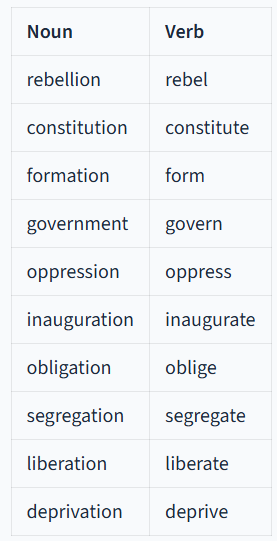
Q1. Make a list of such pairs of nouns and verbs in the text.
Ans: Such pairs of nouns and verbs from the text are:
Q2. Read the paragraph below. Fill in the blanks with the noun forms of the verbs in brackets.
Ans: Martin Luther King’s contribution to our history as an outstanding leader began when he came to the assistance of Rosa Parks, a seamstress who refused to give up her seat on a bus to a white passenger. In those days American Blacks were confined to positions of second class citizenship by restrictive laws and customs. To break these laws would mean subjugation and humiliation by the police and the legal system. Beatings, imprisonment and sometimes death awaited those who defied the System. Martin Luther King’s tactics of protest involved non-violent resistance to racial injustice.
Page 25 — Grammar II (definite article) (Exercise)
Q1. Mr Singh regularly invites the Amitabh Bachchans and the Shah Rukh Khans to his parties. What does this sentence mean?
Ans: It means Mr Singh invites many people like Amitabh Bachchan and Shah Rukh Khan — film stars of their type or kind, whose names may not be as well known.
Q2. Many people think that Madhuri Dixit is the Madhubala of our times. What does this sentence mean?
Ans: It means people think Madhuri Dixit is as beautiful and talented as Madhubala — a actress of the same type or calibre.
Q3. History is not only the story of the Alexanders, the Napoleons and the Hitlers, but of ordinary people as well. What does this sentence mean?
Ans: It means history is not only about famous conquerors and rulers like Alexander, Napoleon and Hitler, but also about ordinary people.
Page 27 — Writing
I. Looking at Contrasts
Use the following phrases to complete the sentences given below.
(i) they can be taught to love.
(ii) I was born free.
(iii) but the triumph over it.
(iv) but he who conquers that fear.
(v) to create such heights of
character.
1. It requires such depths of oppression _______________________________
Ans: to create such heights of character.
2. Courage was not the absence of fear _______________________________
Ans: but the triumph over it.
3. The brave man is not he who does not feel afraid _______________________________
Ans: but he who conquers that fear.
4. Complete the sentence: If people can learn to hate _______________________________
Ans: they can be taught to love.
5. I was not born with a hunger to be free _______________________________
Ans: I was born free.
II. This text repeatedly contrasts the past with the present or the future. We
can use coordinated clauses to contrast two views, for emphasis or effect.
Given below are sentences carrying one part of the contrast. Find in the text
the second part of the contrast, and complete each item. Identify the words
which signal the contrast. This has been done for you in the first item.
1. For decades the Union Buildings had been the seat of white supremacy, and now ________
Ans: it was the site of a rainbow gathering of different colours and nations, celebrating the birth of a democratic, non-racial South Africa.
2. Only moments before, the highest generals of the South African defence force and police saluted me and pledged their loyalty. … not so many years before they would not have saluted ________
Ans: but arrested me.
3. Although that day neither group knew the lyrics of the anthem …, they would soon ________
Ans: know the words by heart.
4. My country is rich in the minerals and gems that lie beneath its soil, ________
Ans: but I have always known that its greatest wealth is its people, finer and truer than the purest diamonds.
5. The Air Show was not only a display of pinpoint precision and military force, but ________
Ans: but a demonstration of the military’s loyalty to democracy, to a new government that had been freely and fairly elected.
6. It was this desire for the freedom of my people …. that transformed ________ into a bold one, that drove ________ to become a criminal, that turned ________ into a man without a home.
Ans: It was this desire for the freedom of my people that transformed a frightened young man into a bold one, that drove a law-abiding attorney to become a criminal, that turned a family-loving husband into a man without a home.
Page 27 – 28 Expressing Your Opinion (Exercise)
III. Do you think there is colour prejudice in our own country? Discuss with your friend and write a paragraph of about 100 to 150 words.
Ans: Yes, colour prejudice exists in our own country in many forms. People are often judged by the darkness or fairness of their skin, and matrimonial advertisements openly ask for “fair” brides, showing how deeply this bias is rooted. Such prejudice hurts people and divides society, even though skin colour says nothing about a person’s character or ability. We must learn to respect every individual, because, as Mandela reminds us, no one is born hating others — hate is learned, and so love can be taught.