Class 10 Science Chapter – 3 Metals and Non-metals Questions and Answers New Updated NCERT Solutions
3.1 PHYSICAL PROPERTIES, QUESTIONS page no : 40
Question: 1. Give an example of a metal which
(i) is a liquid at room temperature.
Answer: Mercury (Hg) is the only metal that remains liquid at room temperature.
(ii) can be easily cut with a knife.
Answer: Sodium (Na) is a soft metal that can be easily cut with a knife.
(iii) is the best conductor of heat.
Answer: Silver (Ag) is known to be the best conductor of heat among metals.
(iv) is a poor conductor of heat.
Answer: Lead (Pb) is considered a poor conductor of heat compared to other metals.
Question: 2. Explain the meanings of malleable and ductile.
Answer: Malleable: Malleability refers to the ability of a metal to be hammered or rolled into thin sheets without breaking. For example, gold and silver are highly malleable metals, allowing them to be shaped into various forms for jewelry and other applications
Ductile: Ductility is the property of a metal that allows it to be drawn into thin wires without breaking. Gold is an excellent example of a ductile metal, as a single gram of gold can be stretched into a wire that is approximately 2 kilometers long.
3.2 CHEMICAL PROPERTIES OF METALS QUESTIONS page no : 46
Question: 1. Why is sodium kept immersed in kerosene oil?
Answer: Sodium is a highly reactive metal, particularly with water and moisture in the air. When sodium comes into contact with water, it reacts vigorously, producing hydrogen gas and heat, which can lead to a fire or explosion. To prevent such dangerous reactions, sodium is stored immersed in kerosene oil.
Key Reasons for Storing Sodium in Kerosene Oil:
– Prevention of Reaction with Water: Kerosene acts as a barrier, preventing sodium from coming into contact with moisture or water vapor in the air.
– Safety: By keeping sodium submerged in kerosene, the risk of accidental reactions is minimized, ensuring safe handling and storage of this reactive metal.
Question: 2. Write equations for the reactions of
(i) iron with steam
Answer: When iron reacts with steam (water vapor), it forms iron(II,III) oxide and hydrogen gas. The balanced chemical equation for this reaction is:
3Fe(s)+4H2O(g)→Fe3O4(s)+4H2(g)
In this reaction:
1. Fe represents iron.
2. H₂O is steam (water in gaseous form).
3. Fe₃O₄ is the iron oxide produced.
(ii) calcium and potassium with water
Answer: Both calcium and potassium react with water, but they do so in different manners due to their reactivity levels.
Calcium with water: Calcium reacts with water to form calcium hydroxide and hydrogen gas. The balanced equation for this reaction is: Ca(s)+2H2O(l)→Ca(OH)2(aq)+H2(g)
In this reaction:
1. Ca represents calcium.
2. H₂O is water.
3. Ca(OH)₂ is calcium hydroxide.
2. Potassium with water: Potassium reacts vigorously with water, producing potassium hydroxide and hydrogen gas. The balanced equation for this reaction is: 2K(s)+2H2O(l)→2KOH(aq)+H2(g)
In this reaction:
1. K represents potassium.
2. KOH is potassium hydroxide.
These reactions illustrate the reactivity of metals with water, where potassium reacts more vigorously than calcium, producing hydrogen gas and corresponding hydroxides.
Question: 3. Samples of four metals A, B, C and D were taken and added to the following solution one by one. The results obtained have been tabulated as follows.
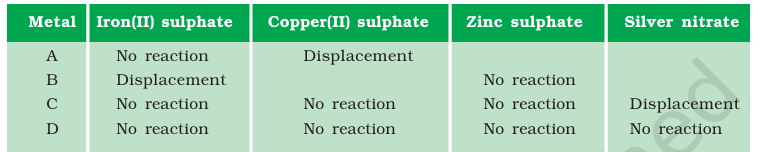
| Metal | Iron(II) Sulphate | Copper(II) Sulphate | Zinc Sulphate | Silver Nitrate |
| A | No reaction | Displacement | No reaction | Displacement |
| B | Displacement | No reaction | No reaction | No reaction |
| C | No reaction | No reaction | No reaction | Displacement |
| D | No reaction | No reaction | No reaction | No reaction |
Question: Use the Table above to answer the following questions about metals A, B, C and D.
(i) Which is the most reactive metal?
Answer: Metal A is the most reactive metal. This is indicated by its ability to displace both copper from copper(II) sulphate and silver from silver nitrate, while not reacting with iron(II) sulphate or zinc sulphate.
(ii) What would you observe if B is added to a solution of Copper(II) sulphate?
Answer: If Metal B is added to a solution of copper(II) sulphate, no reaction would be observed. This is because Metal B does not displace copper from its salt solution, indicating that it is less reactive than copper.
(iii) Arrange the metals A, B, C and D in the order of decreasing reactivity.
Answer: The order of decreasing reactivity based on the observations is as follows:
1. A (most reactive)
2. B
3. C
4. D (least reactive)
This arrangement reflects the ability of each metal to displace others from their respective salt solutions, which is a key indicator of their reactivity in the context of the reactivity series.
Question: 4. Which gas is produced when dilute hydrochloric acid is added to a reactive metal? Write the chemical reaction when iron reacts with dilute H2 SO4 .
Answer: Answer: When dilute hydrochloric acid (HCl) is added to a reactive metal, hydrogen gas (H2) is produced. This occurs because the metal displaces hydrogen from the acid, resulting in the formation of a salt and hydrogen gas.
For example, when iron reacts with dilute sulfuric acid (H2SO4), the following chemical reaction takes place: Fe+H2SO4→FeSO4+H2
In this reaction, iron (Fe) reacts with sulfuric acid to form iron(II) sulfate (FeSO4) and hydrogen gas (H2). The hydrogen gas can be observed as bubbles forming during the reaction.
Key Point: The general reaction for a metal with dilute acid can be summarized as:
Metal+Dilute Acid→Salt+Hydrogen Gas
Question: 5. What would you observe when zinc is added to a solution of iron(II) sulphate? Write the chemical reaction that takes place.
When zinc is added to a solution of iron(II) sulfate (FeSO4), a displacement reaction occurs because zinc is more reactive than iron. As a result, zinc displaces iron from the iron(II) sulfate solution.
The observable changes include the formation of a reddish-brown precipitate of iron as zinc displaces iron ions from the solution. The solution may also become colorless as the iron(II) ions are removed.
The chemical reaction can be represented as follows: Zn+FeSO4→ZnSO4+Fe
In this reaction, zinc (Zn) reacts with iron(II) sulfate (FeSO4) to form zinc sulfate (ZnSO4) and iron (Fe), which precipitates out of the solution.
Key Point: This reaction illustrates the principle that a more reactive metal can displace a less reactive metal from its compound in solution.
3.3 HOW DO METALS AND NON-METALS REA ALS REA ALS REACT? , QUESTIONS page no : 49
Question: 1. (i) Write the electron-dot structures for sodium, oxygen and magnesium.
Answer: The electron-dot structures illustrate the arrangement of valence electrons in an atom. For sodium (Na), oxygen (O), and magnesium (Mg), the structures are as follows:
Sodium (Na): Sodium has one electron in its outermost shell. Its electron-dot structure is represented as: Na:⋅
Oxygen (O): Oxygen has six electrons in its outermost shell. Its electron-dot structure is represented as: :⋅⋅O:⋅⋅
Magnesium (Mg): Magnesium has two electrons in its outermost shell. Its electron-dot structure is represented as: Mg:⋅⋅
These representations help visualize how these elements will interact during chemical reactions, particularly in the formation of ionic compounds.
Key Point: The number of dots around the element symbol corresponds to the number of valence electrons, which play a crucial role in chemical bonding.
(ii) Show the formation of Na2 O and MgO by the transfer of electrons.
Answer: The formation of sodium oxide (Na2O) and magnesium oxide (MgO) involves the transfer of electrons from the metal atoms to the non-metal atom, resulting in the formation of ionic compounds.
Formation of Sodium Oxide (Na2O):
1. Sodium (Na) has one electron in its outermost shell. To achieve a stable electron configuration, sodium loses this electron, forming a sodium ion (Na⁺).
Reaction: Na→Na++e−
2. Oxygen (O) has six electrons in its outermost shell and needs two more electrons to complete its octet. It accepts two electrons, forming an oxide ion (O²⁻).
Reaction: O+2e−→O2− .
3. The overall reaction for the formation of sodium oxide can be represented as: 2Na+O→Na2O .
Formation of Magnesium Oxide (MgO):
1. Magnesium (Mg) has two electrons in its outermost shell. To achieve a stable electron configuration, magnesium loses both of these electrons, forming a magnesium ion (Mg²⁺).
Reaction: Mg→Mg2++2e−
2. Oxygen (O) again accepts these two electrons to form an oxide ion (O²⁻), as described above.
Reaction: O+2e−→O2−
3. The overall reaction for the formation of magnesium oxide can be represented as: Mg+O→MgO
Summary of Ions Present:
In sodium oxide (Na2O), the ions present are sodium ions (Na⁺) and oxide ions (O²⁻).
In magnesium oxide (MgO), the ions present are magnesium ions (Mg²⁺) and oxide ions (O²⁻).
Key Point: The transfer of electrons during the formation of these ionic compounds results in the creation of stable ionic bonds, where the positively charged cations are attracted to the negatively charged anions.
(iii) What are the ions present in these compounds?
Answer: In the compounds sodium oxide (Na2O) and magnesium oxide (MgO), the ions present are as follows
– In Sodium Oxide (Na2O):
The compound consists of sodium ions (Na⁺) and oxide ions (O²⁻).
Each sodium ion has a +1 charge, and since there are two sodium ions for every oxide ion, the overall charge balance is maintained: 2Na++O2−→Na2O
– In Magnesium Oxide (MgO):
The compound consists of magnesium ions (Mg²⁺) and oxide ions (O²⁻).
The magnesium ion has a +2 charge, which balances with the -2 charge of the oxide ion: Mg2++O2− →MgO
Summary of Ions:
Sodium Oxide (Na2O): Contains sodium ions (Na⁺) and oxide ions (O²⁻).
Magnesium Oxide (MgO): Contains magnesium ions (Mg²⁺) and oxide ions (O²⁻).
Question: 2. Why do ionic compounds have high melting points?
Answer: Ionic compounds exhibit high melting points due to the strong electrostatic forces of attraction between the positively charged cations and negatively charged anions that constitute the compound. These forces, known as ionic bonds, are significantly stronger than the intermolecular forces found in covalent compounds.
Key Factors Contributing to High Melting Points:
1. Strong Ionic Bonds: The electrostatic attraction between oppositely charged ions is very strong, requiring a considerable amount of energy to overcome these forces during melting. For example, in sodium chloride (NaCl), the Na⁺ and Cl⁻ ions are held together by these strong ionic bonds.
2. Lattice Structure: Ionic compounds form a three-dimensional lattice structure, where each ion is surrounded by ions of opposite charge. This arrangement maximizes the attractive forces and minimizes repulsion, contributing to the stability and strength of the compound. Breaking this lattice requires significant energy input, leading to high melting points.
3. Energy Requirement: The energy required to break the ionic bonds and separate the ions in the lattice is reflected in the high melting and boiling points of ionic compounds. For instance, sodium chloride has a melting point of approximately 801°C, which is considerably higher than that of many covalent compounds.
Conclusion:
The combination of strong ionic bonds and the stable lattice structure of ionic compounds results in their high melting points, making them solid at room temperature and requiring substantial energy to transition to a liquid state.
Key Point: The high melting points of ionic compounds are primarily due to the strong electrostatic forces between the ions and the stable lattice structure they form.
3.4 OCCURRENCE OF METALS , QUESTIONS page no : 53
Question: 1. Define the following terms.
(i) Mineral (ii) Ore (iii) Gangue
Answer:
(i) Mineral: A mineral is a naturally occurring inorganic substance that has a definite chemical composition and a crystalline structure. Minerals are the building blocks of rocks and are found in the earth’s crust. They can exist in various forms, including metals, non-metals, and compounds.
(ii) Ore: An ore is a type of mineral that contains a sufficient concentration of a particular metal or valuable mineral that can be economically extracted. Ores are typically mined for their metal content, and the extraction process often involves various physical and chemical methods to separate the metal from the surrounding material.
(iii) Gangue: Gangue refers to the unwanted material or impurities that are found mixed with the ore in a mineral deposit. These impurities can include soil, sand, and other minerals that do not contain the desired metal. The removal of gangue is an essential step in the extraction process to ensure that the final product is as pure as possible.
Key Point: Understanding these terms is crucial for comprehending the processes involved in mining and metallurgy, as they highlight the distinction between valuable resources and waste materials.
Question: 2. Name two metals which are found in nature in the free state.
Answer: Two metals that are commonly found in nature in their free state are:
1. Gold (Au): Gold is a highly unreactive metal and is often found in its elemental form. It does not readily combine with other elements, which allows it to exist naturally as nuggets or grains in rocks and riverbeds.
2. Silver (Ag): Similar to gold, silver is also found in its free state. It is less reactive than many other metals and can be found in nature as native silver, often in the form of veins or nuggets.
Key Point: The occurrence of metals in their free state is primarily limited to those that are less reactive, as more reactive metals tend to form compounds with other elements.
Question: 3. What chemical process is used for obtaining a metal from its oxide?
Answer: The chemical process used for obtaining a metal from its oxide is called reduction. In this process, the metal oxide is heated with a suitable reducing agent, which can be carbon (in the form of coke) or other metals that are more reactive than the metal being extracted.
Example of Reduction:
1. Using Carbon:
– For example, to extract zinc from zinc oxide (ZnO), the reaction can be represented as: ZnO+C→Zn+CO
– Here, carbon reduces zinc oxide to zinc metal while itself gets oxidized to carbon monoxide.
2. Using Electrolysis:
For highly reactive metals, such as sodium or aluminum, electrolysis is used. For instance, aluminum oxide (Al₂O₃) is reduced to aluminum by passing an electric current through it.
Key Points:
– Reduction is essential in metallurgy to convert metal oxides into pure metals.
– The choice of reducing agent depends on the reactivity of the metal being extracted.
3.5 CORROSION , QUESTIONS page no : 55
Question: 1. Metallic oxides of zinc, magnesium and copper were heated with the following metals.
| Metal | Zinc | Magnesium | Copper |
| Zinc oxide | |||
| Magnesium oxide | |||
| Copper oxide |
In which cases will you find displacement reactions taking place?
Answer:
In this experiment, we will observe how different metals react with their respective metallic oxides when heated. The reactions can be summarized as follows:
1. Zinc Oxide + Zinc:
– Zinc does not reduce zinc oxide because it is less reactive than zinc oxide itself. Thus, no reaction occurs.
– Observation: No change.
2. Magnesium Oxide + Magnesium: Magnesium can reduce magnesium oxide to magnesium metal. This is because magnesium is more reactive than magnesium oxide.
– Reaction: 2MgO(s)+2Mg(s)→4Mg(s)+O2(g)
– Observation: Magnesium metal is produced.
3. Copper Oxide + Copper:
– Copper cannot reduce copper oxide because it is less reactive than copper oxide. Therefore, no reaction occurs.
– Observation: No change.
Summary of Reactions:
- Zinc with Zinc Oxide: No reaction.
- Magnesium with Magnesium Oxide: Reaction occurs, producing magnesium.
- Copper with Copper Oxide: No reaction.
Conclusion:
From this experiment, we can conclude that a more reactive metal can reduce the oxide of a less reactive metal, while a less reactive metal cannot reduce the oxide of a more reactive metal.
Question: 2. Which metals do not corrode easily?
Answer: Certain metals are known for their resistance to corrosion. Here are some metals that do not corrode easily:
1. Gold: Gold is highly resistant to corrosion and tarnishing due to its noble nature. It does not react with oxygen or moisture in the air, making it ideal for jewelry and decorative items.
2. Platinum: Similar to gold, platinum is also a noble metal that does not corrode easily. It is highly resistant to oxidation and is often used in jewelry and industrial applications.
3. Silver: While silver can tarnish when exposed to sulfur compounds in the air, it does not corrode in the same way as iron. It can be cleaned to restore its shine.
4. Titanium: Titanium is known for its strength and resistance to corrosion, especially in marine environments. It forms a protective oxide layer that prevents further oxidation.
5. Stainless Steel: An alloy of iron, chromium, and sometimes nickel, stainless steel is designed to resist corrosion. The chromium content forms a passive layer of chromium oxide that protects the underlying metal.
Conclusion:
These metals are often used in applications where durability and resistance to corrosion are essential, such as in jewelry, medical devices, and construction materials. Their ability to withstand corrosion makes them valuable in various industries.
Question: 3. What are alloys?
Alloys are homogeneous mixtures composed of two or more elements, where at least one of the components is a metal. The primary purpose of creating alloys is to enhance certain properties of the base metal, such as strength, durability, corrosion resistance, and malleability.
Key Characteristics of Alloys:
1. Composition: Alloys can consist of two or more metals or a metal combined with non-metals. The proportions of the components can vary, leading to different properties.
2. Improved Properties: Alloys often exhibit superior characteristics compared to their individual components. For example, they may be stronger, harder, or more resistant to corrosion.
3. Common Examples:
– Steel: An alloy of iron and carbon, which is much stronger than pure iron.
– Bronze: A mixture of copper and tin, known for its hardness and resistance to corrosion.
– Brass: An alloy of copper and zinc, valued for its malleability and acoustic properties.
– Stainless Steel: An alloy of iron, chromium, and sometimes nickel, known for its resistance to rust and corrosion.
Applications of Alloys:
1. Construction: Used in building materials due to their strength and durability.
2. Jewelry: Alloys like gold mixed with copper or silver are used to create durable and aesthetically pleasing jewelry.
3. Automotive and Aerospace: Alloys are used in manufacturing parts that require high strength and lightweight properties.
Conclusion:
Alloys play a crucial role in various industries by combining different elements to produce materials with enhanced properties, making them essential in everyday applications.
Class 10 Science Chapter – 3 Metals and Non-metals Questions and Answers New Updated NCERT Solutions
EXERCISES Page no: 56
Question: 1. Which of the following pairs will give displacement reactions?
(a) NaCl solution and copper metal
(b) MgCl2 solution and aluminium metal
(c) FeSO4 solution and silver metal
(d) AgNO3 solution and copper metal.
Answer: The pairs that will give displacement reactions are:
(b) MgCl2 solution and aluminium metal
(d) AgNO3 solution and copper metal
Explanation:
1. Displacement Reactions: A displacement reaction occurs when a more reactive metal displaces a less reactive metal from its compound in solution.
2. Analysis of Each Option:
(a) NaCl solution and copper metal: Copper is less reactive than sodium, so no displacement will occur.
(b) MgCl2 solution and aluminium metal: Aluminium is more reactive than magnesium, so it can displace magnesium from magnesium chloride, resulting in a displacement reaction.
(c) FeSO4 solution and silver metal: Silver is less reactive than iron, so no displacement will occur.
(d) AgNO3 solution and copper metal: Copper is more reactive than silver, so it can displace silver from silver nitrate, resulting in a displacement reaction.
Question: 2. Which of the following methods is suitable for preventing an iron frying pan from rusting?
(a) Applying grease
(b) Applying paint
(c) Applying a coating of zinc
(d) All of the above.
Answer: The correct answer is (d) All of the above.
Explanation:
Each of the methods listed can effectively prevent rusting of iron:
1. Applying grease: This creates a barrier that prevents moisture and air from reaching the iron surface, thus reducing the chances of rust formation.
2. Applying paint: Paint acts as a protective layer that isolates the iron from environmental factors such as moisture and oxygen, which are necessary for rusting to occur.
3. Applying a coating of zinc (Galvanization): Zinc is more reactive than iron and will corrode preferentially. This means that even if the zinc layer is scratched, it will protect the underlying iron from rusting.
Question: 3. An element reacts with oxygen to give a compound with a high melting point. This compound is also soluble in water. The element is likely to be
(a) calcium
(b) carbon
(c) silicon
(d) iron.
Answer: The correct answer is (a) calcium.
Explanation:
a. Calcium reacts with oxygen to form calcium oxide (CaO), which has a high melting point (about 2572 °C) and is soluble in water, forming calcium hydroxide.
b. Carbon forms carbon dioxide (CO₂) or carbon monoxide (CO) upon reacting with oxygen, which are gases and do not have high melting points.
c. Silicon forms silicon dioxide (SiO₂), which has a high melting point but is not soluble in water.
d. Iron reacts with oxygen to form iron oxides, which also have high melting points, but their solubility in water varies and is generally not as straightforward as calcium oxide.
Question: 4. Food cans are coated with tin and not with zinc because
(a) zinc is costlier than tin.
(b) zinc has a higher melting point than tin.
(c) zinc is more reactive than tin.
(d) zinc is less reactive than tin.
Answer: The correct answer to the question regarding why food cans are coated with tin and not with zinc is:
(c) zinc is more reactive than tin.
Explanation:
1. Reactivity: Zinc is more reactive than tin, which means it can corrode more easily when exposed to moisture and air. If zinc were used to coat food cans, it would react with the food and moisture, potentially leading to contamination and spoilage.
2. Tin’s Properties: Tin, being less reactive, provides a protective layer that prevents the underlying metal (usually steel) from rusting and reacting with the food. This makes tin a better choice for food preservation.
Question: 5. You are given a hammer, a battery, a bulb, wires and a switch.
(a) How could you use them to distinguish between samples of metals and non-metals?
(a) Using the Given Materials
Answer: To distinguish between samples of metals and non-metals using a hammer, a battery, a bulb, wires, and a switch, you can perform the following steps:
1. Conductivity Test:
– Set Up: Connect the battery, bulb, and wires to create a simple circuit. Ensure the circuit is complete with a switch.
– Testing: Take a sample of the material (metal or non-metal) and place it in the circuit.
– Observation:
1. If the bulb lights up, the material is likely a metal because metals are good conductors of electricity.
2. If the bulb does not light up, the material is likely a non-metal since non-metals are generally poor conductors of electricity.
2. Malleability Test:
– Use the Hammer: Take the sample and gently strike it with the hammer.
– Observation:
1. If the material can be flattened or shaped without breaking, it is likely a metal (malleable).
2. If it shatters or does not change shape, it is likely a non-metal (brittle).
(b) Assess the usefulness of these tests in distinguishing between metals and non-metals.
Answer: (b) Assessing the Usefulness of These Tests
1. Conductivity Test: Usefulness: This test is highly effective because it directly measures the electrical conductivity, which is a fundamental property distinguishing metals from non-metals.
Metals typically conduct electricity due to the presence of free electrons, while non-metals do not.
2. Malleability Test: Usefulness: This test is also useful as it demonstrates the physical property of malleability, which is characteristic of metals.
Non-metals, on the other hand, are usually brittle and do not exhibit this property.
Question: 6. What are amphoteric oxides? Give two examples of amphoteric oxides.
Answer: Definition: Amphoteric oxides are metal oxides that can react with both acids and bases to form salts and water. This dual reactivity allows them to exhibit both acidic and basic properties, depending on the nature of the reacting substance.
Examples of Amphoteric Oxides
1. Aluminium Oxide (Al₂O₃):
Reaction with Acids: When aluminium oxide reacts with hydrochloric acid (HCl), it forms aluminium chloride and water. Al2O3+6HCl→2AlCl3+3H2O
Reaction with Bases: When it reacts with sodium hydroxide (NaOH), it forms sodium aluminate and water. Al2O3+2NaOH+3H2O→2NaAl(OH)4 .
2. Zinc Oxide (ZnO):
Reaction with Acids: When zinc oxide reacts with hydrochloric acid, it produces zinc chloride and water. ZnO+2HCl→ZnCl2+H2O
Reaction with Bases: When it reacts with sodium hydroxide, it forms sodium zincate and water. ZnO+2NaOH+2H2O→Na2Zn(OH)4
Question: 7. Name two metals which will displace hydrogen from dilute acids, and two metals which will not.
Answer: Metals that Displace Hydrogen from Dilute Acids
1. Metals that Will Displace Hydrogen:
Magnesium (Mg): Magnesium reacts vigorously with dilute acids like hydrochloric acid to produce hydrogen gas. Mg+2HCl→MgCl+H2↑
Zinc (Zn): Zinc also reacts with dilute acids, displacing hydrogen and forming zinc chloride. Zn+2HCl→ZnCl2+H2↑
2. Metals that Will Not Displace Hydrogen:
Copper (Cu): Copper does not react with dilute acids, and therefore does not displace hydrogen.
Silver (Ag): Silver is another metal that does not react with dilute acids to displace hydrogen.
Summary
1. Displacing Metals: Magnesium and zinc can displace hydrogen from dilute acids.
2. Non-displacing Metals: Copper and silver do not displace hydrogen when reacted with dilute acid.
EXERCISES Page no: 57
Question: 8. In the electrolytic refining of a metal M, what would you take as the anode, the cathode and the electrolyte?
Answer: In the electrolytic refining of a metal M, the setup consists of the following components:
1. Anode: The anode is made of impure metal M. During the electrolysis, the impure metal dissolves into the electrolyte.
2. Cathode: The cathode is a thin strip of pure metal M. As the current passes through the electrolyte, pure metal M is deposited on the cathode.
3. Electrolyte: The electrolyte is a solution of a salt of the metal M, typically in a diluted form. For example, if the metal M is copper, the electrolyte would be an acidified solution of copper sulfate.
Summary
1. Anode: Impure metal M
2. Cathode: Pure metal M
3. Electrolyte: Solution of metal M’s salt (e.g., copper sulfate for copper)
Question: 9. Pratyush took sulphur powder on a spatula and heated it. He collected the gas evolved by inverting a test tube over it, as shown in figure below.
(a) What will be the action of gas on :
(i) dry litmus paper?
Answer: When Pratyush heats sulphur powder, it produces sulphur dioxide (SO₂) gas. The behavior of this gas when it comes into contact with litmus paper is as follows:
(a) Action of Sulphur Dioxide on Litmus Paper
Answer: (i) Dry Litmus Paper:
Action: The dry litmus paper will remain unchanged.
Reason: Sulphur dioxide does not react with dry litmus paper because it requires moisture to exhibit its acidic properties.
(ii) moist litmus paper?
Answer: Moist Litmus Paper:
Action: The moist litmus paper will turn red.
Reason: Sulphur dioxide is an acidic gas. When it dissolves in water, it forms sulphurous acid (H₂SO₃), which is acidic in nature. This acidity causes the blue litmus paper to turn red.
Summary
- Dry Litmus Paper: No change
- Moist Litmus Paper: Turns red
(b) Write a balanced chemical equation for the reaction taking place.
Answer: When sulphur powder is heated, it reacts with oxygen in the air to form sulphur dioxide (SO₂) gas. The balanced chemical equation for this reaction is:
S(s)+O2(g)→SO2(g)
Explanation
Reactants: Sulphur (S) in solid form reacts with oxygen (O₂) in gaseous form.
Product: The reaction produces sulphur dioxide (SO₂) gas.
Question: 10. State two ways to prevent the rusting of iron.
Answer: Rusting is a common problem that affects iron and its alloys, leading to deterioration. Here are two effective methods to prevent rusting:
1. Galvanization: This method involves coating iron or steel with a thin layer of zinc. The zinc layer acts as a protective barrier, preventing moisture and oxygen from reaching the iron underneath. Even if the zinc coating gets scratched, it still protects the iron by corroding first, thereby preventing rust formation.
2. Applying Protective Coatings: Iron can be protected from rusting by applying paints, oils, or greases. These coatings create a barrier that prevents air and moisture from contacting the iron surface. Regular maintenance of these coatings is essential to ensure their effectiveness.
By employing these methods, the lifespan of iron objects can be significantly extended, reducing maintenance costs and enhancing durability.
Question: 11. What type of oxides are formed when non-metals combine with oxygen?
Answer: When non-metals react with oxygen, they typically form acidic oxides or neutral oxides. Here’s a brief overview of each type:
1. Acidic Oxides: These oxides react with water to form acids. For example:
– Carbon Dioxide (CO₂): When dissolved in water, it forms carbonic acid (H₂CO₃).
– Sulfur Dioxide (SO₂): This gas reacts with water to produce sulfurous acid (H₂SO₃).
– Nitrogen Dioxide (NO₂): It can react with water to form nitric acid (HNO₃).
2. Neutral Oxides: These do not exhibit acidic or basic properties. They do not react with acids or bases. An example is:
– Carbon Monoxide (CO): This oxide does not react with water to form an acid or base.
Summary
In summary, non-metals primarily form acidic oxides when they react with oxygen, which can further react with water to produce acids. Neutral oxides, while less common, do exist and do not exhibit acidic or basic behavior.
Question: 12. Give reasons :
(a) Platinum, gold and silver are used to make jewellery.
Answer: Reasons for Using Platinum, Gold, and Silver in Jewellery
1. Aesthetic Appeal:
– Lustrous Appearance: Platinum, gold, and silver possess a natural shine and luster that make them visually appealing. Their ability to reflect light enhances their beauty, making them desirable for jewellery.
– Variety of Colors: Gold comes in various colors (yellow, white, and rose) depending on its alloying elements, allowing for diverse design options.
2. Corrosion Resistance:
– Durability: These metals are highly resistant to tarnishing and corrosion. For instance, gold does not oxidize or tarnish, ensuring that jewellery maintains its appearance over time.
– Longevity: The resistance to corrosion means that jewellery made from these metals can last for generations without significant degradation.
3. Malleability and Ductility:
– Ease of Crafting: Gold and silver are highly malleable and ductile, allowing artisans to create intricate designs and detailed craftsmanship. This property enables the production of fine and delicate jewellery pieces.
4. Cultural and Economic Value:
– Tradition and Status: Gold and silver have been historically associated with wealth and status. They are often used in cultural and ceremonial contexts, making them significant in various traditions.
– Investment Value: These metals are considered valuable and can serve as a form of investment. Their intrinsic value makes them a preferred choice for jewellery.
5. Hypoallergenic Properties:
– Skin Compatibility: Platinum, gold (especially 18K and above), and silver are generally hypoallergenic, making them suitable for individuals with sensitive skin. This quality ensures comfort for the wearer.
Conclusion
In summary, the combination of aesthetic appeal, durability, ease of crafting, cultural significance, and hypoallergenic properties makes platinum, gold, and silver the preferred choices for jewellery making.
(b) Sodium, potassium and lithium are stored under oil.
Answer: Reasons for Storing Sodium, Potassium, and Lithium Under Oil
1. Reactivity with Water:
– Vigorous Reactions: Sodium, potassium, and lithium are highly reactive metals, particularly with water. When these metals come into contact with water, they react vigorously, producing hydrogen gas and heat, which can lead to fire or explosions. For example:
Sodium reacts with water as follows: 2Na+2H2O→2NaOH+H2↑+heat
Preventing Accidents: Storing these metals under oil prevents them from coming into contact with moisture in the air or water, thus avoiding dangerous reactions.
2. Protection from Air:
– Oxidation Prevention: These metals can also react with oxygen in the air, forming oxides that can tarnish their surfaces. For instance, sodium forms sodium oxide when exposed to air: 4Na+O2→2Na2O
– Oil Barrier: The oil layer acts as a barrier, protecting the metals from atmospheric oxygen and moisture, thus preserving their purity and preventing oxidation.
3. Ease of Handling:
– Safe Storage: Storing these reactive metals under oil makes it safer to handle them. The oil prevents accidental exposure to air and moisture, reducing the risk of unintended reactions during storage and handling.
4. Long-term Preservation:
– Maintaining Reactivity: By keeping these metals submerged in oil, their reactivity is maintained over time without degradation. This is essential for laboratory and industrial applications where these metals may be required for various reactions.
Conclusion
In summary, sodium, potassium, and lithium are stored under oil primarily to prevent their violent reactions with water and air, ensuring safe handling and long-term preservation of these highly reactive metals.
(c) Aluminium is a highly reactive metal, yet it is used to make utensils for cooking.
Answer: Reasons for Using Aluminium in Cooking Utensils
1. Formation of Protective Oxide Layer:
– Passivation: Although aluminium is a reactive metal, it quickly forms a thin layer of aluminium oxide (Al₂O₃) when exposed to air. This oxide layer acts as a protective barrier, preventing further oxidation and corrosion. As a result, aluminium utensils do not react significantly with food or moisture, making them safe for cooking.
2. Lightweight and Durable:
– Ease of Use: Aluminium is much lighter than many other metals, making it easier to handle and use in cooking. This lightweight property is particularly beneficial for cookware that needs to be moved frequently.
– Strength: Despite its lightness, aluminium is strong and durable, allowing it to withstand the rigors of cooking without easily bending or breaking.
3. Excellent Heat Conductor:
– Efficient Cooking: Aluminium has a high thermal conductivity, which means it heats up quickly and distributes heat evenly. This property allows for efficient cooking, reducing cooking times and ensuring that food is cooked uniformly.
1. Cost-Effective:
Affordability: Aluminium is relatively inexpensive compared to other metals like stainless steel or copper. This cost-effectiveness makes it a popular choice for both manufacturers and consumers when producing cooking utensils.
2. Non-Toxic:
Safety: When properly anodized or coated, aluminium utensils do not leach harmful substances into food. This makes them safe for cooking and food preparation, provided they are used correctly.
3. Versatility:
Variety of Applications: Aluminium can be easily shaped and formed into various types of cookware, such as pots, pans, and baking trays. This versatility allows for a wide range of cooking applications.
Conclusion
In summary, despite being a highly reactive metal, aluminium is widely used for cooking utensils due to its protective oxide layer, lightweight nature, excellent heat conductivity, cost-effectiveness, safety, and versatility in manufacturing. These properties make aluminium an ideal material for everyday cooking needs.
(d) Carbonate and sulphide ores are usually converted into oxides during the process of extraction.
Answer: Reasons for Converting Carbonate and Sulphide Ores into Oxides During Extraction
1. Ease of Reduction:
– Higher Reactivity of Oxides: Metal oxides are generally easier to reduce to their respective metals compared to their carbonate or sulphide forms. The reduction process often requires less energy and can be achieved using carbon or other reducing agents. For example: Zinc oxide can be reduced to zinc metal using carbon: ZnO+C→Zn+CO .
2. Thermal Stability:
– Stability of Metal Oxides: Metal oxides are typically more thermally stable than their carbonate or sulphide counterparts. This stability allows them to withstand the high temperatures used in metallurgical processes without decomposing. For instance, carbonate ores can decompose upon heating, releasing carbon dioxide gas: CaCO3→CaO+CO2↑
3. Removal of Impurities:
– Purification Process: Converting ores to oxides often helps in the removal of impurities. During the calcination of carbonate ores or roasting of sulphide ores, unwanted materials can be eliminated, resulting in a purer oxide that is more suitable for reduction. For example, during roasting, sulphur dioxide is released, leaving behind a purer metal oxide: 2ZnS+3O2→2ZnO+2SO2
1. Formation of Useful By-products:
– Utilization of Gases: The conversion of carbonate and sulphide ores into oxides often results in the production of gases (like CO₂ or SO₂) that can be captured and utilized in other industrial processes. This not only aids in the extraction of metals but also contributes to environmental management by reducing gas emissions.
2. Simplified Reaction Pathways:
– Fewer Reaction Steps: The extraction process becomes more straightforward when starting from oxides, as the subsequent reduction steps are often well-established and efficient. This simplification can lead to lower production costs and higher yields of the desired metal.
Conclusion
In summary, the conversion of carbonate and sulphide ores into oxides during extraction is primarily due to the ease of reduction, thermal stability of oxides, removal of impurities, formation of useful by-products, and simplified reaction pathways. These factors contribute to more efficient and cost-effective metallurgical processes.
Class 10 Science Chapter – 3 Metals and Non-metals Questions and Answers New Updated NCERT Solutions
EXERCISES Page no: 57
Question: 13. You must have seen tarnished copper vessels being cleaned with lemon or tamarind juice. Explain why these sour substances are effective in cleaning the vessels.
Answer: Cleaning Tarnished Copper Vessels with Sour Substances
Tarnished copper vessels develop a greenish layer known as copper carbonate or copper oxide due to exposure to air and moisture. This tarnish can be effectively removed using sour substances like lemon or tamarind juice. Here’s why these substances work well:
1. Acidic Nature:
– Presence of Acids: Lemon juice contains citric acid, and tamarind juice contains tartaric acid. These acids react with the copper oxide or carbonate on the surface of the tarnished copper.
– Chemical Reaction: The acids help in converting the tarnished copper oxide back to its metallic form. For example, the reaction can be represented as follows:
CuO+2H+→Cu2++H2O
- This reaction effectively dissolves the tarnish, restoring the copper’s shiny appearance.
2. Chelating Action:
– Formation of Soluble Complexes: The acids in lemon and tamarind juice can form soluble complexes with copper ions. This helps in removing the tarnish from the surface of the metal.
– Example: Citric acid can form a complex with copper ions, making them soluble and easy to wash away.
3. Natural Abrasive:
– Physical Scrubbing: When using lemon or tamarind juice, the physical action of scrubbing the surface with a cloth or sponge can help remove the tarnish along with the acidic reaction. The pulp of these fruits can act as a mild abrasive, aiding in the cleaning process.
4. Non-Toxic and Eco-Friendly:
– Safe Cleaning Agents: Unlike harsh chemical cleaners, lemon and tamarind juice are non-toxic and environmentally friendly, making them safe for household use.
Conclusion
In summary, sour substances like lemon and tamarind juice are effective in cleaning tarnished copper vessels due to their acidic nature, ability to form soluble complexes with copper ions, and mild abrasive properties. These natural cleaners not only restore the shine of copper but also do so in a safe and eco-friendly manner.
Question: 14. Differentiate between metal and non-metal on the basis of their chemical properties.
Answer: Metals and non-metals exhibit distinct chemical properties that differentiate them from each other. Here’s a concise comparison:
1. Reactivity with Acids –
– Metals: Metals react with dilute acids to produce hydrogen gas and a salt. For example:
Metal+Dilute Acid→Salt+Hydrogen
Example: Zinc reacts with hydrochloric acid: Zn+2HCl→ZnCl2+H2. .
– Non-Metals: Non-metals do not react with acids in the same manner. Instead, they can react with bases or may not react at all with acids. For example, carbon does not produce hydrogen when reacting with acids.
2. Formation of Ions –
– Metals: Metals tend to lose electrons during chemical reactions, forming positive ions (cations). For example, sodium loses one electron to form Na+
– Non-Metals: Non-metals tend to gain electrons to form negative ions (anions). For example, chlorine gains an electron to form Cl−
3. Oxides Formation –
– Metals: When metals react with oxygen, they form basic oxides. For example:
Metal+Oxygen→Metal Oxide
– Example: Magnesium reacts with oxygen to form magnesium oxide: 2Mg+O2→2MgO
– Non-Metals: Non-metals react with oxygen to form acidic or neutral oxides. For example: Non-Metal+Oxygen→Non-Metal Oxide
Example: Sulfur reacts with oxygen to form sulfur dioxide: S+O2→SO2
4. Displacement Reactions –
– Metals: More reactive metals can displace less reactive metals from their compounds in solution. For example, zinc can displace copper from copper sulfate solution: Zn+CuSO4→ZnSO4+Cu
– Non-Metals: Non-metals do not typically participate in displacement reactions involving metals.
5. Conductivity –
– Metals: Metals are good conductors of electricity and heat due to the presence of free-moving electrons.
– Non-Metals: Non-metals are generally poor conductors of electricity and heat, with the exception of graphite, which can conduct electricity.
Summary
In summary, metals and non-metals differ significantly in their chemical behavior, particularly in their reactions with acids, the formation of ions, the nature of oxides produced, and their ability to conduct electricity. Understanding these differences is crucial in the study of chemistry and the application of these elements in various fields.
Question: 15. A man went door to door posing as a goldsmith. He promised to bring back the glitter of old and dull gold ornaments. An unsuspecting lady gave a set of gold bangles to him which he dipped in a particular solution. The bangles sparkled like new but their weight was reduced drastically. The lady was upset but after a futile argument the man beat a hasty retreat. Can you play the detective to find out the nature of the solution he had used?
Answer: In this scenario, the man posing as a goldsmith likely used a solution that contained a strong acid, such as hydrochloric acid (HCl) or a mixture of acids, to clean the gold bangles. Here’s a breakdown of why this is plausible:
1. Cleaning Effect:
– Strong acids can effectively remove tarnish and oxidation from gold surfaces, restoring their shine. Gold itself does not tarnish easily, but it can become dull due to the presence of other metals in the alloy or due to surface contaminants.
2. Weight Reduction:
– The drastic reduction in weight indicates that the solution may have dissolved some of the metals alloyed with the gold. For instance, if the gold bangles were made of 22-carat gold (which contains 22 parts gold and 2 parts other metals like copper or silver), these other metals could be corroded or dissolved by the acid, leading to a significant loss in weight.
3. Common Cleaning Solutions:
– Solutions containing acids like vinegar (acetic acid) or lemon juice (citric acid) are also known for cleaning purposes, but they are less likely to cause significant weight loss compared to stronger acids.
Conclusion –
The man likely used a strong acidic solution to clean the gold bangles, which not only restored their shine but also caused the loss of weight by dissolving some of the non-gold metals in the alloy. This deceptive practice highlights the importance of being cautious when dealing with jewelry cleaning, especially when the cleaning agent is unknown.
Question: 16. Give reasons why copper is used to make hot water tanks and not steel (an alloy of iron).
Answer: Copper is preferred over steel (an alloy of iron) for making hot water tanks due to several key reasons:
1. Corrosion Resistance:
– Copper is highly resistant to corrosion, which is crucial for hot water tanks that are constantly exposed to water. It does not rust or corrode easily, ensuring a longer lifespan for the tank.
– Steel, on the other hand, is prone to rusting when exposed to moisture, especially if the protective coating is damaged. Rust can compromise the integrity of the tank, leading to leaks and requiring frequent replacements.
2. Thermal Conductivity:
– Copper has excellent thermal conductivity, meaning it can efficiently transfer heat. This property allows hot water tanks made of copper to heat water quickly and maintain the desired temperature effectively.
– Steel has lower thermal conductivity compared to copper, which means it takes longer to heat water and may not maintain temperature as efficiently.
3. Weight and Strength:
– Copper is relatively lightweight yet strong, making it easier to handle and install. This is particularly beneficial in residential settings where weight can be a concern.
– Steel is heavier, which can make installation more cumbersome and may require additional structural support.
4. Aesthetic Appeal:
– Copper has a natural, attractive appearance that can blend well with various home designs. It also develops a patina over time, which some people find appealing.
– Steel may require additional coatings or finishes to achieve a similar aesthetic, which can add to maintenance costs.
Conclusion
Due to its corrosion resistance, superior thermal conductivity, lightweight nature, and aesthetic appeal, copper is the preferred material for hot water tanks compared to steel. These properties ensure that copper tanks are more durable and efficient for heating water.