Page: 172
Q1. What does an electric circuit mean?
Ans: An electric circuit is a continuous and closed path through which an electric current flows. If the circuit is broken anywhere (or the switch is turned off), the current stops flowing.
Q2. Define the unit of current.
Ans: The SI unit of current is the ampere (A). One ampere is the current when one coulomb of charge flows through a cross-section of a conductor in one second, i.e.  .
Q3. Calculate the number of electrons constituting one coulomb of charge.
Ans: Charge of one electron  .

So about  electrons (nearly
 ) constitute one coulomb of charge.
Page: 174
Q1. Name a device that helps to maintain a potential difference across a conductor.
Ans: A battery (or a cell) helps to maintain a potential difference across a conductor.
Q2. What is meant by saying that the potential difference between two points is 1 V?
Ans: It means that 1 joule of work is done to move a charge of 1 coulomb between those two points.
Q3. How much energy is given to each coulomb of charge passing through a 6 V battery?
Ans: Energy per coulomb:  .
Page: 181
Q1. On what factors does the resistance of a conductor depend?
Ans: The resistance of a conductor depends on (i) its length  , (ii) its area of cross-section
 , and (iii) the nature of its material. It is given by
 , where
 is the resistivity of the material.
Q2. Will current flow more easily through a thick wire or a thin wire of the same material, when connected to the same source? Why?
Ans: Current flows more easily through a thick wire. A thicker wire has a larger area of cross-section, and since resistance is inversely proportional to area ( ), its resistance is smaller, allowing more current to flow.
Q3. Let the resistance of an electrical component remains constant while the potential difference across the two ends of the component decreases to half of its former value. What change will occur in the current through it?
Ans: By Ohm's law,  . Since
 is constant and
 becomes half, the current through the component also becomes half of its former value.
Q4. Why are coils of electric toasters and electric irons made of an alloy rather than a pure metal?
Ans: Alloys have a higher resistivity than their constituent metals and do not oxidise (burn) readily at high temperatures. Hence they are commonly used in electrical heating devices like toasters and irons.
Q5. Use the data in Table 11.2 to answer the following – (a) Which among iron and mercury is a better conductor? (b) Which material is the best conductor?
Ans: From Table 11.2: resistivity of iron =  ; mercury =
 ; silver =
 (lowest).
(a) Iron is a better conductor than mercury, since it has lower resistivity.
(b) Silver is the best conductor, as it has the lowest resistivity of all the materials listed.
Page: 185
Q1. Draw a schematic diagram of a circuit consisting of a battery of three cells of 2 V each, a 5 Ω resistor, an 8 Ω resistor, and a 12 Ω resistor, and a plug key, all connected in series.
Ans: The schematic diagram shows a battery of three cells (each 2 V, total 6 V) connected in series with a plug key K, then a 5 Ω resistor, an 8 Ω resistor, and a 12 Ω resistor, all in a single loop. (Draw: battery symbol of three long–short lines → key → 5 Ω → 8 Ω → 12 Ω → back to battery, all in one series loop.)
Q2. Redraw the circuit of Question 1, putting in an ammeter to measure the current through the resistors and a voltmeter to measure the potential difference across the 12 Ω resistor. What would be the readings in the ammeter and the voltmeter?
Ans: The ammeter is connected in series anywhere in the loop, and the voltmeter is connected in parallel across the 12 Ω resistor.
Total resistance:

Ammeter reading (current in circuit):

Voltmeter reading (p.d. across 12 Ω):

So the ammeter reads 0.24 A and the voltmeter reads 2.88 V.
Page: 188
Q1. Judge the equivalent resistance when the following are connected in parallel – (a) 1 Ω and 10^6 Ω, (b) 1 Ω and 10^3 Ω, and 10^6 Ω.
Ans: In parallel, the equivalent resistance is less than the smallest individual resistance.
(a) For  and
 :

(b) For  ,
 and
 :

In both cases the equivalent resistance is very close to  (just slightly less), since the smallest resistor dominates.
Q2. An electric lamp of 100 Ω, a toaster of resistance 50 Ω, and a water filter of resistance 500 Ω are connected in parallel to a 220 V source. What is the resistance of an electric iron connected to the same source that takes as much current as all three appliances, and what is the current through it?
Ans: For the three appliances in parallel:

The electric iron must have resistance  . Current through it:

Q3. What are the advantages of connecting electrical devices in parallel with the battery instead of connecting them in series?
Ans: In a parallel connection, each device gets the full supply voltage and draws current according to its own resistance, so devices needing different currents can operate properly. Also, if one device fails, the others keep working (the circuit is not broken), and the total resistance of the circuit decreases.
Q4. How can three resistors of resistances 2 Ω, 3 Ω, and 6 Ω be connected to give a total resistance of (a) 4 Ω, (b) 1 Ω?
Ans: (a) To get  : connect
 and
 in parallel, then join this combination in series with the
 resistor.

(b) To get  : connect all three (
 ,
 ,
 ) in parallel.

Q5. What is (a) the highest, (b) the lowest total resistance that can be secured by combinations of four coils of resistance 4 Ω, 8 Ω, 12 Ω, 24 Ω?
Ans: (a) Highest resistance: connect all four coils in series.

(b) Lowest resistance: connect all four coils in parallel.

Page: 190
Q1. Why does the cord of an electric heater not glow while the heating element does?
Ans: The heating element has high resistance, so it produces large heat (H = I²R) and glows red-hot. The cord is made of thick copper wires of very low resistance, so it produces negligible heat and does not glow.
Q2. Compute the heat generated while transferring 96000 coulomb of charge in one hour through a potential difference of 50 V.
Ans: Given Q = 96000 C, t = 1 h = 3600 s, V = 50 V.


Q3. An electric iron of resistance 20 Ω takes a current of 5 A. Calculate the heat developed in 30 s.
Ans: Given R = 20 Ω, I = 5 A, t = 30 s.

Page: 192
Q1. What determines the rate at which energy is delivered by a current?
Ans: The rate at which energy is delivered by a current is determined by the electric power of the device, which is the product of the potential difference  across it and the current
 flowing through it, i.e.
 .
Q2. An electric motor takes 5 A from a 220 V line. Determine the power of the motor and the energy consumed in 2 h.
Ans: Power of the motor:

Energy consumed in 2 h:

Page: 193 – Exercise (Q1–Q5)
Q1. A piece of wire of resistance R is cut into five equal parts. These parts are then connected in parallel. If the equivalent resistance of this combination is R′, then the ratio R/R′ is – (a) 1/25 (b) 1/5 (c) 5 (d) 25
Ans: (d) 25 — Each part has resistance  ; five such parts in parallel give
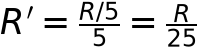 , so
 .
Q2. Which of the following terms does not represent electrical power in a circuit? (a) I²R (b) IR² (c) VI (d) V²/R
Ans: (b)  — Electrical power is given by
 ;
 is not a valid expression for power.
Q3. An electric bulb is rated 220 V and 100 W. When it is operated on 110 V, the power consumed will be – (a) 100 W (b) 75 W (c) 50 W (d) 25 W
Ans: (d) 25 W — Resistance of the bulb:  . At 110 V:

Q4. Two conducting wires of the same material and of equal lengths and equal diameters are first connected in series and then parallel in a circuit across the same potential difference. The ratio of heat produced in series and parallel combinations would be – (a) 1:2 (b) 2:1 (c) 1:4 (d) 4:1
Ans: (d) 4:1 — Each wire has resistance  . In series,
 ; in parallel,
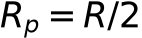 . Since heat
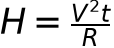 for the same
 and
 :
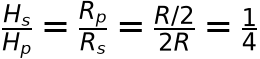
So the ratio is 1:4.
Q5. How is a voltmeter connected in the circuit to measure the potential difference between two points?
Ans: A voltmeter is connected in parallel across the two points between which the potential difference is to be measured. It has a very high resistance so that it draws negligible current from the circuit.
Page: 193 – Exercise (Q6–Q10)
Q6. A copper wire has diameter 0.5 mm and resistivity of 1.6 × 10⁻⁸ Ω m. What will be the length of this wire to make its resistance 10 Ω? How much does the resistance change if the diameter is doubled?
Ans:  , so
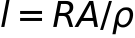 . With
 mm
 m,
 m².

If diameter is doubled, area becomes 4 times, so resistance becomes  — it decreases to one-fourth (a decrease of 7.5 Ω).
Q7. The values of current I flowing in a given resistor for the corresponding values of potential difference V across the resistor are given below – I (amperes): 0.5, 1.0, 2.0, 3.0, 4.0; V (volts): 1.6, 3.4, 6.7, 10.2, 13.2. Plot a graph between V and I and calculate the resistance of that resistor.
Ans: Plotting V against I gives a straight line through the origin; its slope gives the resistance.

(The ratio V/I is constant ≈ 3.3 Ω for all readings.)
Q8. When a 12 V battery is connected across an unknown resistor, there is a current of 2.5 mA in the circuit. Find the value of the resistance of the resistor.
Ans:

Q9. A battery of 9 V is connected in series with resistors of 0.2 Ω, 0.3 Ω, 0.4 Ω, 0.5 Ω and 12 Ω, respectively. How much current would flow through the 12 Ω resistor?
Ans: Total series resistance:


Since the 12 Ω resistor is in series, the same current, about 0.67 A, flows through it.
Q10. How many 176 Ω resistors (in parallel) are required to carry 5 A on a 220 V line?
Ans: For  equal resistors
 in parallel, equivalent resistance is
 . Required:

So 4 resistors of 176 Ω in parallel are needed.
Page: 193–194 – Exercise (Q11–Q15)
Q11. Show how you would connect three resistors, each of resistance 6 Ω, so that the combination has a resistance of (i) 9 Ω, (ii) 4 Ω.
Ans: (i) 9 Ω: connect two 6 Ω resistors in parallel (giving 3 Ω) in series with the third 6 Ω resistor:  .
(ii) 4 Ω: connect two 6 Ω resistors in series (12 Ω) in parallel with the third 6 Ω resistor:

Q12. Several electric bulbs designed to be used on a 220 V electric supply line, are rated 10 W. How many lamps can be connected in parallel with each other across the two wires of 220 V line if the maximum allowable current is 5 A?
Ans: Current per lamp:  A. Number of lamps:

So 110 lamps can be connected in parallel.
Q13. A hot plate of an electric oven connected to a 220 V line has two resistance coils A and B, each of 24 Ω resistance, which may be used separately, in series, or in parallel. What are the currents in the three cases?
Ans:
- Separately:
 A
- In series:
 , A
- In parallel:
 ,
 A
 A
 ,
 A
 ,
 A
Q14. Compare the power used in the 2 Ω resistor in each of the following circuits: (i) a 6 V battery in series with 1 Ω and 2 Ω resistors, and (ii) a 4 V battery in parallel with 12 Ω and 2 Ω resistors.
Ans:
(i) Series: total  ,
 A. Power in 2 Ω resistor:

(ii) Parallel: 2 Ω resistor gets full 4 V:

So the power used in the 2 Ω resistor is 8 W in both cases.
Q15. Two lamps, one rated 100 W at 220 V, and the other 60 W at 220 V, are connected in parallel to electric mains supply. What current is drawn from the line if the supply voltage is 220 V?
Ans: Current drawn by each lamp:  A,
 A. In parallel, total current:

Page: 194 – Exercise (Q16–Q18)
Q16. Which uses more energy, a 250 W TV set in 1 hr, or a 1200 W toaster in 10 minutes?
Ans: Energy used by TV =  Wh = 0.25 kWh. Energy used by toaster =
 Wh = 0.2 kWh. Hence, the TV set uses more energy (0.25 kWh > 0.2 kWh).
Q17. An electric heater of resistance 44 Ω draws 5 A from the service mains for 2 hours. Calculate the rate at which heat is developed in the heater.
Ans: Rate of heat developed is the power:

Q18. Explain the following. (a) Why is the tungsten used almost exclusively for filament of electric lamps? (b) Why are the conductors of electric heating devices, such as bread-toasters and electric irons, made of an alloy rather than a pure metal? (c) Why is the series arrangement not used for domestic circuits? (d) How does the resistance of a wire vary with its area of cross-section? (e) Why are copper and aluminium wires usually employed for electricity transmission?
Ans:
(a) Tungsten has a very high melting point (3380°C), so it does not melt at the high temperature needed for the filament to emit light; it is strong and retains the heat generated.
(b) The resistivity of an alloy is higher than that of its constituent metals, and alloys do not oxidise (burn) readily at high temperatures. Hence they are used in heating devices.
(c) In a series arrangement, if one component fails or is switched off, the entire circuit breaks and all appliances stop working. Also, each appliance does not get the required voltage. Hence series arrangement is not used in domestic circuits.
(d) Resistance of a wire is inversely proportional to its area of cross-section:  . So a thicker wire has less resistance.
(e) Copper and aluminium have very low resistivity, so they are good conductors and cause minimal loss of energy as heat during transmission.