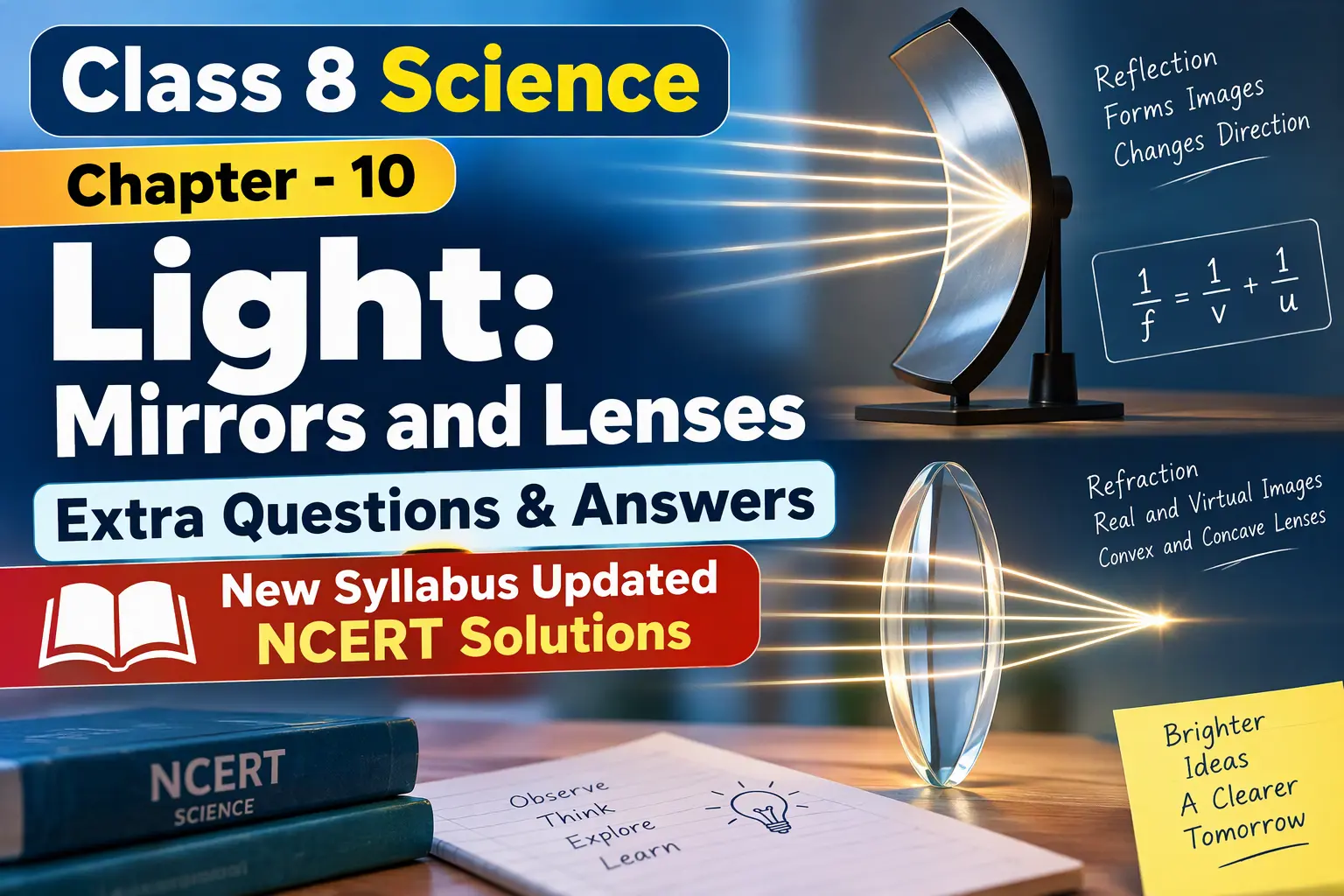
Q1. What is a spherical mirror?
Answer: A mirror whose reflecting surface is curved inward or outward, forming part of an imaginary hollow sphere, is called a spherical mirror. It is made by grinding and polishing a flat glass piece into a curved surface, not by slicing a glass sphere.
Q2. How is a concave mirror different from a convex mirror?
Answer: A concave mirror has its reflecting surface curved inwards, while a convex mirror has its reflecting surface curved outwards. In schematic diagrams, the non-reflecting surface is shown shaded.
Q3. If a reflective coating is applied on the outer curved surface of a glass piece, which mirror is formed?
Answer: A concave mirror. If the coating is applied on the inner curved surface, a convex mirror is formed.
Q4. How can you identify a concave and a convex mirror by looking at their images?
Answer: A concave mirror can form enlarged, diminished, same-size, erect, or inverted images depending on the object’s distance. A convex mirror always forms an erect, diminished image. A plane mirror always forms a same-size, erect image.
Q5. Why are side-view mirrors of vehicles made of convex mirrors?
Answer: Convex mirrors always form erect, diminished images of the traffic behind, and they provide a significantly larger (wider) view area than plane mirrors. This is also why the warning “Objects in mirrors are closer than they appear” is written — the diminished image makes vehicles look farther away than they actually are.
Q6. Why does a dentist use a concave mirror?
Answer: A concave mirror provides an enlarged view of the teeth when held close inside the mouth, helping the dentist inspect teeth clearly.
Q7. Where are concave mirrors used in daily life?
Answer: In the reflectors of torches, headlights of cars and scooters, dental mirrors, and as the main mirror in most modern reflecting telescopes.
Q8. State the two laws of reflection.
Answer: 1. The angle of incidence is equal to the angle of reflection.
2. The incident ray, the normal to the mirror at the point of incidence, and the reflected ray all lie in the same plane.
Q9. Define the incident ray, reflected ray, and normal.
Answer: Incident ray — the ray of light that falls on the mirror. Reflected ray — the ray of light that comes back from the mirror. Normal — the line drawn perpendicular (at 90∘) to the mirror surface at the point of incidence.
Q10. What happens when light falls along the normal on a mirror?
Answer: Both the angle of incidence and the angle of reflection are 0∘ , and the light retraces its path back along the normal.
Q11. Do the laws of reflection apply to spherical mirrors?
Answer: Yes, the laws of reflection are valid for all kinds of mirrors — plane, concave, and convex.
Q12. What happens when multiple parallel beams of light fall on a concave mirror and a convex mirror?
Answer: A concave mirror converges the parallel beams (brings them together at a point), while a convex mirror diverges them (spreads them apart).
Q13. Why can a concave mirror burn a piece of paper in sunlight?
Answer: Sunlight reflected from the concave mirror gets concentrated at one point, producing enough heat at that spot to ignite the paper. Safety: never look at the Sun or its reflection; focus light only on paper, never on anyone’s face or eyes.
Q14. What are solar concentrators?
Answer: Devices that concentrate sunlight into a small area using mirrors and lenses. Solar cookers use this principle to generate heat for cooking, saving electricity and reducing fossil fuel use in Indian villages.
Q15. How can a simple water drop act as a lens?
Answer: A drop of water placed on an oiled glass strip has a curved (bulging outward) surface. Looking through it at the text below makes the letters appear enlarged — the curved water drop acts like a simple convex lens.
Q16. Why is a convex lens called a converging lens and a concave lens a diverging lens?
Answer: A convex lens converges (brings together) parallel light beams passing through it, while a concave lens diverges (spreads out) them. A thin glass plate, by contrast, lets the beam pass through unchanged.
Q17. Can a convex lens burn paper like a concave mirror?
Answer: Yes. A convex lens converges sunlight to a point, and the concentrated heat can ignite a paper kept at that spot.
Q18. Where are lenses used around us?
Answer: In eyeglasses, cameras, telescopes, and microscopes. Even our eye contains a convex lens that can change its shape, allowing us to read a book or see distant objects clearly.
Q19. How did Indian astronomers use reflection over 800 years ago?
Answer: During the time of the mathematician Bhāskara II, astronomers used shallow bowls of water and observed reflected images of stars and planets through tubes placed at appropriate angles to measure their positions in the sky — showing practical understanding of reflection even though the laws were not written down.
Q20. A pencil is placed behind a transparent glass tumbler, which is then filled halfway with water. How does the pencil appear and why?
Answer: When viewed through the water, the pencil appears changed in shape (bent/displaced). This happens because the water and the curved glass act like a lens, altering the way light from the pencil reaches our eyes.