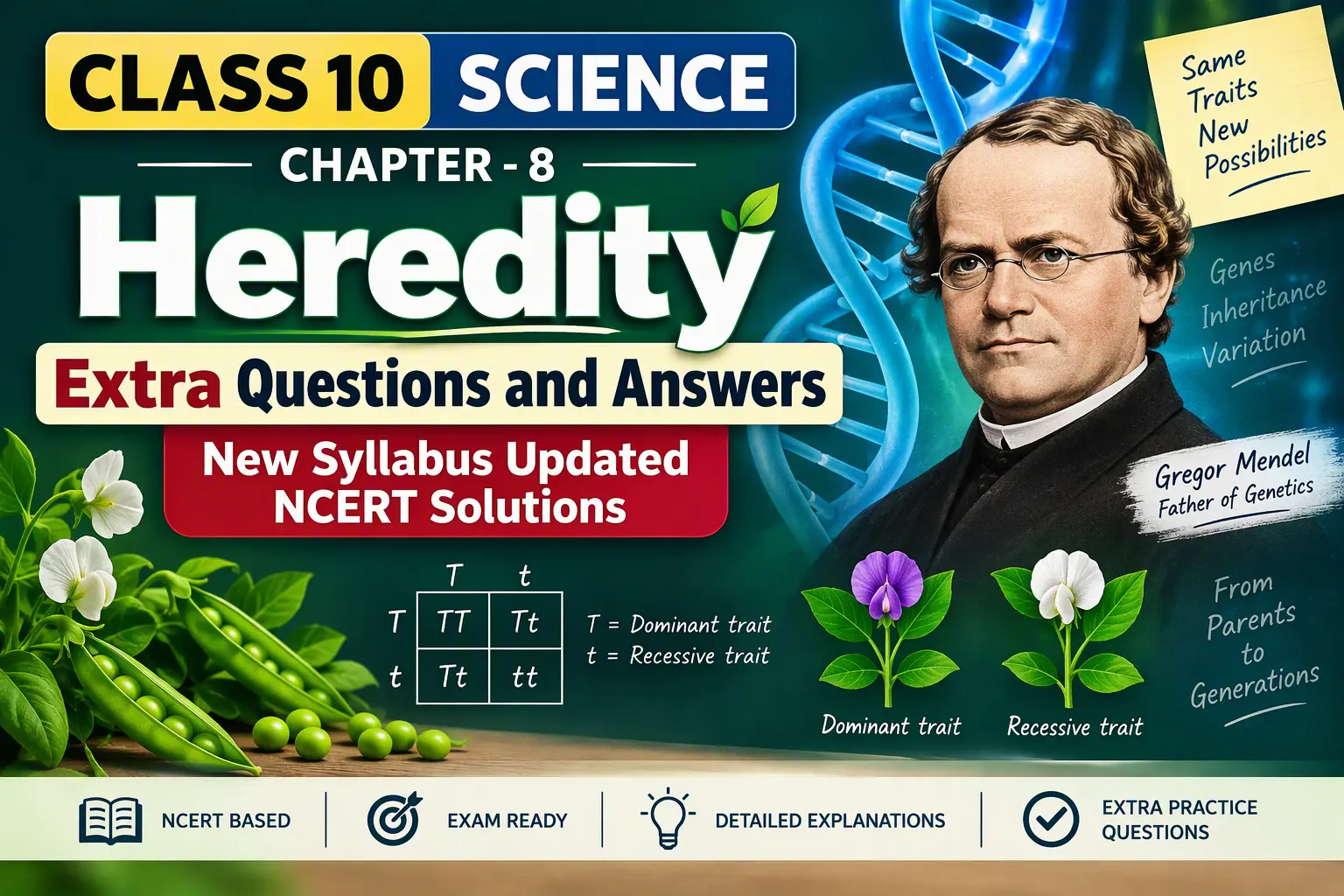
Class 10 Science Chapter – 8 Heredity Extra Questions and Answers
Question 1. What is heredity?
Answer: Heredity is the process by which traits and characteristics are reliably passed from parents to their offspring during reproduction. The rules of heredity decide how traits are inherited.
Question 2. Name the scientist who worked out the main rules of inheritance.
Answer: Gregor Johann Mendel (1822–1884) worked out the main rules of inheritance through his experiments on garden pea plants.
Question 3. Which plant did Mendel use for his experiments on inheritance?
Answer: Mendel used garden pea plants with contrasting visible characters such as round/wrinkled seeds, tall/short plants, and white/violet flowers.
Question 4. What is a gene?
Answer: A gene is a section of DNA that provides information for one protein in the cell. Genes control the characteristics or traits of an organism.
Question 5. What are chromosomes?
Answer: Chromosomes are separate, independent pieces of DNA in which each gene set is present. Every cell has two copies of each chromosome, one from the male parent and one from the female parent.
Question 6. Why do sexually reproducing organisms show more variation than asexually reproducing ones?
Answer: In asexual reproduction, only minor differences arise due to small inaccuracies in DNA copying, so the individuals produced are very similar. In sexual reproduction, greater diversity is generated because genetic material from two different parents combines, maximising the number of successful variations.
Question 7. If a trait A exists in 10% of an asexually reproducing population and trait B exists in 60%, which trait arose earlier?
Answer: Trait B is likely to have arisen earlier. In an asexually reproducing species, traits spread through generations starting from a single individual, so a trait found in a larger percentage of the population has had more time to accumulate and is therefore older.
Question 8. How does the creation of variations in a species promote survival?
Answer: Different variations give different individuals different kinds of advantages. For example, bacteria that can withstand heat will survive better in a heat wave. The selection of variants by environmental factors forms the basis for evolutionary processes and helps a species survive changing conditions.
Question 9. What did Mendel observe in the F1 generation when he crossed tall and short pea plants?
Answer: Mendel observed that there were no halfway characteristics in the F1 progeny – no “medium-height” plants appeared. All the F1 plants were tall, showing that only one of the parental traits was expressed, not a mixture of the two.
Question 10. What did Mendel conclude from the F2 generation of his tall–short pea plant cross?
Answer: When the F1 tall plants self-pollinated, one quarter of the F2 progeny were short. This showed that both the tallness and shortness traits were inherited by the F1 plants, but only tallness was expressed. Mendel therefore proposed that two copies of factors (now called genes) control traits in sexually reproducing organisms.
Question 11. Define dominant and recessive traits.
Answer: A dominant trait is one that gets expressed even when only a single copy of the gene is present – for example, ‘T’ for tallness. A recessive trait is expressed only when both copies of the gene are of that type – for example, ‘t’, where both copies must be ‘t’ (tt) for the plant to be short.
Question 12. What does the 9:3:3:1 ratio in Mendel’s dihybrid cross show? Answer: In the cross involving round/wrinkled seeds and yellow/green seed colour, the F2 generation showed 315 round-yellow, 108 round-green, 101 wrinkled-yellow, and 32 wrinkled-green seeds out of 556 seeds, giving a ratio of 9:3:3:1. This shows that the two traits, seed shape and seed colour, are inherited independently of each other, producing new combinations in the F2 offspring.
Question13. Why must each germ cell have only one gene set?
Answer: If progeny inherited a single whole gene set from each parent as a linked unit, the two characteristics ‘R’ and ‘y’ would be linked to each other and could not be independently inherited. For Mendel’s results to work, each germ cell must take only one chromosome from each pair, which may be of either maternal or paternal origin.
Question 14. How is the normal number of chromosomes restored in the progeny?
Answer: Each germ cell carries only one set of chromosomes. When two germ cells combine during fertilisation, the normal number of chromosomes is restored in the progeny. This ensures the stability of the DNA of the species.
Question 15. Explain how genes control a characteristic such as plant height. Answer: Plant height depends on the amount of a plant hormone that triggers growth, which in turn depends on the efficiency of an enzyme involved in making it. If the gene for that enzyme works efficiently, a lot of hormones are made and the plant is tall. If the gene has an alteration making the enzyme less efficient, less hormone is made and the plant is short. Thus, genes control characteristics or traits.
Question 16. Describe Mendel’s monohybrid cross and the conclusions drawn from it.
Answer: Mendel crossed a tall pea plant with a short pea plant. The F1 progeny were all tall, with no medium-height plants, showing that only one parental trait was expressed. He then allowed the F1 tall plants to self-pollinate. In the F2 generation, one quarter of the progeny were short. This proved that both traits were inherited in the F1 plants but only tallness was expressed. Mendel proposed that two copies of a factor (gene) exist in each sexually reproducing organism; these may be identical or different. The combination TT and Tt gives tall plants while tt gives short plants, so ‘T’ is dominant and ‘t’ is recessive.
Question 17. Explain how independent inheritance of two traits was demonstrated by Mendel.
Answer: Mendel crossed a tall plant with round seeds with a short plant having wrinkled seeds. The F1 progeny were all tall with round seeds, showing tallness and round seeds are dominant traits. When these F1 plants self-pollinated, the F2 progeny included tall–round and short–wrinkled plants as expected, but also new combinations – tall plants with wrinkled seeds and short plants with round seeds. This happened because the factors controlling seed shape and seed colour recombine to form zygotes, proving that the tall/short trait and the round/wrinkled seed trait are inherited independently.
Question 18. How does the inheritance of sex chromosomes determine the sex of a child in human beings?
Answer: Human beings have 22 pairs of matching chromosomes plus one pair of sex chromosomes. Women have a perfect pair, both called X (XX), while men have a mismatched pair – one normal-sized X and one short Y (XY). All children inherit an X chromosome from their mother. Half of the children inherit an X chromosome from their father and become girls, while the other half inherit a Y chromosome from the father and become boys. Thus, the sex of the child is determined by what is inherited from the father.
Question 19. A man with blood group A marries a woman with blood group O and their daughter has blood group O. Is this information enough to tell which trait – A or O – is dominant? Why or why not?
Answer: No, this information alone is not enough. The daughter has blood group O, which means she received an O allele from each parent, so the father with blood group A must also carry an O allele (he is heterozygous). However, without knowing whether group A children are also produced and in what proportions, we cannot conclude whether A is dominant over O or O is dominant over A. More offspring data is required to decide dominance.
Question 20. A Mendelian experiment bred tall pea plants bearing violet flowers with short pea plants bearing white flowers. The progeny all bore violet flowers, but almost half were short. What was the genetic make-up of the tall parent?
Answer: The correct answer is (c) TtWW. Since almost half the progeny are short, the tall parent must carry a recessive ‘t’ allele, so it is Tt for height. Since all progeny bear violet flowers (violet is dominant) and none are white, the tall parent must be homozygous WW for flower colour. Hence the tall parent’s make-up is TtWW.