Class 10 English | First Flight | Chapter 9
Page 135 — Thinking about the Play
Q1. What does Chubukov at first suspect that Lomov has come for? Is he sincere when he later says ‘And I’ve always loved you, my angel, as if you were my own son’? Find reasons for your answer from the play
Answer: Chubukov at first suspects that Lomov has come to borrow money — his aside says, “He’s come to borrow money. Shan’t give him any!” No, he is not sincere. His affection is pretence; the moment Lomov asks for Natalya’s hand he becomes overjoyed and tearful, but later he abuses Lomov, calling him “villain,” “scarecrow,” “stuffed sausage,” and drives him out of the house over petty quarrels.
Q2. Chubukov says of Natalya: ‘… as if she won’t consent! She’s in love; egad, she’s like a lovesick cat…’ Would you agree? Find reasons for your answer.
Answer: No, one cannot fully agree. Natalya does not behave like a lovesick cat pining for Lomov; she doesn’t even know he has come to propose. She quarrels with him fiercely over Oxen Meadows and the dogs, abuses him, and drives him away. Her “willingness” comes only after her father reveals the proposal, and even then the couple keeps arguing — showing the marriage is based more on convenience and the desire to get married than on love.
Q3. Find all the words and expressions in the play that the characters use to speak about each other, and the accusations and insults they hurl at each other. (For example, Lomov in the end calls
Chubukov an intriguer; but earlier, Chubukov has himself called
Lomov a “malicious, doublefaced intriguer.” Again, Lomov begins by
describing Natalya as “an excellent housekeeper, not bad-looking,
well-educated.”)
Answer: Words and expressions the characters use about each other:
About Lomov:
- “grabber” (Chubukov)
- “pettifogger” (Chubukov)
- “malicious, double-faced intriguer” (Chubukov)
- “stuffed sausage”, “wizen-faced frump” (Chubukov)
- “Boy! Pup! Fool! Milksop!” (Chubukov)
- “Old rat! Jesuit!” — Lomov’s words for Chubukov
- “blind hen”, “turnip-ghost” (Chubukov about Lomov)
- “under the slipper of your house-keeper” (Chubukov)
About Natalya:
- “an excellent housekeeper, not bad-looking, well-educated” (Lomov’s initial praise)
- “backbiter” — Natalya is accused of this
- “intriguer” (Lomov calls her this in the end)
About Chubukov:
- “intriguer” (Lomov)
- “grabber” (Lomov)
Accusations hurled at each other’s families:
- Lomov’s grandfather was a drunkard; his aunt ran away with an architect (Chubukov/Natalya)
- Chubukov’s grandfather was tried for embezzlement (Lomov)
- Lomov’s father was a “guzzling gambler”; his mother was “hump-backed” (Chubukov)
- Chubukov’s late wife used to beat him (Lomov)
- The Lomovs have “lunacy” in the family (Chubukov)
- Chubukov bribed before the last elections (Lomov’s insinuation)
(ii) Then think of five adjectives or adjectival expressions of your own to
describe each character in the play.
Answer: Lomov: hypochondriac, argumentative, proud, excitable, money-minded
Natalya: possessive, quick-tempered, stubborn, sharp-tongued, impulsive
Chubukov: diplomatic, hot-headed, insincere, quarrelsome, opportunistic
(iii) Can you now imagine what these characters will quarrel about next?
Answer: Given their nature, they will almost certainly quarrel again — most likely over hunting dogs (Guess vs. Squeezer — which is the superior breed), which is the very dispute that reignited their fight in the play. They may also bicker over the wedding arrangements, household matters, or old family grievances, since even their “kiss and make up” moment is followed by Chubukov’s exasperated “to the devil with you!” — showing the peace is shallow and temporary.
Page 135 — Thinking about Language
QI. 1. This play has been translated into English from the Russian original.
Are there any expressions or ways of speaking that strike you as more
Russian than English? For example, would an adult man be addressed
by an older man as my darling or my treasure in an English play?
Read through the play carefully, and find expressions that you think
are not used in contemporary English, and contrast these with
idiomatic modern English expressions that also occur in the play.
Answer: Expressions that sound more Russian than English:
- “My darling,” “my treasure,” “my angel,” “my precious,” “my beauty” — Chubukov, an older man, addresses the adult male Lomov this way. In contemporary English, such endearments between two male neighbours would sound odd.
- “Honoured Stepan Stepanovitch” — addressing someone as “honoured” plus full name and patronymic is a Russian custom.
- “How may you be getting on?” and “We just get along somehow, thanks to your prayers” — formal, old-fashioned phrasing not typical of modern English conversation.
- “And I’ve always loved you, my angel, as if you were my own son” — overly effusive for English usage between neighbours.
Idiomatic modern English expressions that do occur:
- “Why are you so formal in your get-up?”
- “My foot’s gone to sleep.”
- “You may take it that…”
- “He seems to be coming round.”
- “Don’t shout!” / “Shut up!” — natural spoken English of argument.
Q2. Look up the following words in a dictionary and find out how to pronounce them. Pay attention to how many syllables there are in each word, and find out which syllable is stressed, or said more forcefully.
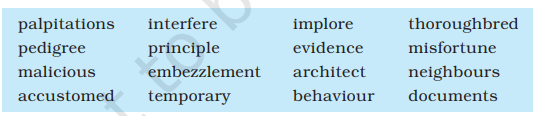
Answer:
| Word | Syllables | Stress |
|---|---|---|
| palpitations | pal-pi-ta-tions | 3rd |
| interfere | in-ter-fere | 3rd |
| implore | im-plore | 2nd |
| thoroughbred | thor-ough-bred | 1st |
| pedigree | ped-i-gree | 1st |
| principle | prin-ci-ple | 1st |
| evidence | ev-i-dence | 1st |
| misfortune | mis-for-tune | 2nd |
| malicious | ma-li-cious | 2nd |
| embezzlement | em-bez-zle-ment | 2nd |
| architect | ar-chi-tect | 1st |
| neighbours | neigh-bours | 1st |
| accustomed | a-cus-tomed | 2nd |
| temporary | tem-po-ra-ry | 1st |
| behaviour | be-ha-viour | 2nd |
| documents | doc-u-ments | 1st |
Q3. Look up the following phrases in a dictionary to find out their meaning,
and then use each in a sentence of your own.
Answer:
(i) You may take it that — meaning: you may assume / rest assured that.
- Sentence: You may take it that the train will arrive on time; it has never been late this month.
(ii) He seems to be coming round — meaning: he is gradually changing his opinion / recovering consciousness.
- Sentence: At first Ravi refused to join the trip, but he seems to be coming round now.
(iii) My foot’s gone to sleep — meaning: my foot has become numb with a tingling feeling (pins and needles).
- Sentence: I couldn’t stand up because my foot had gone to sleep after sitting cross-legged for an hour.
Page no: 136 II. Reported Speech
You must have noticed that when we report someone’s exact words, we
have to make some changes in the sentence structure. In the following
sentences fill in the blanks to list the changes that have occurred in
the above pairs of sentences. One has been done for you.
Anwer:
1. To report a question, we use the reporting verb asked (as in Sentence Set 1). (done for you)
2. To report a statement, we use the reporting verb said (or declared, as in Sentence Set 5).
3. The adverb of place here changes to there.
4. When the verb in direct speech is in the present tense, the verb in reported speech is in the past tense (as in Sentence Set 3 — haven’t been becomes hadn’t been).
5. If the verb in direct speech is in the present continuous tense, the verb in reported speech changes to past continuous tense. For example, (I’m) getting changes to was getting.
6. When the sentence in direct speech contains a word denoting respect, we add the adverb respectfully in the reporting clause (as in Sentence Set 1 — “Honoured Stepan Stepanovitch” becomes “asked… respectfully”).
7. The pronouns I, me, our and mine, which are used in the first person in direct speech, change according to the subject or object of the reporting verb such as he/she, him/her, their or his/hers in reported speech.
QIII. Here is an excerpt from an article from the Times of India dated 27 August 2006. Rewrite it, changing the sentences in direct speech into reported speech. Leave the other sentences unchanged.
Answer: Here is the excerpt rewritten with all sentences of direct speech changed into reported (indirect) speech. The non-speech sentences are left unchanged.
Why do you want to know my age? If people know I am so old, I won’t get work!” laughs 90-year-old A. K. Hangal, one of Hindi cinema’s most famous character actors. For his age, he is rather energetic. “What’s the secret?” we ask. “My intake of everything is in small quantities. And I walk a lot,” he replies. “I joined the industry when people retire. I was in my 40s. So I don’t miss being called a star. I am still respected and given work, when actors of my age are living in poverty and without work. I don’t have any complaints,” he says, adding, “but yes, I have always been underpaid.” Recipient of the Padma Bhushan, Hangal never hankered after money or materialistic gains. “No doubt I am content today, but money is important. I was a fool not to understand the value of money earlier,” he regrets.
A. K. Hangal, one of Hindi cinema’s most famous character actors, laughed and asked (them) why they wanted to know his age. He added that if people knew he was so old, he would not get work. The 90-year-old actor was, for his age, rather energetic.
When we asked him what the secret was, he replied that his intake of everything was in small quantities and that he walked a lot.
He further said that he had joined the industry when people retire (retired) and that he had been in his 40s. He said so he did not miss being called a star. He added that he was still respected and given work, when actors of his age were living in poverty and without work, and that he did not have any complaints. He went on to say that he had always been underpaid.
Recipient of the Padma Bhushan, Hangal never hankered after money or materialistic gains. He regretted that though he was content today, money was important, and said that he had been a fool not to understand the value of money earlier.
Key Rules Applied (as per the chapter’s grammar box)
Questions → reporting verb asked; question word retained; statement word order used (why they wanted to know his age).
Statements → reporting verbs like said, replied, added, regretted.
Present tense → past tense (know → knew; am → was; don’t have → did not have).
Present perfect → past perfect (have always been → had always been).
Simple past → past perfect (joined → had joined; was → had been).
Pronoun changes: I → he, my → his, we → they (according to the subject/object of the reporting verb).
Universal truths or statements still valid (e.g., “when people retire”) may remain unchanged.
Page – 137 Speaking and Writing
Q1. Anger Management: As adults, one important thing to learn is how to manage our temper. Some of us tend to get angry quickly, while others remain calm. Can you think of three ill effects that result from anger? Note them down. Suggest ways to avoid losing your temper in such situations. Are there any benefits from anger?
Answer: Three Ill Effects of Anger:-
1. Poor decisions – An angry person cannot think clearly and often says or does things that are later regretted, just as Chubukov cries, “We’ve done for her!” after driving Lomov out.
2. Damage to health – Frequent anger causes stress, high blood pressure, headaches and palpitations. (Interestingly, Lomov in this very play keeps complaining of a “twitch in my right eyebrow” and heart palpitations — a comic picture of what constant agitation does to a person!)
3. Broken relationships – Angry words spoken in the heat of the moment hurt loved ones. In the play, Chubukov, Natalya and Lomov quarrel over trivial matters like Oxen Meadows and the dogs, and end up abusing each other.
Ways to Avoid Losing One’s Temper:-
- Count to ten or take deep breaths before responding — this gives the mind time to cool down.
- Walk away from the situation temporarily; physical distance helps emotions settle.
- Practise listening patiently and try to see the other person’s point of view instead of jumping to conclusions.
- Use calm, polite language — replacing shouting with a quiet, firm tone often defuses an argument.
Are There Any Benefits from Anger?
Yes, in a limited way. Anger expressed rightly can:
- Show others that a boundary has been crossed, so it can protect us from injustice or unfair treatment.
- Give us the energy and motivation to correct a wrong — many social reformers were moved to action by righteous anger at injustice.
However, anger is beneficial only when it is controlled and constructive; uncontrolled anger, as the play shows hilariously, only creates chaos.
Q2. In pairs, prepare a script based on the given excerpt from The Home and the World by Rabindranath Tagore. You may write five exchanges between the characters with other directions such as movements on stage and way of speaking, etc.
Answer: Characters: Nikhil (the husband) and Bimala (the Chota Rani) Setting: An inner room of the house. Bimala is dressed up, toying with her bangles, nervous. Nikhil enters.
BIMALA: (flushing a little, fingers playing with her bangles, then abruptly) Look here! Is it right that ours should be the only market in all Bengal which allows foreign goods?
NIKHIL: (calmly, setting down his papers) What, then, would be the right thing to do?
BIMALA: (stepping forward, voice firm) Order them to be cleared out!
NIKHIL: (shaking his head slowly) But the goods are not mine.
BIMALA: (impatiently, hands on hips) Is not the market yours?
NIKHIL: (quietly but firmly) It is much more theirs who use it for trade.
BIMALA: (raising her voice) Let them trade in Indian goods, then.
NIKHIL: (sighing) Nothing would please me better. But suppose they do not?
BIMALA: (angrily turning away) Nonsense! How dare they be so insolent? Are you not…
NIKHIL: (picking up his papers, coldly) I am very busy this afternoon and cannot stop to argue it out. But I must refuse to tyrannise.
BIMALA: (pleading, moving towards him) It would not be tyranny for selfish gain, but for the sake of the country.
NIKHIL: (pausing at the door, gravely) To tyrannise for the country is to tyrannise over the country. But that, I am afraid, you will never understand. (Exit.)
Q3. In groups, discuss the qualities one should look for in a marriage partner.
You might consider the following points.
- Personal qualities
– Appearance or looks
– Attitudes and beliefs
– Sense of humour - Value system
– Compassion and kindness
– Tolerance, ambition
– Attitude to money and wealth - Education and professional background
Answer: This is an open-ended discussion question, so there is no single “correct” answer. Below is a model answer you can use for your group discussion, connecting the points to The Proposal.
- Appearance or looks: Looks may attract initially, but they matter less than character over a lifetime. In the play, Lomov describes Natalya as “not bad-looking” — but he is really more interested in her being an excellent housekeeper and the land she would bring.
- Attitudes and beliefs: A partner should have a positive, cooperative attitude. Lomov, Natalya and Chubukov are all quarrelsome and stubborn — they fight over petty issues like Oxen Meadows and the dogs. Such attitudes would make married life miserable.
- Sense of humour: A good sense of humour helps resolve conflicts lightly. None of the three characters has one — they take every small dispute as a matter of life and death, and Lomov even suffers from palpitations over trivial arguments.
- Compassion and kindness: Essential for a lasting relationship. The characters in the play hurl insults like “malicious, double-faced intriguer” at each other — the opposite of kindness.
- Tolerance and ambition: Partners should tolerate each other’s weaknesses and disagree politely. A reasonable level of ambition is good, but greed should not dominate — in the play, the marriage is driven mainly by economic sense (increasing estates), not love.
- Attitude to money and wealth: One should value the person more than property. Chekhov satirises wealthy families who seek marriage ties only to expand their estates — a warning against money-centred marriages.
Education and Professional Background:-
- Similar educational levels and compatible professional backgrounds help partners understand each other better, but they cannot replace mutual respect and affection.
Conclusion: A good marriage partner needs understanding, patience, a sense of humour and shared values — precisely the qualities the characters in The Proposal lack, which is what makes the play a comedy.
Q4. Are there parts of the play that remind you of film scenes from romantic comedies? Discuss this in groups, and recount to the rest of the class episodes similar to those in the play.
Answer: Yes, several moments in the play resemble scenes from romantic comedy films:
The fainting episodes: Lomov repeatedly feels his lip trembles, his foot goes numb, and he “faints” during arguments — much like the exaggerated comic scenes in films.
The quarrel over Oxen Meadows: The couple argues bitterly about a trivial piece of land even while a marriage proposal is pending — similar to “meet-cute” fights in rom-coms where couples argue before falling in love.
The dog argument (Squeezer vs. Guess): The absurd, heated debate over whose dog is superior, right after the proposal is accepted, is classic comic timing.
The on-again, off-again proposal: Chubukov rushes in to announce that Natalya has agreed, the proposal is finally made — and immediately the couple resumes arguing about the dogs. This “happy ending with a twist” is a typical rom-com device.
Page 137 — Speaking — Anger Management (Speaking)
Q1. Anger Management: As adults, one important thing to learn is how to manage our temper. Can you think of three ill effects that result from anger? Suggest ways to avoid losing your temper. Are there any benefits from anger?
Ans:
Page 137 — Writing (Writing)
Q1. In pairs, prepare a script based on the given excerpt from The Home and the World by Rabindranath Tagore. You may write five exchanges between the characters with directions such as movements on stage and way of speaking.
Ans:
Page 138 — Speaking — Discussion (Speaking)
Q1. In groups, discuss the qualities one should look for in a marriage partner: personal qualities, value system, education and professional background.
Ans: