Q U E S T I O N S ( 6.1 ANIMALS – NERVOUS SYSTEM ) page no: 105
Question: 1. What is the difference between a reflex action and walking?
Answer: Difference between Reflex Action and Walking:
- Reflex Action: This is an involuntary and immediate response to a stimulus, which occurs without conscious thought. For example, when you touch a hot object, your hand automatically pulls back without you having to think about it.
- Walking: This is a voluntary action that requires conscious thought and coordination. You decide to walk, and your brain sends signals to the muscles to perform the action. Walking involves planning and control over movements, unlike reflex actions which are automatic.
Question: 2. What happens at the synapse between two neurons?
Answer: At the synapse, the electrical impulse traveling along the axon of one neuron triggers the release of neurotransmitters (chemical signals) from the end of the axon. These neurotransmitters cross the synaptic gap and bind to receptors on the dendrites of the next neuron, generating a new electrical impulse in that neuron. This process allows for the transmission of signals between neurons.
Question: 3. Which part of the brain maintains posture and equilibrium of the body?
Answer: The cerebellum, located in the hind-brain, is responsible for maintaining posture and equilibrium. It coordinates voluntary movements and helps in balance, ensuring that actions such as walking or riding a bicycle are smooth and controlled.
Question: 4. How do we detect the smell of an agarbatti (incense stick)?
Answer: The detection of smell occurs through olfactory receptors located in the nasal cavity. When the scent molecules from the agarbatti enter the nose, they bind to these receptors, which send signals to the brain, allowing us to perceive the smell.
Question: 5. What is the role of the brain in reflex action?
Answer: While reflex actions are primarily processed in the spinal cord for quick responses, the brain also plays a role by receiving information about the reflex action. This allows the brain to be aware of the event and can later process the experience. However, the actual reflex action occurs before the brain can consciously respond, making it a rapid protective mechanism.
Q U E S T I O N S (6.2 COORDINATION IN PLANTS) page no: 108
Question: 1. What are Plant Hormones?
Answer: Plant hormones, also known as phytohormones, are chemical substances produced in one part of a plant that regulate growth, development, and responses to environmental stimuli. They are synthesized in specific areas and then transported to other parts of the plant where they exert their effects. Examples include auxins, gibberellins, and cytokinins.
Question: 2. How is the Movement of Leaves of the Sensitive Plant Different from the Movement of a Shoot Towards Light?
Answer: The movement of leaves in the sensitive plant (Mimosa pudica) is a rapid response to touch, which is not associated with growth. This movement occurs quickly due to changes in cell turgor pressure. In contrast, the movement of a shoot towards light (phototropism) is a slower, growth-related response where the plant grows towards the light source. This involves elongation of cells on the side of the shoot that is away from the light, allowing the shoot to bend towards the light.
Question: 3. Give an Example of a Plant Hormone that Promotes Growth.
Answer: Auxin is a well-known plant hormone that promotes growth. It is primarily responsible for cell elongation and is involved in various growth processes, including phototropism and gravitropism.
Question: 4. How Do Auxins Promote the Growth of a Tendril Around a Support?
Answer: Auxins promote the growth of tendrils by causing differential growth. When a tendril comes into contact with a support, auxins accumulate on the side of the tendril that is away from the support. This differential distribution of auxins causes the cells on that side to elongate more than those on the side in contact with the support, resulting in the tendril curling around the support.
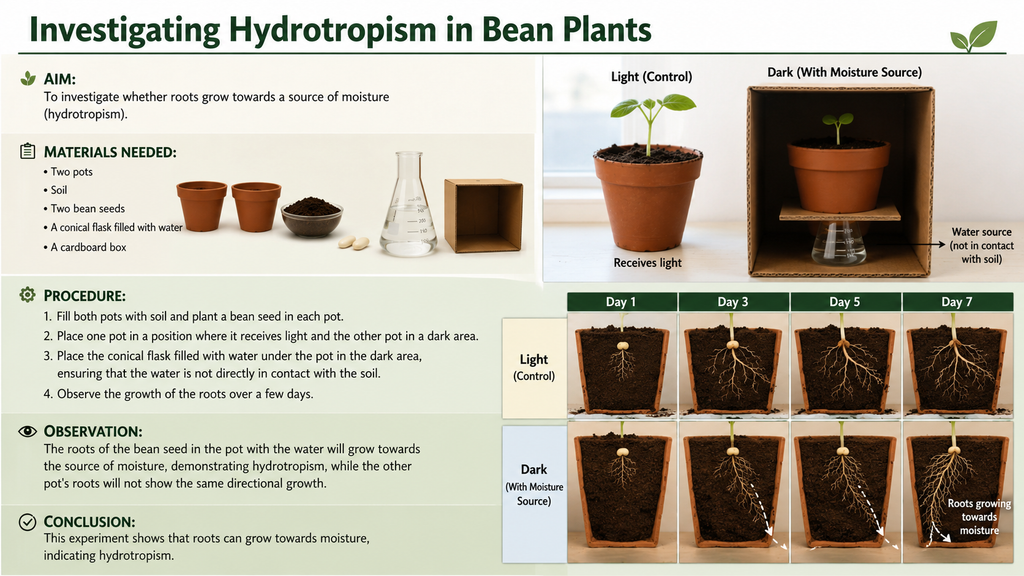
Question: 5. Design an Experiment to Demonstrate Hydrotropism.
Answer: Experiment to Demonstrate Hydrotropism:
– Materials Needed: Two pots, soil, two bean seeds, a conical flask filled with water, and a cardboard box.
– Procedure:
1. Fill both pots with soil and plant a bean seed in each pot.
2. Place one pot in a position where it receives light and the other pot in a dark area.
3. Place the conical flask filled with water under the pot in the dark area, ensuring that the water is not directly in contact with the soil.
4. Observe the growth of the roots over a few days.
– Observation: The roots of the bean seed in the pot with the water will grow towards the source of moisture, demonstrating hydrotropism, while the other pot’s roots will not show the same directional growth.
– Conclusion: This experiment shows that roots can grow towards moisture, indicating hydrotropism.
Q U E S T I O N S (6.3 HORMONES IN ANIMALS) Page no: 111
Question: 1. How does chemical coordination take place in animals?
Answer: Chemical coordination in animals occurs through the endocrine system, which involves the secretion of hormones by various glands. These hormones are released into the bloodstream and travel to target organs or tissues, where they exert their effects. For example, when the body experiences stress, the adrenal glands release adrenaline, which prepares the body for a “fight or flight” response by increasing heart rate and energy availability. This system allows for widespread and prolonged responses to internal and external stimuli.
Question: 2. Why is the use of iodised salt advisable?
Answer: Iodised salt is recommended because it contains iodine, which is essential for the synthesis of the hormone thyroxin by the thyroid gland. Thyroxin plays a crucial role in regulating metabolism, growth, and development. A deficiency of iodine can lead to conditions such as goitre, characterized by swelling of the thyroid gland, and can also affect cognitive development and overall health. Thus, using iodised salt helps prevent iodine deficiency disorders.
Question: 3. How does our body respond when adrenaline is secreted into the blood?
Answer: When adrenaline is secreted into the bloodstream, the body undergoes several physiological changes to prepare for immediate action. These responses include:
– Increased heart rate: This helps pump more blood to the muscles and organs.
– Increased breathing rate: More oxygen is supplied to the body, enhancing energy production.
– Dilated pupils: This improves vision by allowing more light to enter the eyes.
– Redirected blood flow: Blood is diverted away from non-essential functions (like digestion) to the skeletal muscles, enhancing physical performance.
– Collectively, these changes enable the body to respond quickly and effectively to stressful situations.
Question: 4. Why are some patients of diabetes treated by giving injections of insulin?
Answer: Patients with diabetes, particularly Type 1 diabetes, have insufficient insulin production due to the destruction of insulin-producing cells in the pancreas. Insulin is a hormone that regulates blood sugar levels by facilitating the uptake of glucose into cells for energy. Without adequate insulin, blood sugar levels can become dangerously high, leading to various health complications. Therefore, insulin injections are administered to help manage blood sugar levels, allowing the body to utilize glucose effectively and maintain metabolic balance.
E X E R C I S E S page no : 112
Question: 1. Which of the following is a plant hormone?
(a) Insulin.
(b) Thyroxin.
(c) Oestrogen.
(d) Cytokinin.
Answer: (d) Cytokinin.
Cytokinin is a plant hormone that promotes cell division and is found in greater concentrations in areas of rapid cell division, such as in fruits and seeds. The other options (Insulin, Thyroxin, and Oestrogen) are hormones found in animals.
Question: 2. The gap between two neurons is called a
(a) dendrite.
(b) synapse.
(c) axon.
(d) impulse.
Answer: (b) synapse.
The synapse is the junction between two neurons where the transmission of nerve impulses occurs through chemical signals.
Question: 3. The brain is responsible for
(a) thinking.
(b) regulating the heart beat.
(c) balancing the body.
(d) all of the above.
Answer: (d) all of the above.
The brain is involved in thinking, regulating heartbeat, and maintaining balance, among other functions. It serves as the main coordinating center of the body, processing information and sending out appropriate responses.
Question: 4 What is the function of receptors in our body? Think of situations where receptors do not work properly. What problems are likely to arise?
Answer: Receptors are specialized structures in our body that detect and respond to various stimuli from the environment. They play a crucial role in our sensory perception and help us interact with the world around us. Here are the key functions of receptors:
Detection of Stimuli: Receptors are responsible for detecting changes in the environment, such as light, sound, temperature, taste, and smell.
Signal Transduction: Once a stimulus is detected, receptors convert this information into electrical impulses that are transmitted to the nervous system for processing.
Initiation of Responses: Receptors help initiate appropriate responses to stimuli, allowing us to react quickly to changes in our surroundings (example: pulling back from a hot surface).
Situations Where Receptors Do Not Work Properly
If receptors do not function correctly, it can lead to various problems, including:
Loss of Sensation: If sensory receptors (like those for touch or pain) are damaged, individuals may not feel sensations, which can lead to injuries (example: burns or cuts) because they cannot detect harmful stimuli.
Impaired Vision or Hearing: Dysfunctional receptors in the eyes or ears can result in vision or hearing impairments. For example, if photoreceptors in the retina are damaged, it can lead to blindness or visual disturbances.
Altered Taste or Smell: If gustatory (taste) or olfactory (smell) receptors are not working properly, it can affect appetite and the ability to enjoy food, as well as impair the detection of hazards (like smoke or spoiled food).
Neurological Disorders: Certain conditions, such as diabetes, can affect the functioning of receptors, leading to neuropathy, where individuals experience pain, tingling, or numbness in their extremities.
Conclusion
Receptors are vital for our sensory experiences and overall well-being. Proper functioning of these receptors is essential for detecting environmental changes and responding appropriately. Dysfunction in receptors can lead to significant health issues and impair daily activities.
Answer: Structure of a Neuron and Its Function:
A neuron is the fundamental unit of the nervous system, responsible for transmitting information throughout the body. Below is a description of its structure and functions:
Question: 5. Draw the structure of a neuron and explain its function.
Structure of a Neuron
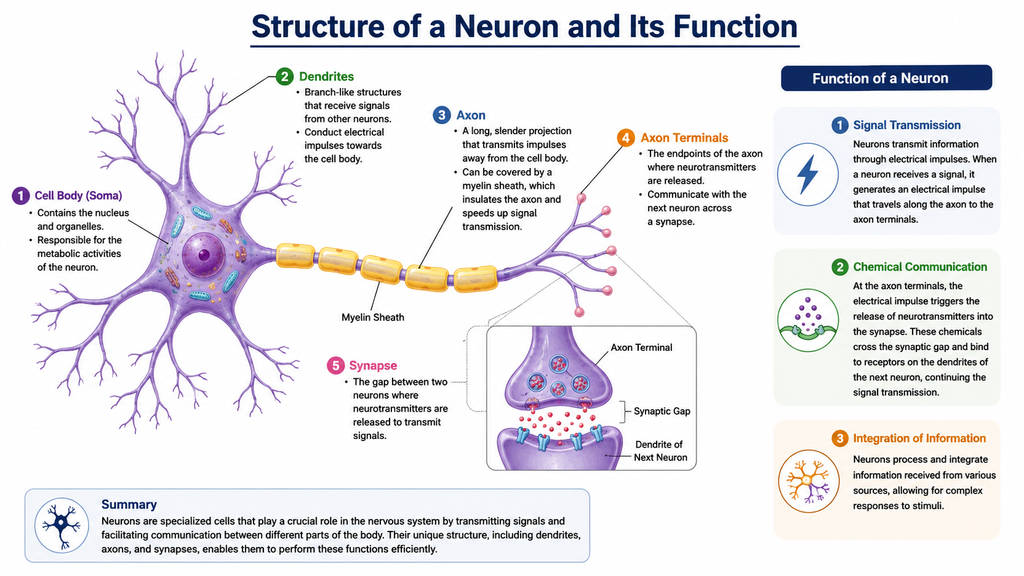
Cell Body (Soma): Contains the nucleus and organelles.
Responsible for the metabolic activities of the neuron.
Dendrites: Branch-like structures that receive signals from other neurons.
Conduct electrical impulses towards the cell body.
Axon: A long, slender projection that transmits impulses away from the cell body.
Can be covered by a myelin sheath, which insulates the axon and speeds up signal transmission.
Axon Terminals: The endpoints of the axon where neurotransmitters are released.
Communicate with the next neuron across a synapse.
Synapse: The gap between two neurons where neurotransmitters are released to transmit signals.
Function of a Neuron
Signal Transmission: Neurons transmit information through electrical impulses. When a neuron receives a signal, it generates an electrical impulse that travels along the axon to the axon terminals.
Chemical Communication: At the axon terminals, the electrical impulse triggers the release of neurotransmitters into the synapse. These chemicals cross the synaptic gap and bind to receptors on the dendrites of the next neuron, continuing the signal transmission.
Integration of Information: Neurons process and integrate information received from various sources, allowing for complex responses to stimuli.
– Summary
Neurons are specialized cells that play a crucial role in the nervous system by transmitting signals and facilitating communication between different parts of the body. Their unique structure, including dendrites, axons, and synapses, enables them to perform these functions efficiently.
Question: 6. How does phototropism occur in plants?
Answer: Phototropism is the growth response of a plant towards light. This phenomenon is crucial for plants as it helps them maximize light absorption for photosynthesis. Here’s how phototropism occurs:
Mechanism of Phototropism
- Light Perception:
- Plants have specialized cells that can detect light. When light is directed towards one side of the plant, it is perceived by these cells.
- Auxin Hormone Production:
- In response to light, the plant produces a hormone called auxin at the shoot tip. Auxin is responsible for regulating growth.
- Uneven Distribution of Auxin:
- The auxin hormone is distributed unevenly in the plant. When light shines on one side, auxin accumulates on the shaded side of the plant.
- Cell Elongation:
- The higher concentration of auxin on the shaded side causes those cells to elongate more than the cells on the light-exposed side. This differential growth results in bending.
- Bending Towards Light:
- As the cells on the shaded side elongate more, the plant bends towards the light source. This movement allows the plant to optimize its exposure to sunlight, which is essential for photosynthesis.
Summary
Phototropism is a vital adaptive mechanism that enables plants to grow towards light. The process involves the perception of light, production of auxin, uneven distribution of this hormone, and subsequent differential growth of plant cells, leading to the bending of the plant towards the light source. This response enhances the plant’s ability to capture light for energy production.
Question: 7. Which signals will get disrupted in case of a spinal cord injury?
Answer: Signals Disrupted by Spinal Cord Injury-
In the event of a spinal cord injury, several critical signals within the body can be disrupted, leading to various physiological and functional impairments. Here’s a detailed explanation:
1. Motor Signals
– Voluntary Movements: The spinal cord acts as a conduit for motor signals from the brain to the muscles. An injury can prevent the brain from sending commands to voluntary muscles, resulting in paralysis or weakness in the affected areas.
– Reflex Actions: Reflex arcs, which are quick responses to stimuli that do not require brain involvement, can also be affected. If the injury interrupts the reflex pathways, reflex actions may be diminished or absent.
2. Sensory Signals
– Sensory Information Transmission: The spinal cord transmits sensory information from the body to the brain. An injury can disrupt the flow of signals related to touch, pain, temperature, and proprioception (awareness of body position), leading to numbness or loss of sensation below the injury site.
3. Autonomic Signals
– Autonomic Functions: The spinal cord is involved in autonomic functions such as heart rate, blood pressure, and digestion. An injury can disrupt these signals, potentially leading to issues like unstable blood pressure, impaired bowel and bladder control, and other autonomic dysregulations.
– Conclusion
Spinal cord injuries can severely impact both voluntary and involuntary functions by disrupting the transmission of motor, sensory, and autonomic signals. The extent of these disruptions depends on the location and severity of the injury. Rehabilitation and therapy are often necessary to help regain as much function as possible.
Question: 8. How does chemical coordination occur in plants?
Answer: Chemical coordination in plants primarily occurs through the action of hormones. These hormones are chemical substances that regulate various physiological processes, including growth, development, and responses to environmental stimuli. Here’s how it works:
1. Hormones: Plants produce hormones such as auxins, gibberellins, cytokinins, and abscisic acid. These hormones are synthesized in one part of the plant and transported to other parts where they exert their effects.
2. Mechanism of Action:
– Auxins: For instance, when a plant experiences light from one side, auxins accumulate on the shaded side, promoting cell elongation on that side. This causes the plant to bend towards the light (phototropism).
– Gibberellins: These hormones promote stem elongation and seed germination.
– Cytokinins: They stimulate cell division and are found in areas of rapid growth.
– Abscisic Acid: This hormone inhibits growth and helps in responses to stress, such as drought.
3. Transport: Unlike animals, plants do not have a nervous system. Instead, hormonal signals diffuse through the plant tissues, allowing for a slower but widespread effect.
Question: 9. What is the need for a system of control and coordination in an organism?
Answer: The need for a system of control and coordination in an organism arises from the following reasons:
1. Response to Stimuli: Organisms must respond to changes in their environment (e.g., light, temperature, and food availability) to survive. Control and coordination systems enable quick and appropriate responses.
2. Homeostasis: Maintaining stable internal conditions (homeostasis) is crucial for the proper functioning of cells and organs. This includes regulating temperature, pH, and nutrient levels.
3. Complex Functions: Multicellular organisms perform complex functions that require coordination among different systems (e.g., nervous and endocrine systems). This coordination ensures that various body parts work together harmoniously.
4. Growth and Development: Control mechanisms are essential for regulating growth and development processes, ensuring that organisms develop properly and adapt to their environments.
Question: 10. How are involuntary actions and reflex actions different from each other?
Answer: Involuntary actions and reflex actions differ in several key aspects:
– Definition:
1. Involuntary Actions: These are automatic actions that occur without conscious thought, such as breathing, digestion, and heartbeats. They are controlled by the autonomic nervous system.
2. Reflex Actions: These are specific, quick responses to stimuli that occur without the involvement of the brain. They are mediated by reflex arcs in the spinal cord.
– Control:
1. Involuntary Actions: Controlled by the autonomic nervous system and do not require immediate sensory input.
2. Reflex Actions: Involve a direct pathway from sensory neurons to motor neurons, allowing for rapid responses.
– Examples:
1. involuntary Actions: Heartbeat, peristalsis in the digestive tract.
2. Reflex Actions: Pulling your hand back from a hot surface, blinking when something approaches your eye.
Question: 11. Compare and contrast nervous and hormonal mechanisms for control and coordination in animals.
Answer: – Nervous Mechanism:
1. Speed: Rapid transmission of signals through electrical impulses.
2. Pathway: Involves neurons and synapses for communication.
3. Duration: Short-lived effects; responses are immediate and often temporary.
– Examples: Reflex actions, muscle contractions, and sensory responses.
– Hormonal Mechanism:
1. Speed: Slower transmission through the bloodstream.
2. Pathway: Involves endocrine glands that secrete hormones into the blood.
3. Duration: Longer-lasting effects; responses can be sustained over time.
– Examples: Growth regulation, metabolism, and stress responses (e.g., adrenaline release).
– Comparison:
1. Both systems are essential for maintaining homeostasis and coordinating bodily functions.
2. The nervous system provides quick responses, while the hormonal system regulates longer-term processes.
Question: 12. What is the difference between the manner in which movement takes place in a sensitive plant and the movement in our legs?
Answer: Movement in a Sensitive Plant (e.g., Mimosa pudica):
- Type of Movement: Rapid movement in response to touch (thigmonasty).
- Mechanism: Involves changes in turgor pressure within plant cells. When touched, certain cells lose water, causing them to shrink and resulting in the folding of leaves.
- Control: No nervous system; relies on chemical signals and changes in water content.
Movement in Our Legs:
- Type of Movement: Voluntary movement controlled by the nervous system.
- Mechanism: Involves the contraction of muscle fibers in response to electrical impulses sent from the brain via motor neurons.
- Control: Requires conscious thought and coordination between the brain and muscles.
In summary, while sensitive plants exhibit quick, non-growth-related movements in response to stimuli, human leg movements are voluntary and involve complex neural control.