Class 8 Science Chapter – 9 The Amazing World of Solutes, Solvents, and Solutions Questions and Answers
Keep the curiosity alive Page no: 149
Question: 1. State whether the statements given below are True [T] or False [F]. Correct the false statement(s).
(i) Oxygen gas is more soluble in hot water rather than in cold water.
Answer: False (F) – Correction: Oxygen gas is more soluble in cold water rather than in hot water.
(ii) A mixture of sand and water is a solution.
Answer: False (F) – Correction: A mixture of sand and water is not a solution; it is a non-uniform mixture
(iii) The amount of space occupied by any object is called its mass.
Answer: False (F) – Correction: The amount of space occupied by any object is called its volume, not its mass.
(iv) An unsaturated solution has more solute dissolved than a saturated solution.
Answer: False (F) – Correction: An unsaturated solution has less solute dissolved than a saturated solution. A saturated solution contains the maximum amount of solute that can be dissolved at a given temperature.
(v) The presence of different gases in the atmosphere is also a uniform mixture.
Answer: True (T) – The presence of different gases in the atmosphere is indeed a uniform mixture, as the gases are evenly distributed.
Page no: 150
Question: 2. Fill in the blanks.
(i) The volume of a solid can be measured by the method of displacement, where the solid is __________ in water and the ____________ in water level is measured.
Answer: immersed , increase
(ii) The maximum amount of _______________ dissolved in _______________ at a particular temperature is called solubility at that temperature.
Answer: solute , solvent.
(iii) Generally, the density ____________ with increase in temperature.
Answer: decreases.
(iv) The solution in which glucose has completely dissolved in water, and no more glucose can dissolve at a given temperature, is called a __________ solution of glucose.
Answer: Saturated.
Question: 3. You pour oil into a glass containing some water. The oil floats on top. What does this tell you?
(i) Oil is denser than water
(ii) Water is denser than oil
(iii) Oil and water have the same density
(iv) Oil dissolves in water
Answer: (ii) Water is denser than oil.
Explanation:
- Density Comparison: The fact that oil floats on water suggests that oil has a lower density compared to water. In other words, for the same volume, oil weighs less than water.
- Density Concept: Objects with lower density than the liquid they are placed in will float, while those with higher density will sink.
Question: 4. A stone sculpture weighs 225 g and has a volume of 90 cm³ Calculate its density and predict whether it will float or sink in water.
Answer: To calculate the density of the stone sculpture and predict whether it will float or sink in water, we can use the formula for density:
Density=Mass/Volume
Given:
- Mass of the stone sculpture = 225 g
- Volume of the stone sculpture = 90 cm³
Calculation: Density= 90 cm³ /225 g=2.5 g/ cm³
Prediction: Since the density of the stone sculpture (2.5 g/cm³) is greater than the density of water (approximately 1 g/cm³), the sculpture will sink in water.
Question: 5. Which one of the following is the most appropriate statement, and why are the other statements not appropriate?
(i) A saturated solution can still dissolve more solute at a given temperature.
Answer: Evaluation: This statement is incorrect. By definition, a saturated solution is one in which no more solute can dissolve at a given temperature. If additional solute is added, it will remain undissolved.
(ii) An unsaturated solution has dissolved the maximum amount of solute possible at a given temperature.
Answer: Evaluation: This statement is also incorrect. An unsaturated solution is one that can still dissolve more solute. It has not reached its maximum capacity for solute at that temperature.
(iii) No more solute can be dissolved into the saturated solution at that temperature.
Answer: Evaluation: This statement is correct. A saturated solution is defined as one where the solvent has dissolved all the solute it can at a specific temperature, and any additional solute will not dissolve.
(iv) A saturated solution forms only at high temperatures.
Answer: Evaluation: This statement is incorrect. Saturated solutions can form at any temperature, not just high temperatures. The solubility of the solute varies with temperature, but saturation can occur at low temperatures as well.
The most appropriate statement is (iii) No more solute can be dissolved into the saturated solution at that temperature. The other statements are incorrect because they misrepresent the definitions of saturated and unsaturated solutions.
Question: 6. You have a bottle with a volume of 2 litres. You pour 500 mL of water into it. How much more water can the bottle hold?
Answer: we have a bottle with a total volume of 2 litres. When you pour 500 mL (which is equivalent to 0.5 litres) of water into it, the remaining capacity of the bottle can be calculated as follows:
- Total volume of the bottle: 2 litres
- Volume of water added: 0.5 litres
Remaining capacity = Total volume – Volume of water added
Remaining capacity = 2 litres – 0.5 litres = 1.5 litres
Thus, the bottle can hold 1.5 litres more water.
Question: 7. An object has a mass of 400 g and a volume of 40 cm³. What is its density?
Answer: To find the density of an object, you can use the formula:
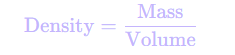
Given:
- Mass = 400 g
- Volume = 40 cm³
Now, substituting the values into the formula:
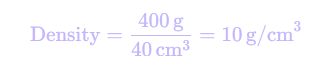
Therefore, the density of the object is 10 g/cm³.
This means that the object is denser than water (which has a density of approximately 1 g/cm³) and will sink when placed in water.
Question: 8. Analyse Fig. 9.25a and 9.25b. Why does the unpeeled orange float, while the peeled one sinks? Explain.
Answer: The difference in buoyancy between the unpeeled and peeled orange can be explained by density and the presence of air within the orange’s peel.
- Unpeeled Orange: The peel of the orange contains air pockets, which contribute to its overall volume without significantly increasing its mass. This makes the density of the unpeeled orange lower than that of water, allowing it to float.
- Peeled Orange: When the peel is removed, the air pockets are lost, and the density of the orange increases. As a result, the density of the peeled orange becomes greater than that of water, causing it to sink.
In summary, the presence of air in the peel reduces the overall density of the unpeeled orange, enabling it to float, while the peeled orange, having a higher density, sinks.
Question: 9. Object A has a mass of 200 g and a volume of 40 cm³. Object B has a mass of 240 g and a volume of 60 cm³. Which object is denser?
Answer: To determine which object is denser, we can calculate the density of both objects using the formula:
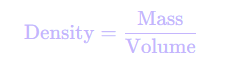
- Object A:
- Mass = 200 g
- Volume = 40 cm³
- Density of Object A =

- Object B:
- Mass = 240 g
- Volume = 60 cm³
- Density of Object B =
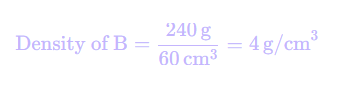
Conclusion: Object A has a density of 5 g/cm³, while Object B has a density of 4 g/cm³. Therefore, Object A is denser than Object B
Page no: 151
Question: 10. Reema has a piece of modeling clay that weighs 120 g. She first moulds it into a compact cube that has a volume of 60cm³
Later, she flattens it into a thin sheet. Predict what will happen to its density.
Answer: When Reema first molds the modeling clay into a compact cube with a volume of 60 cm³, its density can be calculated using the formula:

Later, when she flattens the clay into a thin sheet, the mass remains the same (120 g), but the volume will increase because the clay spreads out over a larger area.
- Effect on Density: Since density is inversely proportional to volume (for a constant mass), as the volume increases, the density will decrease. Therefore, after flattening, the density of the modeling clay will be less than 2 g/cm³.
Question: 11. A block of iron has a mass of 600 g and a density of 7.9 g/cm³. What is its volume?
To find the volume of the block of iron, we can rearrange the density formula:
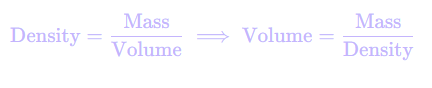
Given:
- Mass = 600 g
- Density = 7.9 g/cm³
Now, substituting the values:
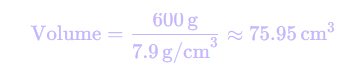
Question: 12. You are provided with an experimental setup as shown in Fig. 9.26a and 9.26b. On keeping the test tube (Fig 9.26b) in a beaker containing hot water (~70 °C), the water level in the glass tube rises. How does it affect the density?
Answer: In the experimental setup described, when the test tube is placed in hot water (~70 °C), the water level in the glass tube rises. This indicates that the water is expanding due to the increase in temperature.
- Effect on Density: As the temperature of water increases, its density decreases because the particles move apart, increasing the volume without changing the mass significantly. Therefore, the density of the water in the beaker decreases as it is heated.
In summary:
- The density of the water decreases as the temperature rises, which is consistent with the general principle that density decreases with increasing temperature for most substances.