Class 6 Chapter – 2 Friendship ‘The Unlikely Best Friends’ , ‘A Friend’s Prayer’ and ‘The chair’ Questions and Answers
‘Let us discuss’ page no: 42
Question: 1. Talk about the things that Gajaraj and Buntee did together. Now, write in the shapes given below. One has been done for you.
Answer: Here are some of the things they did together:
1. Played Together: Gajaraj and Buntee enjoyed playful moments, especially during their bath time when Gajaraj splashed water on Buntee.
2. Shared Food: Gajaraj shared some of his food with Buntee when the dog first arrived at the stable, showcasing his kindness.
3. Went for a Bath: They often went to the elephant pond together, where Gajaraj would bathe, and Buntee would watch.
4. Riding: Gajaraj would pick up Buntee with his trunk and give him rides on his back, which made Buntee very happy.
Question: 2. Why did the farmer hug Buntee?
Answer: In the story “The Unlikely Best Friends,” the farmer hugged Buntee for a few significant reasons:
- Joy of Reunion: The farmer was overjoyed to find Buntee, his lost dog. After searching for Buntee since he had disappeared, the moment he saw him in the stable, he felt a wave of relief and happiness. Hugging Buntee was a natural expression of that joy.
- Affection and Care: The hug also reflected the farmer’s affection for Buntee. It demonstrated the bond they shared, as the farmer had likely missed his dog during the time they were apart.
- Acknowledgment of Friendship: By hugging Buntee, the farmer acknowledged their friendship. It showed that he valued Buntee not just as a pet but as a companion who brought joy to his life.
Question: 3. Do you think Buntee will leave Gajaraj and go home with the farmer?
Answer: Here are some considerations:
- Emotional Bond: Buntee and Gajaraj have developed a strong friendship during their time together. They shared joyful moments, such as playing in the water and riding on Gajaraj’s back. This emotional bond may influence Buntee’s decision to stay with Gajaraj.
- Sense of Loyalty: Buntee’s loyalty to Gajaraj is evident when he realizes he is being taken away. His yelp and Gajaraj’s wince indicate that both friends are distressed at the thought of separation. This suggests that Buntee may feel a sense of loyalty towards Gajaraj, which could make him hesitant to leave.
- Farmer’s Affection: On the other hand, Buntee has a history with the farmer, who has shown love and care for him. The farmer’s hug signifies their bond, and Buntee might feel a sense of obligation to return home.
- Conflict of Emotions: Ultimately, Buntee is caught in a conflict between his affection for Gajaraj and his connection to the farmer. This internal struggle is a common theme in stories about friendship, highlighting the complexity of relationships.
Conclusion
While it is difficult to predict Buntee’s final decision, the story suggests that his friendship with Gajaraj has made a significant impact on him. The emotional connection they share may lead him to choose to stay with Gajaraj, at least for the moment, as they both express sadness at the thought of separation. However, the pull of home and the farmer’s affection cannot be underestimated. Thus, Buntee’s choice remains a heartfelt dilemma between two important relationships.
‘Let us discuss’ page no: 45
Question: 1. Why did Gajaraj not eat his food?
Answer: Gajaraj, the elephant, refused to eat his food because he was deeply saddened by the absence of his friend, Buntee, the dog. After Buntee was taken away by the farmer, Gajaraj felt lonely and missed his companionship. This emotional distress led him to lose his appetite, resulting in him not touching his food for several days. The mahout, noticing Gajaraj’s lack of interest in food, initially thought it might be due to indigestion, but later realized that Gajaraj was mourning the loss of his friend.
Question: 2. Who were friends at the end of the story?
Answer: By the end of the story, Gajaraj and Buntee had solidified their friendship, demonstrating a deep bond that transcended their differences as animals. Additionally, the mahout and the farmer also developed a friendship through their shared concern for Gajaraj and Buntee. The story concludes with the mahout expressing joy in having found a friend in the farmer, thus highlighting that true friendship can form in unexpected ways.
‘Let us think and reflect’ page no: 45-46
1. In spite of royal comforts, Gajaraj was sad because he had no friends. The mahout, or elephant trainer, was the only one he ever interacted with. The mahout was a kind man who served Gajaraj food, and gave him a bath in the elephant pond daily. He was a good caretaker, but not a friend.
(i) Complete with one word:
Answer: mahout : kind : : Gajaraj : Sad.
This indicates that while the mahout is characterized by his kindness, Gajaraj is characterized by his sadness due to the lack of friendship.
(ii) The mahout was a good caretaker because he gave _________ to Gajaraj and a ______ in the pond.
Answer: (ii) The mahout was a good caretaker because he gave ‘food’ to Gajaraj and a ‘bath’ in the pond.
This highlights the basic needs that the mahout fulfilled for Gajaraj, ensuring his physical well-being.
(iii) What do you think is the difference between a friend and a caretaker?
Answer: Difference between a friend and a caretaker:
- A friend is someone who shares emotional connections, companionship, and mutual support. Friends engage in activities together, share joys and sorrows, and provide emotional comfort.
- A caretaker, on the other hand, primarily focuses on fulfilling the physical needs of another, such as providing food, shelter, and care, but may not necessarily form an emotional bond. In the case of Gajaraj, the mahout was a good caretaker but did not fulfill the emotional companionship that Gajaraj yearned for.
Question: 2. “Are you missing your friend?” asked the farmer, remembering the happy look on Buntee’s face while sitting on the elephant’s back. “I cannot see you go hungry,” said the farmer, “If you miss your friend so much, go to him.” The farmer removed the rope with which he had tied the dog.
(i) The farmer uses the word __________________ to refer to the elephant.
Answer: The farmer uses the word “friend” to refer to the elephant.
This indicates the bond he recognizes between Gajaraj and Buntee, acknowledging their friendship.
(ii) How did the farmer know that Buntee was hungry?
Answer: The farmer knew that Buntee was hungry because he observed the happy look on Buntee’s face while riding on Gajaraj. This observation led him to recall how much joy Buntee experienced in the company of Gajaraj, suggesting that Buntee was missing his friend and, consequently, not eating.
(iii) Why did the farmer remove the rope with which he had tied Buntee?
Answer: The farmer removed the rope with which he had tied Buntee because he realized that Buntee was missing Gajaraj. He understood that if Buntee was so attached to Gajaraj, it would be better for both of them to be together. The farmer’s compassion for Buntee’s feelings prompted him to set the dog free.
(iv) Complete with one word: Gajaraj : Buntee : : __________ : farmer
Answer: Gajaraj : Buntee : : farmer : mahout
This analogy illustrates the relationship dynamics: Gajaraj is to Buntee as the farmer is to the mahout, both pairs representing a caretaker and a friend.
‘Let us think and reflect’ page no: 46
Question: II. Give two examples to show that Gajaraj was very happy to have a friend.
Answer: Here are two examples that illustrate Gajaraj’s happiness:
- Playful Interactions:
- Gajaraj shows his happiness by engaging in playful activities with Buntee. For instance, when Gajaraj takes a bath, he joyfully splashes water on Buntee using his trunk. This playful behavior indicates that Gajaraj is not only enjoying the company of Buntee but is also expressing his happiness through fun interactions.
- Sharing and Caring:
- Gajaraj’s happiness is further evident when he shares his food with Buntee. Initially, he offers some of his food to the stray dog, which shows his willingness to share and care for his new friend. This act of kindness reflects Gajaraj’s joy in having someone to bond with, highlighting the emotional connection he feels towards Buntee.
These examples demonstrate how Gajaraj’s life transforms with the presence of a friend, showcasing the joy and fulfillment that friendship brings.
Question: III. How did the mahout come to know that Gajaraj was sad?
Answer: Here are the key points that illustrate how the mahout comes to this realization:
1. Untouched Food: The first sign that alerts the mahout to Gajaraj’s sadness is when he serves Gajaraj his favorite food, but the elephant does not touch it. This behavior is unusual for Gajaraj, who typically enjoys his meals. The mahout becomes concerned when he sees that the food remains untouched not just for one meal, but for several days.
2. Physical Examination: The mahout, worried about Gajaraj’s lack of appetite, examines him by running his hand over the elephant’s tummy. He finds that there is nothing physically wrong with Gajaraj, which leads him to wonder if the elephant is missing his friend, Buntee. This indicates that the mahout is attentive and cares deeply for Gajaraj’s well-being.
– These observations highlight the mahout’s concern and understanding of Gajaraj’s emotional state, ultimately leading him to consider that Gajaraj might be feeling sad due to the absence of his friend.
Question: IV. Why do you think Buntee licked the farmer’s hand?
Answer: Here are the key points:
1. Expression of Gratitude: Buntee’s action of licking the farmer’s hand can be seen as a gesture of thanks. After being found by the farmer, who had been searching for him, Buntee likely felt grateful for the farmer’s care and concern. This licking signifies his appreciation for being reunited with someone who loves him.
2. Affection and Bonding: Licking is a common behavior in dogs that signifies affection. By licking the farmer’s hand, Buntee is expressing his love and loyalty. It shows that despite being taken away from Gajaraj, he still cherishes the bond he shares with the farmer, who has been a significant part of his life.
3. Emotional Response to Separation: After realizing he was being taken away from Gajaraj, Buntee might have felt a mix of emotions, including sadness and confusion. Licking the farmer’s hand could also be a way for him to seek comfort and reassurance from the farmer during a moment of distress.
– In summary, Buntee’s licking of the farmer’s hand serves as a multifaceted expression of gratitude, affection, and an emotional response to the situation, highlighting the deep connections that exist between pets and their owners.
Question: V. What was ‘unlikely’ about the friendship of Gajaraj and Buntee?
Answer: In the story “The Unlikely Best Friends,” the friendship between Gajaraj, the elephant, and Buntee, the dog, is considered ‘unlikely’ for several reasons:
1. Different Species: Gajaraj is a large elephant, while Buntee is a small dog. Typically, animals of such different sizes and species do not form friendships. This stark contrast makes their bond surprising and unusual, as one would not expect an elephant and a dog to become close companions.
2. Contrasting Backgrounds: Gajaraj lives in the royal stables, enjoying a life of luxury and comfort, while Buntee is a stray dog who wanders into the stables. Their vastly different living conditions and lifestyles add to the improbability of their friendship. Despite these differences, they find common ground and develop a strong emotional connection.
3. Social Expectations: Generally, animals are expected to form friendships within their own species. The friendship between Gajaraj and Buntee challenges these social norms, illustrating that true friendship can transcend boundaries and expectations. Their bond showcases that companionship can arise from the most unexpected circumstances.
‘Let us learn’ Page: 46-47
Question:1. Gajaraj was sad without a friend and when he met Buntee, he was filled with joy. ‘Sad’ and ‘filled with joy’ are opposites. Opposites can also be formed by adding some letters before a word. For example, un- unhappy, in- incorrect, dis- disconnect, mis- misuse. Now, take help from the words given as hints and fill up their opposites in the puzzle. (Note: All the words are from the story you have just read.)
Answer: These are the correct opposites for the crossword clues:
Across
3. unkind → Kind
7. yelped → Laughed
8. awake → Asleep
9. relieved → Worried
10. missing → Found
Down
1. started → Finished
2. appeared → Disappeared
4. sad → Delighted (or Happy, depending on the number of boxes; in this crossword Delighted fits.)
5. untouched → Touched
6. hate → Love
‘Let us learn’ Page: 47
Question: 2. Now, complete the paragraph with some of the words you have used in the puzzle.
My pencil was _____________.
Answer: missing.
I was very ________________ as it was a gift from my friend.
Answer: sad.
I woke up my elder brother who was ____________ on the bed.
Answer: asleep.
I told him that my pencil seemed to have ________________.
Answer: disappeared.
He _______________ and told me to look under my pillow.
Answer: woke.
I was ___________________
Answer: relieved.
when I ______________ the pencil there.
Answer: found.
Pg no: 48-49
Question: 3. The words that tell us about an action are called verbs. In the story, the author tells us what happened before. To do that, the past form of the action word (verb) is used. Let us learn about the three forms of past tense.
Answer: In the chapter “The Unlikely Best Friends,” the author employs various forms of past tense to narrate the events. Here’s a breakdown of the three forms of past tense as described in the content:
1. Simple Past Tense
- Definition: This tense indicates that an action occurred in the past and is now completed.
- Formation: The second form of the verb is used, often adding -d or -ed.
- Examples from the story:
- looked
- told
- gave
- joined
- hated
- threw
2. Past Progressive Tense
- Definition: This tense describes an action that was ongoing in the past.
- Formation: It is formed using “was” or “were” followed by the verb in its -ing form.
- Examples from the story:
- was looking
- was munching
- was missing
3. Past Perfect Tense
- Definition: This tense indicates that an action was completed before another action in the past.
- Formation: It is formed using “had” followed by the third form of the verb.
- Examples from the story:
- had tied
- had followed
- had ordered
- had remained
| Simple Past Tense | Past Progressive Tense | Past Perfect Tense |
| looked | was looking | had tied |
| told | was munching | had followed |
| gave | had ordered | |
| joined | had remained | |
| hated | ||
| threw |
‘Let us learn’ Pg no: 49
Question: Select the correct form of the verb to complete the passage.
Check your answers with the teacher.
The farmer came back and ____________ (noticed/was noticing/had noticed) that Buntee was sad. He ____________ (tied/ was tying/had tied) Buntee with a rope the day before. He ____________ (asked/was asking/ had asked) Buntee why he was sad. The farmer ____________ (felt/was feeling/had felt) that Buntee ____________ (missed/was missing/had missed) Gajaraj and set him free.
Answer: To accurately complete the passage, we need to select the appropriate verb forms based on the context provided. Here’s the passage with the correct verb forms filled in:
Passage: The farmer came back and noticed (noticed/was noticing/had noticed) that Buntee was sad. He had tied (tied/was tying/had tied) Buntee with a rope the day before. He asked (asked/was asking/had asked) Buntee why he was sad. The farmer felt (felt/was feeling/had felt) that Buntee missed (missed/was missing/had missed) Gajaraj and set him free.
Explanation of Choices:
- noticed: This is the simple past form, indicating that the farmer saw Buntee’s sadness at a specific moment in the past.
- had tied: This is the past perfect tense, showing that the action of tying Buntee occurred before the farmer noticed his sadness.
- asked: This is the simple past form, indicating that the farmer inquired about Buntee’s feelings at a specific time.
- felt: This is the simple past form, indicating the farmer’s realization of Buntee’s feelings at that moment.
- missed: This is the simple past form, indicating that Buntee’s feeling of missing Gajaraj occurred at that time.
‘Let us listen’ page no: 49
Question: 1. You will listen to a story about ‘Unlikely Friends’. Use exact words from the story to fill up the missing details in the paragraph. (refer to page 71 for transcript) The leopard is a ___________ animal but it became a friend of a cow. When the leopard grew up, it left the village. It came in the _______________ to meet the cow. The leopard would sit __________________ the cow. They also played together. _____________ were surprised at their friendship.
Answer: In the story about ‘Unlikely Friends’, the missing details can be filled in as follows:
- The leopard is a wild animal but it became a friend of a cow.
- When the leopard grew up, it left the village. It came in the night to meet the cow.
- The leopard would sit beside the cow. They also played together.
- Villagers were surprised at their friendship.
This story illustrates the theme of unexpected friendships, highlighting how even animals from different backgrounds can form strong bonds.
‘Let us listen’ pg no: 50
Question: 2. Now, listen to the story again and number the sentences in correct order. The first one has been done for you.

Answer: To arrange the sentences from the story about the cow and the leopard in the correct order, follow this sequence based on the narrative flow:
- The cow took care of the leopard cub as a mother.
- The leopard left the village after growing up.
- The leopard came to meet the cow at night.
- The leopard stopped coming regularly.
‘Let us speak’ pg no: 50
Gajaraj and Buntee had a wonderful time with each other even if they were ‘unlikely’ friends. Talk to your friend and find out your common likes and dislikes. Share your answers with the class.
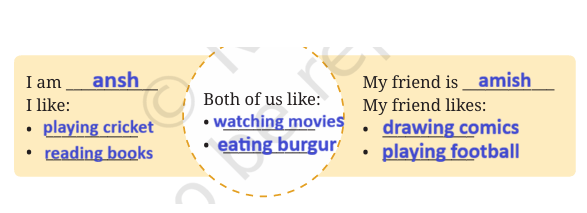
Now, tell your classmates about your friend. You may take help of the cues given below.
• My friend and I like to play. Both of us want to play basketball after school.
• I like to read adventure books but my friend likes to watch cartoons .
• We are different as she/he is very outgoing and loves meeting new people, and I am more reserved and enjoy quiet time .
‘Let us write’ pg no: 51
Question: Write six sentences about your friend with the help of the facts collected in the above task. Mention how you are not only similar but also different. You may take help of the words given below. same both neither different still nor and like either but unlike or
Answer: When writing about your friend, it’s important to highlight both the similarities and differences that define your friendship. Here’s a structured approach to help you create six sentences using the provided words:
- Introduction of Similarities:
- My friend and I both enjoy playing outdoor games like cricket and football.
- Highlighting a Shared Interest:
- We like to share our lunch during school, which makes our time together even more enjoyable.
- Mentioning a Difference:
- Unlike me, my friend prefers reading mystery novels, while I enjoy adventure stories.
- Discussing Another Similarity:
- We are both passionate about music and often sing our favorite songs together.
- Pointing Out a Unique Trait:
- Neither of us is good at drawing, but we still try to create art for fun.
- Concluding with a Reflection:
- Our friendship is special because we are different in many ways, but we appreciate those differences and learn from each other.
“A Friend’s Prayer” Questions and Answers
‘Let us discuss’ pg no: 53
Question: 1. Read the poem silently. As you read, underline the parts of the poem that you agree with.
Answer:
1. “I want to do much more than share.” – This suggests that true friendship goes beyond mere sharing; it involves deeper emotional connections and support.
2. To make their wishes come true.” – This line emphasizes the desire to help friends achieve their dreams and desires, showcasing the selflessness that comes with genuine friendship.
3. “But love my friends the way they are.” – This line underscores the essence of unconditional love in friendships, reminding us to embrace our friends’ true selves.
4. “With special friends I feel I’m blessed” – This line may resonate with many as it reflects the joy and gratitude felt in true friendships.
5. “I’ll try all that a friend can do” – This emphasizes the commitment to being a supportive friend.
Question: 2. Now, share the details of your underlined parts of the poem in groups and explain why you liked those lines.
Answer: When discussing the underlined parts of the poem “A Friend’s Prayer,” we can focus on the following points:-
- Importance of Friendship:
- Lines to Highlight: “With special friends I feel I’m blessed.”
- Explanation: This line emphasizes the value of having friends who enrich our lives. It suggests that true friendship brings joy and a sense of gratitude.
- Commitment to Friends:
- Lines to Highlight: “I’ll try all that a friend can do to make their wishes come true.”
- Explanation: This expresses the speaker’s dedication to being a supportive friend. It highlights the idea that friendship involves effort and a willingness to help each other.
- Understanding and Acceptance:
- Lines to Highlight: “Let me use my heart to see, to realise what friends can be.”
- Explanation: This line reflects the importance of empathy and understanding in friendships. It encourages us to appreciate friends for who they are, without judgment.
Why These Lines are Appreciated
- Relatability: Many students can relate to the feelings expressed in these lines, as they mirror their own experiences with friends.
- Emotional Connection: The lines evoke emotions of gratitude and love, making them impactful and memorable.
- Life Lessons: They provide valuable lessons about the essence of friendship, such as loyalty, support, and acceptance, which are crucial for building strong relationships.
Question: 3. Which line was underlined by most people in your group? Share it with your teacher.
Answer: Answer: In our group discussion about the poem “A Friend’s Prayer,” we can present the following points regarding the line that was most frequently underlined by your peers:-
1. Identifying the Line:-
– Most Underlined Line: “With special friends I feel I’m blessed.”
2. Reason for Popularity:-
– Emotional Resonance: This line resonates deeply with many students because it encapsulates the joy and gratitude that come from having close friends.
– Relatability: Most people can relate to the feeling of being fortunate to have friends who support and uplift them, making this line particularly impactful.
– Personal Experiences: Encourage your classmates to share their own experiences of friendship
3. Discussion Points:-
– that make them feel blessed.
– Importance of Friendship: Discuss how friendships contribute to happiness and emotional well-being, reinforcing the idea presented in the line.
– Conclusion:-
Summarize that this line highlights the essence of friendship and serves as a reminder to appreciate and nurture the bonds we have with our friends.
Let us think and reflect pg no: 54
Question: I. Complete the summary of the poem by circling the correct highlighted words.
The poet says a prayer for/speech on friendship and friends. She wants that friendship should always be an important part of her complete life/ school days. She says that her friendship makes her feel brave/special. She wishes to do the best she can, for her friends. She wants to clap for/ listen to the wishes of her friends. As a good friend, she prays/imagines that she is able to make her friends’ wishes come true. She wants her heart/mind to understand what a true friend is. She prays that she loves her friends as they are/when they are happy. She tells us that true/correct friends accept their friends for all their qualities.
Answer: Here is complete summary of the poem with correct highlighted words :-
The poet says a prayer for friendship and friends. She wants that friendship should always be an important part of her complete life. She says that her friendship makes her feel special. She wishes to do the best she can, for her friends. She wants to listen to the wishes of her friends. As a good friend, she prays that she is able to make her friends’ wishes come true. She wants her heart to understand what a true friend is. She prays that she loves her friends as they are. She tells us that true friends accept their friends for all their qualities.
Here are the highlighted words from the summary of the poem:-
- prayer
- complete life
- special
- listen
- prays
- heart
- as they are
- true
Question: II Answer in one word only.
1. How does the poet feel about special friends?
Answer: The poet feels blessed about special friends.
2. What does the poet use to realise what friends can be?
Answer: The poet uses heart to realise what friends can be.
Question: III. Read the following lines from the poem and answer the questions given below.
1. I want to do much more than share The hopes and plans of friends who care; I’ll try all that a friend can do To make their wishes come true.
(i) Complete the sentence with the most suitable option. These lines tell us that the speaker is _______________.
A. clever B. caring C. curious D. calm
Answer: B. caring.
(ii) How will the speaker make her friends’ wishes come true? (by trying hard/by working a lot)
Answer: by trying hard.
(iii) Fill in the blank with a suitable word. My friends will feel __________ if their wishes come true.
Answer: happy.
Pg no: 55
Question: 2. Let me use my heart to see, To realise what friends can be, And make no judgements from afar, But love my friends the way they are.
(i) The speaker says that feelings are important to understand friendship. Which line tells us this?
Answer: The line “Let me use my heart to see,” indicates that the speaker believes understanding friendship requires emotional insight and empathy.
(ii) Complete the sentence with the most suitable option. These lines tell us that the speaker is _______________.
A. helpful B. thoughtful C. cheerful D. hopeful
Answer: B. thoughtful.
(iii) Fill in the blank with one word.
The speaker does not wish to make any ___________. She cares for them just as they are.
Answer: Judgements.
Question: IV. Give one reason why we can say that this poem is a prayer.
Answer: In the poem “A Friend’s Prayer,” we can say that it is a prayer because it expresses a heartfelt wish for the well-being and happiness of friends. The speaker reflects on the importance of friendship and desires to be a good friend by making their friends’ wishes come true. This selfless sentiment is characteristic of a prayer, where one seeks to invoke blessings and express gratitude for the relationships they cherish.
Key Points:
- Heartfelt Wishes: The poem conveys deep wishes for friends’ happiness and success.
- Selflessness: The speaker’s desire to do more for friends aligns with the essence of prayer, which often involves seeking good for others.
- Reflection on Friendship: The poem emphasizes the value of friendship, akin to a prayerful acknowledgment of the blessings friends bring into our lives.
Question: V. Why does the speaker ‘want to do more’ for her friend?
Answer: The speaker in the poem “A Friend’s Prayer” expresses a desire to do more for her friend because she values the friendship deeply and recognizes the importance of being a supportive and caring companion. This desire stems from a sense of gratitude and appreciation for the joy and blessings that friends bring into our lives.
Key Reasons:
- Value of Friendship: The speaker understands that true friendship involves mutual support and care. She wants to reciprocate the kindness and love she receives from her friends.
- Desire to Contribute: By wanting to do more, the speaker aims to actively contribute to her friends’ happiness, showing that she is committed to nurturing the relationship.
- Empathy and Understanding: The speaker’s wish to fulfill her friends’ wishes reflects her empathy, as she recognizes their needs and aspirations, and wants to help them achieve their goals.
Question: VI. Do you think that the speaker knows about the wishes of her friend? How can we say so?
Answer: Yes, I believe that the speaker knows about the wishes of her friend. Here are a few reasons to support this idea:
- Understanding and Empathy: The speaker expresses a desire to do much more than just share hopes and plans. This indicates that she is attentive to her friend’s feelings and wishes. She wants to understand what her friend truly desires.
- Actions Speak Louder: The speaker mentions trying all that a friend can do to make their wishes come true. This shows that she is not only aware of her friend’s wishes but is also willing to take action to help fulfill them.
- Connection and Communication: The speaker emphasizes the importance of using her heart to see and realize what friends can be. This suggests that there is a strong emotional connection between the speaker and her friend, allowing her to sense what her friend might wish for, even if it is not explicitly stated.
- Caring Nature: The speaker’s intention to love her friends as they are indicates that she values their individuality and understands that each friend has unique wishes and dreams. This caring nature reflects her awareness of her friend’s needs.
Question: VII. Do you also pray for your friend? What do you wish for? Discuss.
Answer: Yes, I do pray for my friends! I believe that wishing good things for them is very important. Here are some of the things I wish for:
- Happiness: I always pray that my friends stay happy and smile every day. I want them to enjoy every moment, whether they are at school or home.
- Good Health: I wish for my friends to be healthy and strong. I hope they never get sick and can play and study without any problems.
- Success in Studies: I pray that my friends do well in their studies and achieve their goals. I want them to get good grades and be proud of their hard work.
- Support During Tough Times: I wish that my friends find the strength to face any challenges. If they are feeling sad or stressed, I hope they can overcome those feelings and find joy again.
- Friendship: I also pray that our friendship stays strong and that we always support each other. I want us to have fun together and create wonderful memories.
‘Let us learn’ pg no: 55-56
Question: I. The poet says, ‘With special friends I feel I’m blessed’. Select the words that are similar to the meaning of being blessed, from those given below.
excited, grateful, thankful, understood, relaxed
Answer: I. Meaning of “Blessed”
The words that are similar to the meaning of being blessed from the given options are:
- grateful
- thankful
Both of these words convey a sense of appreciation and recognition of the good things in life, which aligns with the sentiment expressed in the poem.
Question: II. Good friends have a lot of qualities. Let us list some.
loyal, h e __ __ f __ l, k __ __ d, c __ __ i n g, h o __ __ __ t
Answer: here are full words :-
helpful
Kind
caring
honest.
Now, fill in the blanks with the words you just listed above.
1. My friend is always _____________ to me even when I make a mistake.
Answer: Helpful.
2. My friend shares things with me. She is very _____________.
Answer: Caring.
3. My friend is _____________ because he always supports me.
Answer: Loyal.
4. My friend never lies. She is an _____________ person.
Answer: Honest.
5. My friend and I believe in _____________ for each other.
Answer: Kindness.
Question: III. Think of any three of your friends. Write three sentences on why you like each one of them.
Answer: Here are three sentences about why I like each of my friends:
1. Aisha: I like Aisha because she is always there to listen to my problems and gives me great advice when I need it. Her caring nature makes me feel valued and understood.
2. Ravi: I appreciate Ravi for his loyalty; he stands by me in tough times and never lets me down. His support gives me the confidence to face challenges.
3. Swati: I enjoy spending time with Sneha because she is incredibly kind and always makes me laugh. Her positive energy brightens my day and makes every moment enjoyable.
“The Chair” Questions and Answers
‘Let us discuss’ page no: 61
Question: 1. Mario was very proud of having so many friends. State whether True or False.
Answer: Answer: This statement is True. Mario often boasted about the number of friends he had at school, indicating his pride in having many acquaintances.
Explanation:- In the story, Mario’s behavior reflects his belief that having numerous friends is a measure of his social standing. However, as the story progresses, he learns the difference between true friends and mere companions, which adds depth to his understanding of friendship.
Question: 2. What did the grandfather take from the attic?
Answer: Answer: The grandfather took an invisible chair from the attic.
Explanation
This special chair was meant to help Mario determine who his real friends were. The chair’s invisibility made it tricky to sit on, and it was part of a challenge that Mario accepted from his grandfather. The magic of the chair allowed Mario to see which of his classmates genuinely cared for him when he attempted to sit on it.
Question: 3. Will Mario face any challenges?
Answer: Answer: Yes, Mario will face challenges while trying to use the invisible chair.
Explanation
When Mario attempts to sit on the invisible chair, he initially struggles to find it, causing him to fall repeatedly. His classmates laugh at his attempts, which highlights the challenge he faces in not only using the chair but also in discerning who his true friends are based on their reactions to his struggles.
Question: 4. Will Mario be able to use the magic?
Answer: Answer: Yes, Mario will eventually be able to use the magic of the chair.
Explanation
After several unsuccessful attempts and falls, Mario finally manages to sit on the invisible chair without falling. This achievement allows him to experience the magic his grandfather described. When he sits on the chair, he discovers who his true friends are—those who genuinely care for him, such as Guneet, Asma, and Deepa, who support him instead of laughing at his struggles. This moment is crucial for Mario as it teaches him the true meaning of friendship, distinguishing between those who are merely acquaintances and those who are real friends.
‘Let us discuss’ page no: 64
Question: 1. Mario successfully sat on the invisible chair on his first attempt. State whether True or False.
Answer: This statement is False.
Explanation
Mario did not succeed in sitting on the invisible chair on his first attempt. Instead, he fell multiple times, which caused laughter among his classmates. This struggle was part of his learning experience about friendship.
Question: 2. Fill in the blank with a suitable word.
Mario’s grandfather challenged him to a bet of __________.
Answer: Mario’s grandfather challenged him to a bet of fruit chaat.
Explanation
The bet was about whether Mario truly had as many friends as he claimed. His grandfather offered fruit chaat as a wager, which added a playful element to the challenge.
Question: 3. Match the following characters with their action.
| Characters | Actions |
| Guneet, Asma, and Deepa | (i) held Mario up, so he wouldn’t fall |
| Other classmates | (ii) made fun of Mario’s attempts |
Explanation
- Guneet, Asma, and Deepa were the supportive friends who helped Mario when he sat on the invisible chair, demonstrating their care and loyalty.
- In contrast, other classmates laughed at Mario’s attempts, showing that they were not true friends. This distinction helped Mario realize the value of genuine friendship.
Let us think and reflect page no: 64
Question: I. Read the following lines and answer the questions that follow.
1. “Take it. It’s a very special chair. As it’s invisible, it’s rather tricky to sit on it. But if you take it to school and manage to sit on it, then the magic will work and you’ll be able to tell who your real friends are.”
(i) Fill in the blanks with two words that describe the chair. The chair is _____________ and ___________.
Answer: The chair is invisible and special.
(ii) Why was it tricky to sit on the chair?
Answer: It was tricky to sit on the chair because the chair was invisible, making it difficult for Mario to see where it was located. This invisibility posed a challenge for him to accurately sit on it without missing the seat.
(iii) Why does Mario’s grandfather call the chair ‘special’?
Answer: Mario’s grandfather refers to the chair as ‘special’ because it possesses magical qualities that allow Mario to discern who his true friends are. The chair is invisible, making it challenging to sit on, which adds an element of difficulty and intrigue. The magic of the chair reveals the nature of friendships by showing who genuinely cares for Mario when he tries to sit on it. Those who help him are identified as true friends, while those who laugh at his struggles are not considered real friends.
Question: 2. “Wait, wait, just a slight technical problem,” he said, trying again. But again, he missed the seat, causing more surprised looks and laughter. Mario wouldn’t give up.
(i) Fill in the blank with a suitable reason.
Mario says there was a technical problem because ___________.
Answer: he was unable to see the invisible chair.
(ii) Mario’s friends were very caring and helpful. State whether True or False.
Answer: False.
In the story, when Mario attempts to sit on the invisible chair, many of his classmates laugh at him instead of helping him. Only Guneet, Asma, and Deepa are shown to be caring and supportive, as they help him by holding him up when he finally manages to sit on the chair. This indicates that not all of Mario’s friends were caring, highlighting the distinction between true friends and those who merely enjoy watching him fail.
(iii) Choose the correct option to complete the sentence. Mario wouldn’t give up.
This shows he is _____________.
A. strong-willed
B. supportive
C. loving
D. hard-working
Answer: A. strong-willed.
Explanation:
- Strong-willed refers to someone who is determined and persistent, which accurately describes Mario’s attitude as he continues to try sitting on the invisible chair despite multiple failures. His determination to succeed demonstrates his strong will.
- The other options, while positive traits, do not specifically capture the essence of Mario’s persistence in this scenario
Page no: 65
Question: II. answer the following questions.
1. What was the bet about?
Answer: The bet was about Mario’s claim that he had many friends. His grandfather challenged him, suggesting that many of those friends were not true friends but merely companions or partners. To prove this, he offered Mario a fruit chaat if he could demonstrate that he had real friends. The challenge involved using an invisible chair that would help Mario identify who his true friends were based on their reactions when he tried to sit on it.
This bet set the stage for Mario to discover the true nature of his friendships, ultimately leading him to understand the difference between genuine friends and those who only pretended to be his friends.
2. What happened when Mario sat on the chair for the first time?
Answer: When Mario attempted to sit on the invisible chair for the first time, he missed the seat and fell onto the ground. His classmates found this amusing and laughed at his failed attempt. Despite the embarrassment, Mario was determined to keep trying to sit on the chair.
3. How was Mario able to find his real friends?
Answer: Mario discovered his real friends when he finally managed to sit on the invisible chair and experienced the magic his grandfather had described. While he was suspended in mid-air, he noticed that Guneet, Asma, and Deepa were the only ones helping him by holding him up. In contrast, many others, whom he had considered friends, were laughing at him instead of supporting him. This experience revealed to Mario who truly cared for him.
4. Do you think the magic chair test was good? Why do you say so?
Answer: Yes, the magic chair test was a good idea because it provided Mario with a unique and insightful way to evaluate his friendships. It helped him distinguish between genuine friends who support and care for him and those who do not. This lesson was valuable for Mario as it taught him the importance of having true friends who stand by you in difficult times.
5. What does ‘friends for life’ mean to you?
Answer: ‘Friends for life’ refers to those friendships that are enduring and meaningful, where both individuals support each other through various life experiences. These are the friends who remain by your side during both good and bad times, creating lasting memories and bonds that withstand the test of time.
6. The grandfather’s idea helped Mario find his ‘real friends’. Mention any other way that would help you find out who are your ‘real friends’.
Answer: Another way to identify real friends could be through shared experiences and challenges. For example, going through a tough situation together, such as a difficult project or personal hardship, can reveal who is willing to support and help you. Additionally, observing who reaches out to you during times of need or who celebrates your successes with genuine happiness can also help in recognizing true friendships.
Let us learn page no: 65
I. Read the following words from the text.
friendly, suddenly, talking, carrying, called, showed
Complete the following table by dividing the words into two parts. One has been done for you.
Answer:
| Column A (Root Words) | Column B (Suffixes) |
| 1. friend | ly |
| 2. sudden | ly |
| 3. talk | ing |
| 4. carry | ing |
| 5. call | ed |
| 6. show | ed |
Explanation:
Root Words: These are the base forms of the words that carry the primary meaning.
Suffixes: These are added to the root words to create new forms or meanings. For example:
1. friendly (from “friend” + “ly”) means showing friendship.
2. suddenly (from “sudden” + “ly”) means happening quickly and unexpectedly.
3. talking (from “talk” + “ing”) indicates the action of speaking.
4. carrying (from “carry” + “ing”) indicates the action of holding something while moving.
5. called (from “call” + “ed”) indicates the past tense of calling.
6. showed (from “show” + “ed”) indicates the past tense of showing.
page no: 66
Question: II Match the following root words with suitable suffixes. You can use a suffix more than once as shown. Use them to make sentences of your own. One has been done for you.
Answer:
| S. No. | Root Word | Suffix | Word | Sentence |
| 1. | magic | al | magical | The magician performed an amazing magical act. |
| 2. | care | ful | careful | She is very careful while crossing the road. |
| 3. | celebrate | ion | celebration | We had a grand celebration for her birthday. |
| 4. | laugh | ly | laughingly | He laughed laughingly at the funny joke. |
| 5. | wonder | ed | wondered | She wondered about the mysteries of the universe. |
| 6. | help | tion | helpation | The helpation of volunteers made the event successful. |
| 7. | friend | ly | friendly | He is very friendly to everyone he meets. |
| 8. | courage | ship | friendship | Their friendship is built on trust and courage. |
Explanation of Each Word and Sentence
1.Magical: Refers to something that has the qualities of magic.
2. Careful: Describes someone who is cautious and attentive to avoid mistakes or accidents.
3. Celebration: A joyful event or gathering to mark a special occasion.
4. Laughingly: An adverb that describes the manner of laughing.
5. Wondered: The past tense of wonder, indicating curiosity or amazement.
6. Helpation: A creative word formed to describe the act of helping; however, the more common term would be “help” or “assistance.”
7. Friendly: Describes someone who is kind and pleasant to others.
8. Friendship: The bond between friends, characterized by mutual affection and support.
Question: III Read the following lines from the story.
Mario, brave and determined, took the strange invisible chair … You have already described the chair. Now, describe what kind of a person Mario is in the image given below.
[Use words from the story. You may also use words of your own.]
Answer: Description of Mario:-
Mario is a brave and determined boy. He shows great courage by accepting the challenge from his grandfather to test his friendships with the invisible chair. Despite facing laughter and challenges from his classmates, he does not give up easily. His perseverance is commendable as he keeps trying to sit on the chair until he succeeds.
- Brave: Mario faces the challenge head-on, showing that he is not afraid to take risks.
- Determined: He is committed to proving his grandfather wrong and finding out who his real friends are.
- Caring: After discovering who his true friends are, he values their support and appreciates them.
- Resilient: Even when he falls and faces embarrassment, he continues to try, demonstrating his resilience.
Example Sentences:-
1. Mario is brave because he dares to sit on an invisible chair in front of his classmates.
2. He is determined to find out who his real friends are, showing his commitment to understanding true friendship.
3. Mario’s caring nature is evident when he acknowledges the support of his friends who helped him during the challenge.
4. His resilience shines through as he keeps trying to sit on the chair despite falling multiple times.
Question: IV. Match each word (adjectives) in Column A with a suitable word (noun) in Column B. You can make more than one combination. One has been done as an example.
Answer:
| Column A (Adjective) | Column B (Noun) | Column C (Phrase) | Column D (Sentence) |
| Brave | Soldier | Brave soldier | The brave soldier marched ahead. |
| Clever | Plan | Clever plan | The clever plan worked perfectly. |
| Tasty | Peanuts | Tasty peanuts | The tasty peanuts were a hit at the party. |
| Heavy | Rain | Heavy rain | The heavy rain caused flooding in the streets. |
| Slight | Cold | Slight cold | I caught a slight cold after being out in the rain. |
| True | Friends | True friends | True friends support each other through thick and thin. |
Question: V. Complete the paragraph with suitable adjective-noun pairings. Use the words in the box given below.
| old book, magical adventures, happy boy, amazing stories, fantastic adventures, colourful creatures, old castles. |
Once upon a time in a little village, a/an 1. __________________ named Abhishek found a/an 2. __________________ in the attic. He read 3. __________________ about fairy lands, 4. __________________ and 5. __________________. Abhishek’s eyes got big as he imagined these 6. __________________. He told his friends about the stories, and they started to have their own 7. __________________ when they played together.
Answer: Once upon a time in a little village, a happy boy named Abhishek found an old book in the attic. He read amazing stories about fairy lands, colourful creatures and old castles. Abhishek’s eyes got big as he imagined these fantastic adventures. He told his friends about the stories, and they started to have their own magical adventures when they played together.
Let us listen page no: 68
you will listen to Manu talk about her friend Monika. As you listen, fill in the blanks with the words you hear. Here are the sentences to complete:
- Manu found it ___________ when she took admission in the school.
- Manu met ___________ and was helped by her in many ways.
- So, it was not so ___________ for the new girl to adjust in the school.
- Both friends experienced difficult and ___________ moments together.
- Manu is ___________ to Monika for making her life easy and finding a friend.