NCERT Solutions for Class 7 Science Chapter: 7 Heat Transfer in Nature Question and Answers New Updated NCERT Solutions
Let Us Enhance Our Learning page no – 102
1. Choose the correct option in each case.
Question: (i) Your father bought a saucepan made of two different materials, A and B, as shown in Fig. 7.14. The materials A and B have the following properties —
(a) Both A and B are good conductors of heat
(b) Both A and B are poor conductors of heat
(c) A is a good conductor and B is a poor conductor of heat
(d) A is a poor conductor and B is a good conductor of heat
Answer: The correct option is (c) A is a good conductor and B is a poor conductor of heat.
Explanation:
1. Good Conductors of Heat: Metals, such as aluminum and copper, are typically good conductors of heat. They allow heat to pass through them easily, making them ideal for cooking utensils.
2. Poor Conductors of Heat: Materials like wood or plastic are poor conductors (insulators) of heat. They do not transfer heat effectively, which is why they are often used for handles or parts of utensils that should not get hot.
Question: (ii) Pins are stuck to a metal strip with wax and a burning candle is kept below the rod, as shown in Fig. 7.15. Which of the following will happen?
(a) All the pins will fall almost at the same time
(b) Pins I and II will fall earlier than pins III and IV
(c) Pins I and II will fall later than pins III and IV
(d) Pins II and III will fall almost at the same time
Answer: The correct option is (b) Pins I and II will fall earlier than pins III and IV.
Explanation:
1. When the metal strip is heated from one end (the end closest to the candle), the heat travels along the strip through the process of conduction.
The pins are attached at different distances from the heat source. Therefore, the pin closest to the candle (Pin I) will receive heat first and fall off as the wax melts.
2. Following that, Pin II, which is the next closest, will fall after Pin I, while Pins III and IV, being further away, will take longer to receive enough heat to melt the wax holding them in place.
Question: (iii) A smoke detector is a device that detects smoke and sounds an alarm. Suppose you are fitting a smoke detector in your room. The most suitable place for this device will be:
(a) Near the floor
(b) In the middle of a wall
(c) On the ceiling
(d) Anywhere in the room
Answer: The correct option is (c) On the ceiling.
Explanation:
1. Smoke rises due to convection, which means that smoke will accumulate near the ceiling before it reaches the floor. By placing the smoke detector on the ceiling, it can detect smoke more quickly, providing an early warning in case of a fire.
2. Additionally, smoke detectors are designed to sense the particles in the air, and since smoke is lighter than air, it will rise. Therefore, a ceiling-mounted smoke detector will be more effective than one placed near the floor or on a wall.
Question: 2. A shopkeeper serves you cold lassi in a tumbler. By chance, the tumbler had a small leak. You were given another tumbler by the shopkeeper to put the leaky tumbler in it. Will this arrangement help to keep the lassi cold for a longer time? Explain.
Answer: Yes, placing the leaky tumbler inside another tumbler can help keep the lassi cold for a longer time. Here’s why:
1. Insulation Effect: The air trapped between the two tumblers acts as an insulator. Air is a poor conductor of heat, which means it slows down the transfer of heat from the warmer external environment to the cold lassi inside the inner tumbler.
2. Reduced Heat Transfer: Since the outer tumbler protects the inner tumbler from direct contact with warmer air, the heat transfer to the cold lassi is minimized. This helps maintain the low temperature of the lassi for a longer duration.
3. Leakage Consideration: Although the inner tumbler has a leak, the outer tumbler will still provide some level of insulation. As long as the lassi does not leak out too quickly, this arrangement will be beneficial.
– Conclusion
In summary, using a second tumbler around the leaky one creates an insulating layer that helps keep the lassi cold longer by reducing heat transfer from the environment. This principle is similar to how double-walled containers work, which are designed to maintain the temperature of their contents.
Question: 3. State with reason(s) whether the following statements are True [T] or False [F].
(i) Heat transfer takes place in solids through convection.
Answer: False [F]
Reason: Heat transfer in solids occurs primarily through conduction, not convection. In conduction, heat is transferred through direct contact between particles, while convection involves the movement of particles in fluids (liquids and gases).
(ii) Heat transfer through convection takes place by the actual movement of particles.
Answer: True [T]
Reason: This statement is correct because convection involves the actual movement of particles within a fluid. As particles gain heat, they become lighter and rise, while cooler, denser particles sink, creating a circulation pattern.
(iii) Areas with clay materials allow more seepage of water than those with sandy materials.
Answer: False [F]
Reason: Clay has smaller particle sizes and tighter packing, which results in slower seepage of water compared to sandy materials. Sandy areas allow water to pass through more quickly due to larger particle sizes and greater spaces between them.
(iv) The movement of cooler air from land to sea is called land breeze.
Answer: True [T]
Reason: This statement is accurate. A land breeze occurs at night when the land cools down faster than the sea, causing cooler air from the land to move towards the warmer sea.
Question: 4. Some ice cubes placed in a dish melt into water after sometime. Where do the ice cubes get heat for this transformation?
Answer: When ice cubes placed in a dish melt into water, they acquire heat from their surroundings. Here’s a detailed explanation:
1. Heat Transfer from the Environment: The ice cubes absorb heat from the air around them. Since the temperature of the surrounding air is typically higher than that of the ice, thermal energy flows from the warmer air to the colder ice cubes.
2. Conduction: The dish itself, if it is made of a material that conducts heat well (like metal), also transfers heat to the ice cubes. The heat from the dish warms the ice cubes through conduction, facilitating the melting process.
3. Heat from the Surface: If the dish is placed on a warmer surface (like a countertop or table), heat can also be transferred from that surface to the dish and then to the ice cubes.
– Conclusion
In summary, the ice cubes get heat for their transformation into water primarily from the surrounding air and the dish they are in. This heat transfer occurs through conduction, allowing the ice to absorb energy and change its state from solid to liquid.
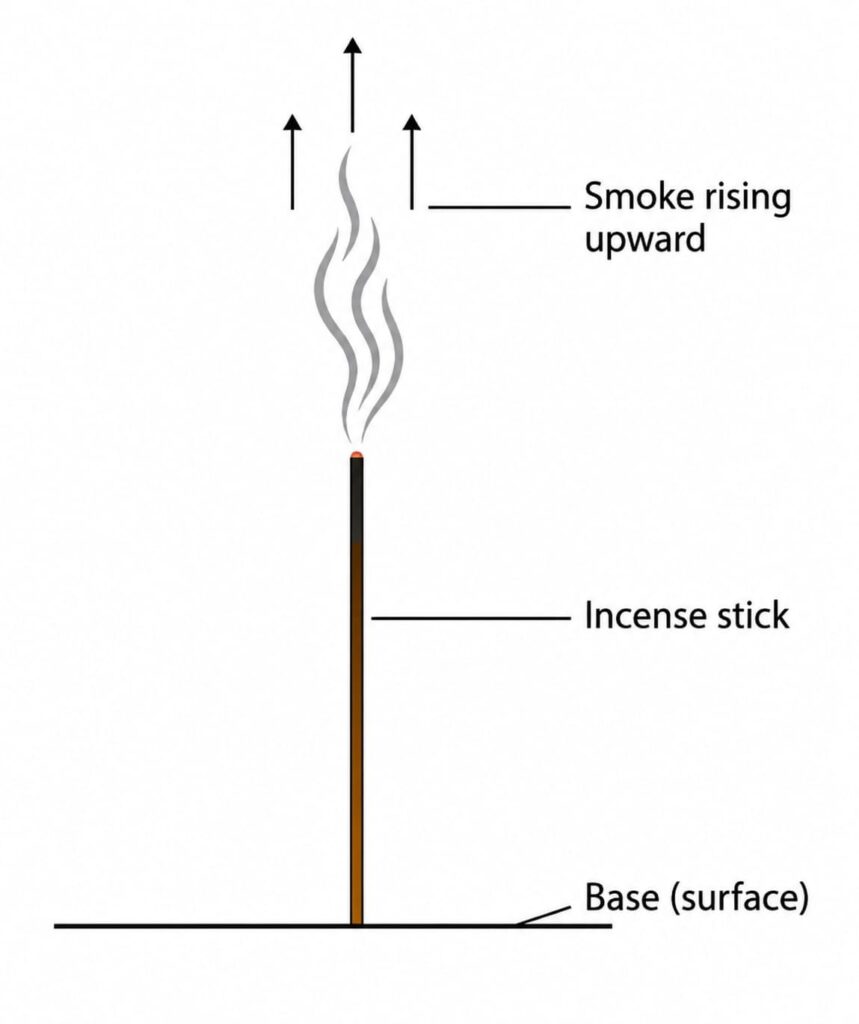
Question: 5. A burning incense stick is fixed, pointing downwards. In which direction would the smoke from the incense stick move? Show the movement of smoke with a diagram.
Answer: When a burning incense stick is fixed pointing downwards, the smoke produced will rise upwards. This occurs due to the principle of convection, where the hot smoke, being lighter than the surrounding cooler air, ascends.
– Explanation:
1. Hot Air Rises: The smoke from the burning incense stick is composed of hot gases. As these gases are heated, they become less dense and rise.
2. Surrounding Cooler Air: The cooler air around the incense stick moves in to replace the rising smoke, creating a continuous upward movement.
Here’s a simple representation of the smoke movement:
– Conclusion
In summary, when an incense stick is positioned downwards, the smoke will rise upwards due to the convection process, where hot air ascends and cooler air moves in to fill the space. This phenomenon can be observed in everyday life, such as when burning incense or candles.
Question: 6. Two test tubes with water are heated by a candle flame as shown in Fig. 7.16. Which thermometers (Fig. 7.16a or Fig. 7.16b) will record a higher temperature? Explain.
Answer: To determine which thermometer will record a higher temperature when two test tubes with water are heated by a candle flame, we need to analyze the setup described in Fig. 7.16.
Explanation of the Setup
1. Fig. 7.16 a: This setup shows a thermometer placed in a test tube of water that is not directly exposed to the candle flame.
2. Fig. 7.16 b: In this setup, the thermometer is placed in a test tube of water that is directly heated by the candle flame.
– Which Thermometer Records a Higher Temperature?
Answer: The thermometer in Fig. 7.16b will record a higher temperature.
Reasons:
1. Direct Heating: In Fig. 7.16b, the thermometer is in direct contact with the water that is being heated by the candle flame. The heat from the flame is transferred to the water, causing it to warm up quickly. Consequently, the thermometer will register this increase in temperature effectively.
2. Indirect Heating: In Fig. 7.16 a, the thermometer is not directly exposed to the flame. The water in this test tube may still warm up, but the rate of heating will be slower compared to the water in Fig. 7.16 b. This is because the heat transfer occurs indirectly, and some heat may be lost to the surrounding environment before it reaches the water.
– Conclusion
In summary, the thermometer in Fig. 7.16 b will record a higher temperature due to direct exposure to the heat source, allowing for more efficient heat transfer to the water. This demonstrates the principle of conduction, where heat is transferred from the flame to the water and subsequently to the thermometer.
Question: 7. Why are hollow bricks used to construct the outer walls of houses in hot regions?
Answer: Hollow bricks are commonly used in the construction of outer walls in hot regions due to their excellent thermal insulation properties. The air trapped within the hollow spaces of these bricks serves as a poor conductor of heat, which significantly reduces the transfer of heat from the outside environment into the interior of the house. This insulation effect helps maintain a cooler indoor temperature during hot days, enhancing comfort for the occupants.
– Key Benefits of Using Hollow Bricks :-
1. Thermal Insulation: The air within the hollow bricks minimizes heat transfer, keeping interiors cooler.
2. Energy Efficiency: By reducing the need for artificial cooling systems, hollow bricks can lower energy consumption.
3. Comfortable Living Environment: They help create a more pleasant indoor climate in hot weather.
Question: 8. Explain how large water bodies prevent extreme temperature in areas around them.
Answer: Large water bodies, such as oceans, seas, and lakes, play a significant role in moderating the climate of the regions surrounding them. This phenomenon is primarily due to the unique properties of water, particularly its high specific heat capacity.
– Key Mechanisms :-
1. High Specific Heat Capacity :
– Water can absorb and store a large amount of heat without experiencing a significant change in temperature. This means that during the day, when the sun heats the land, the water body absorbs excess heat, preventing the surrounding area from becoming excessively hot.
– Conversely, at night, when temperatures drop, the water releases the stored heat slowly, helping to keep the nearby land warmer than it would be otherwise.
2. Temperature Regulation :
– Daytime: During the day, land heats up more quickly than water. The warm air above the land rises, creating a low-pressure area, while the cooler air over the water moves in to replace it, resulting in a sea breeze. This breeze helps to cool the land.
– Nighttime: At night, the land cools down faster than the water. The warmer air over the water rises, and cooler air from the land moves towards the water, creating a land breeze. This process helps to maintain a more stable temperature in coastal areas.
3. Humidity Control :
– Water bodies also contribute to higher humidity levels in the surrounding areas. The evaporation of water from the surface adds moisture to the air, which can lead to more moderate temperatures and even precipitation, further stabilizing the local climate.
– Conclusion :-
In summary, large water bodies prevent extreme temperature fluctuations in adjacent areas by absorbing heat during the day and releasing it at night, thereby creating a more temperate climate. This effect is especially noticeable in coastal regions, where the differences in temperature between land and water are most pronounced.
Question: 9. Explain how water seeps through the surface of the Earth and gets stored as groundwater.
Answer: Answer: Water seeps through the surface of the Earth through a process known as infiltration. This process involves the movement of water from the surface into the soil and rock layers beneath. Here’s how it occurs:
– Steps of Infiltration:
1. Precipitation: When it rains, water falls onto the ground and can either run off into rivers and lakes or infiltrate into the soil.
2. Soil Composition: The ability of water to seep through the ground depends on the type of soil and rock. Different materials have varying porosities:
– Gravel: Water seeps through gravel quickly due to larger spaces between particles.
– Sand: Water moves through sand at a moderate rate.
– Clay: Water seeps slowly through clay because of its small particle size and compact structure.
3. Pore Spaces: As water infiltrates, it fills the pore spaces between soil and rock particles. These spaces are crucial as they determine how much water can be stored underground.
4. Groundwater Storage: The infiltrated water accumulates in underground layers known as aquifers. Aquifers are geological formations that can hold significant amounts of water, which can be accessed through wells and boreholes.
Conclusion:
This process of infiltration is vital for replenishing groundwater supplies, which are essential for drinking water, irrigation, and various ecological processes. Proper management of infiltration is crucial for sustainable water use.
Question: 10. The water cycle helps in the redistribution and replenishment of water on the Earth. Justify the statement.
Answer: The water cycle, also known as the hydrological cycle, is a continuous process that describes the movement of water on, above, and below the surface of the Earth. It plays a crucial role in redistributing and replenishing water resources. Here’s how:
– Key Processes of the Water Cycle :-
1. Evaporation: Water from oceans, rivers, and lakes evaporates into the atmosphere due to solar heat. This process transforms liquid water into water vapor, contributing to the moisture in the air.
2. Transpiration: Plants also release water vapor into the atmosphere through a process called transpiration, further adding to the moisture content.
3. Condensation: As water vapor rises, it cools and condenses to form clouds. This process is essential for the formation of precipitation.
4. Precipitation: Water returns to the Earth’s surface in the form of rain, snow, sleet, or hail. This precipitation replenishes surface water bodies and infiltrates into the ground, replenishing groundwater supplies.
5. Runoff: Excess water flows over the land surface as runoff, eventually returning to oceans, rivers, and lakes, where it can evaporate again, continuing the cycle.
– Importance of the Water Cycle :-
1. Redistribution of Water: The water cycle ensures that water is distributed across different regions, balancing water availability in various ecosystems.
2. Replenishment of Resources: It replenishes groundwater and surface water bodies, which are critical for human consumption, agriculture, and maintaining biodiversity.
3. Climate Regulation: The cycle helps regulate climate patterns by influencing temperature and precipitation, thus supporting various life forms.
Conclusion :-
In summary, the water cycle is essential for the redistribution and replenishment of water on Earth, ensuring that ecosystems remain healthy and that human needs for water are met sustainably.er use.
Exploratory Projects page no : 140
Society: Visit a site of water harvesting or a recharge pit. Find out from people how they are constructed and how they work. Prepare a report with illustrations.
Answer: 1. Society: Water Harvesting and Recharge Pits
Objective:
Visit a site of water harvesting or a recharge pit to understand its construction and functionality.
Steps:
- Site Visit: Identify a local site where water harvesting or recharge pits are implemented.
- Interview: Speak with local residents or experts about the construction process and the purpose of these systems.
- Documentation: Take notes and photographs to illustrate your findings.
Report Structure:
- Introduction: Explain the importance of water conservation and the role of recharge pits.
- Construction: Describe how the recharge pit is built, including materials used and techniques.
- Functionality: Explain how the recharge pit works to replenish groundwater.
- Illustrations: Include diagrams or photos of the site and the construction process.
Activity: Tightly wrap a thin paper strip around a metallic rod. Try to burn the paper with a candle while rotating the rod continuously. Does the paper burn? Explain your observations.
Answer: 2. Activity: Burning Paper on a Rotating Metallic Rod
Objective:
Investigate the effect of heat conduction on a paper strip wrapped around a metallic rod.
Procedure:
- Materials Needed: Thin paper strip, metallic rod, candle.
- Method:
- Wrap the paper strip tightly around the metallic rod.
- Hold the rod over a candle flame while continuously rotating it.
Observation:
- Expected Outcome: The paper may not burn immediately due to the continuous rotation, which helps dissipate heat. The metallic rod conducts heat away from the paper, preventing it from reaching the ignition temperature.
Explanation:
- Heat Conduction: Metals are good conductors of heat, which means they can absorb and distribute heat quickly. As the rod rotates, the heat from the candle flame is conducted away from the paper, preventing it from burning.
Activity: Take a sheet of paper. Draw a spiral on it, as shown in Fig. 7.17a. Cut the paper along the spiral. Suspend the paper as shown in the Fig. 7.17b above a burning candle. Observe what happens. Provide an explanation for your observation.
Answer: 3. Activity: Spiral Paper Above a Candle
Objective:
Observe the behavior of a spiral-cut paper when heated.
Procedure:
- Materials Needed: A sheet of paper, scissors, a candle.
- Method:
- Draw a spiral on the paper and cut it out.
- Suspend the spiral above a burning candle.
- Observation:
- Expected Outcome: As the paper heats up, it may begin to spin or move due to the rising hot air from the candle flame.
- Explanation:
- Convection: The hot air from the candle rises and creates an upward draft. This draft can cause the spiral paper to spin or flutter, demonstrating the principle of convection where warm air rises and cooler air moves in to replace it.
Conclusion
These activities not only enhance understanding of heat transfer concepts such as conduction and convection but also promote awareness of practical applications like water conservation through harvesting and recharge techniques.