Exercise Set 5.6
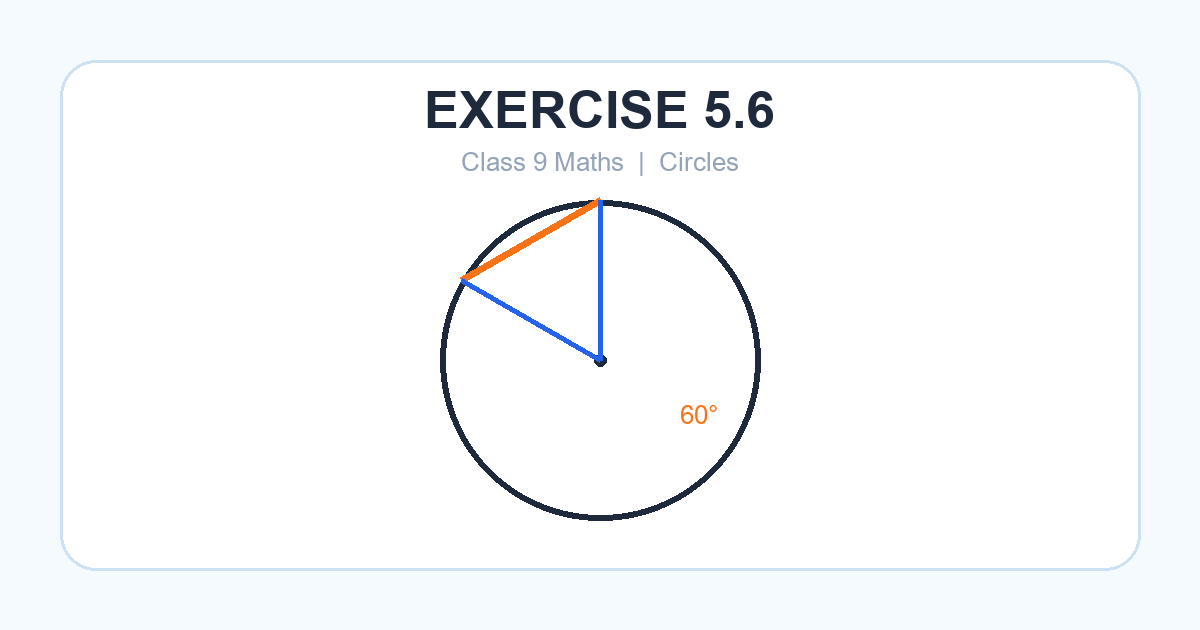
Q1. In a circle with centre O, the central angle AOB is 60°. If the radius of the circle is 12 cm, what is the length of the chord AB?
Ans: The chord AB subtends 60° at the centre O, so triangle OAB is isosceles with OA = OB = 12 cm and vertex angle 60°. Hence the base angles are also 60°, making △OAB equilateral.
AB = OA = OB = 12 cm
So the length of chord AB is 12 cm.
Q2. Let A and B be two points on a circle with centre O. (i) Are there points X, Y on the circle, on the same side of AB, such that ∠AXB is different from ∠AYB? (ii) Is it true that if ∠AXB = ∠AYB, then X and Y lie on the same side of the circle? (iii) If ∠AXB = ∠AYB, and X and Y do not lie on the circle, does the circle through A, B and X also pass through Y?
Ans: (i) No. All points on the circle lying on the same side (same arc) of chord AB subtend equal angles, since angles in the same segment are equal. So ∠AXB cannot differ from ∠AYB for X, Y on the same side of AB.
(ii) No. If ∠AXB = ∠AYB, X and Y could lie on opposite sides of AB (on the two different arcs), where the angles are supplementary-equal only in special cases; equality of angles alone does not force them to be on the same side.
(iii) Yes. If ∠AXB = ∠AYB and X, Y are on the same side of AB, then by Theorem 10 (concyclicity), A, B, X, Y all lie on one circle. So the circle through A, B and X also passes through Y.
Q3. Find x in Fig. 5.26.
Ans: In Fig. 5.26, ABCD is a cyclic quadrilateral with ∠D = 100° and ∠B = x. Opposite angles of a cyclic quadrilateral sum to 180°:
x + 100° = 180°
x = 80°