Exercise Set 5.3
Q1. Can you explain why the converse to Theorem 4 is true, i.e., why does the perpendicular from the centre of a circle to a chord of the circle bisect the chord? (Hint: Use Fig. 5.12. You are told that ∠CMA = ∠CMB = 90°. You need to show that AM = BM.)
Ans: In Fig. 5.12, let C be the centre and CM ⊥ AB, so ∠CMA = ∠CMB = 90°. Since CA = CB (radii) and CM is common, by RHS congruence ∆CMA ≅ ∆CMB. Hence AM = BM, i.e., the perpendicular from the centre bisects the chord.
Q2. An isosceles triangle ABC is inscribed in a circle, with AB = AC. Show that the altitude from A to BC passes through the centre of the circle.
Ans: Let the altitude from A meet BC at M. In isosceles ∆ABC with AB = AC, the altitude from A to the base BC is also the median, so BM = CM. Also AM ⊥ BC. Since B and C lie on the circle, the line through the centre perpendicular to chord BC bisects it (converse of Theorem 4). As AM is perpendicular to BC and bisects it, the altitude AM passes through the centre of the circle.
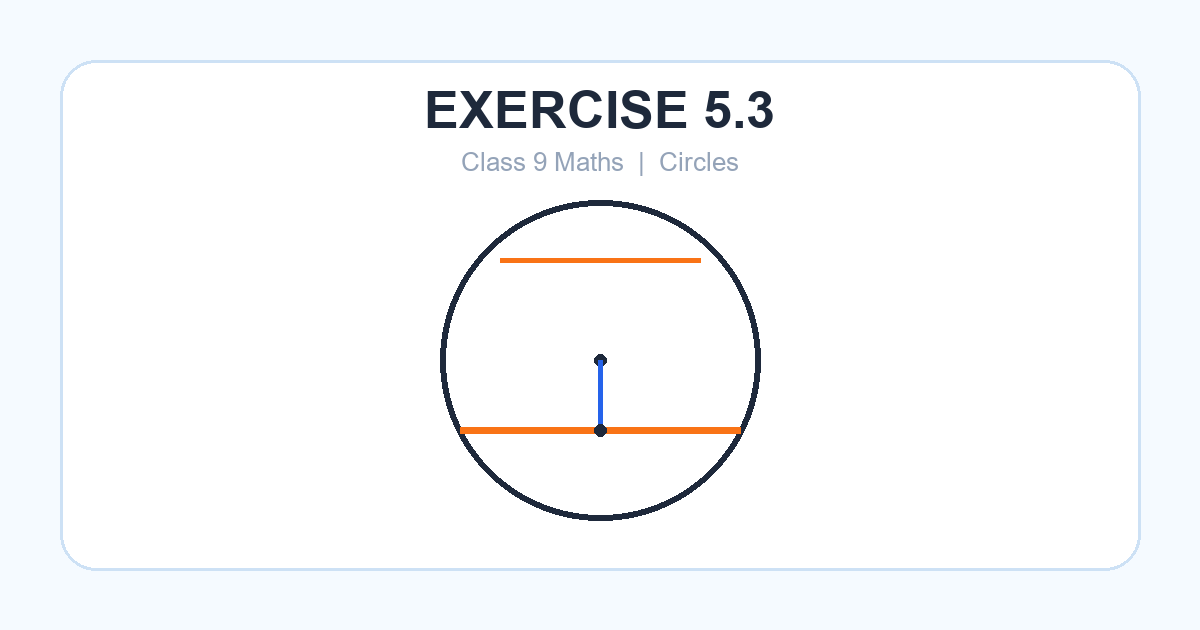
Q3. Two parallel chords of lengths 6 cm and 8 cm are on opposite sides of the centre of a circle. If the radius of the circle is 5 cm, find the distance between the midpoints of the chords.
Ans: Half-chords: 3 cm and 4 cm. Distances from the centre:

The chords are on opposite sides of the centre, so the distance between their midpoints is
