Exercises
Q1. Fill in the blanks:
(a) Production of new individuals from the vegetative part of parent is called_____________.
(b) A flower may have either male or female reproductive parts. Such a flower is called_____________.
(c) The transfer of pollen grains from the anther to the stigma of the same or of another flower of the same kind is known as _____________.
(d) The fusion of male and female gametes is termed as _____________.
(e) Seed dispersal takes place by means of _____________, _____________ and _____________.
Ans: (a) Production of new individuals from the vegetative part of parent is called vegetative propagation.
(b) A flower may have either male or female reproductive parts. Such a flower is called unisexual flower.
(c) The transfer of pollen grains from the anther to the stigma of the same or of another flower of the same kind is known as pollination.
(d) The fusion of male and female gametes is termed as fertilisation.
(e) Seed dispersal takes place by means of wind, water, and animals.
Q2. Describe the different methods of asexual reproduction. Give examples.
Ans: Different Methods of Asexual Reproduction in Plants
Asexual reproduction in plants is a process where new individuals are produced without the involvement of seeds or gametes. Here are the primary methods of asexual reproduction along with examples:
- Vegetative Propagation:
- This method involves the growth of new plants from the vegetative parts of the parent plant, such as roots, stems, or leaves.
- Examples:
- Potato: New plants can grow from the “eyes” or buds on a potato tuber.
- Ginger: New plants can sprout from the rhizomes (underground stems).
- Budding:
- In this method, a new organism develops as a small outgrowth or bud from the parent organism. The bud eventually detaches and becomes an independent individual.
- Examples:
- Yeast: Yeast cells reproduce by forming a bud that grows and separates from the parent cell.
- Hydra: This freshwater organism can also reproduce by budding.
- Fragmentation:
- This process occurs when a parent organism breaks into fragments, and each fragment can grow into a new individual.
- Examples:
- Algae: Many types of algae reproduce through fragmentation, where pieces of the algae can develop into new plants.
- Fungi: Certain fungi can also reproduce by fragmentation.
- Spore Formation:
- Spores are specialized reproductive cells that can develop into new individuals under favorable conditions. They are often produced in large numbers and can survive harsh conditions.
- Examples:
- Fungi: Organisms like bread mold reproduce through spore formation, where spores are released into the air and can germinate in suitable environments.
- Mosses and Ferns: These plants reproduce using spores that are dispersed by wind or water.
Summary: Asexual reproduction allows plants to reproduce quickly and efficiently without the need for seeds. Each method has its advantages, such as rapid population increase and the ability to thrive in specific environments. Understanding these methods is crucial for studying plant biology and ecology.
Q3. Explain what you understand by sexual reproduction.
Ans: Sexual reproduction in plants is a biological process that involves the fusion of male and female gametes to form a new individual. This process typically occurs in flowering plants, where the reproductive structures are found within the flowers.
Key Components of Sexual Reproduction:
- Flowers: The primary reproductive organs of flowering plants. They contain both male (stamens) and female (pistils) reproductive parts.
- Stamens: The male part, consisting of the anther (which produces pollen grains containing male gametes) and the filament.
- Pistils: The female part, made up of the stigma (where pollen lands), style, and ovary (which contains ovules that develop into seeds).
- Pollination: This is the process of transferring pollen grains from the anther of one flower to the stigma of the same or another flower. Pollination can occur through various agents such as wind, water, or animals (like bees and butterflies).
- Fertilization: After pollination, if the pollen grain successfully reaches the ovule, fertilization occurs. This is the fusion of the male gamete (from the pollen) with the female gamete (in the ovule), resulting in the formation of a zygote.
- Seed and Fruit Formation: Following fertilization, the zygote develops into an embryo, and the ovule transforms into a seed. The ovary matures into a fruit, which protects the seeds and aids in their dispersal.
- Advantages of Sexual Reproduction:
- Genetic Diversity: Offspring produced through sexual reproduction have genetic variations, which can enhance adaptability and survival in changing environments.
- Evolutionary Benefits: The mixing of genetic material from two parents can lead to new traits that may be beneficial for the species.
In summary, sexual reproduction in plants is a complex but essential process that ensures the continuation of plant species and promotes genetic diversity, which is crucial for adaptation and survival.
Q4. State the main difference between asexual and sexual reproduction.
Ans: Difference Between Asexual and Sexual Reproduction
Asexual reproduction and sexual reproduction are two fundamental modes through which organisms reproduce, including plants. Here are the main differences:
- Number of Parents:
- Asexual Reproduction: Involves only one parent organism. The offspring are genetically identical to the parent, resulting in clones.
- Sexual Reproduction: Involves two parents, typically one male and one female. The offspring have genetic material from both parents, leading to genetic variation.
- Genetic Variation:
- Asexual Reproduction: Produces offspring that are exact copies of the parent, meaning there is no genetic variation. This can be beneficial in stable environments where the parent’s traits are advantageous.
- Sexual Reproduction: Results in offspring that are genetically diverse. This variation can enhance survival in changing environments, as some offspring may possess traits that better suit them to new conditions.
- Reproductive Structures:
- Asexual Reproduction: Does not require specialized reproductive structures. For example, plants can reproduce through methods like vegetative propagation, budding, or fragmentation.
- Sexual Reproduction: Requires specialized structures, such as flowers in flowering plants. Flowers contain the reproductive organs (stamens and pistils) necessary for the fusion of gametes.
- Time and Energy:
- Asexual Reproduction: Generally faster and requires less energy. For instance, a single plant can quickly produce many clones through vegetative propagation.
- Sexual Reproduction: Often takes more time and energy due to the processes of pollination, fertilization, and seed development.
- Examples:
- Asexual Reproduction: Examples include the budding of yeast, fragmentation in algae, and vegetative propagation in plants like potatoes and strawberries.
- Sexual Reproduction: Examples include flowering plants like roses and sunflowers, where seeds are formed after fertilization.
In summary, while asexual reproduction allows for rapid population growth and is efficient in stable environments, sexual reproduction promotes genetic diversity and adaptability, which can be crucial for survival in fluctuating conditions.
For a deeper understanding, students should engage in practical activities such as observing plant reproduction methods in their surroundings or conducting experiments with plant cuttings to see asexual reproduction in action. Additionally, studying the structure of flowers can provide insights into the mechanisms of sexual reproduction.
Q5. Sketch the reproductive parts of a flower.
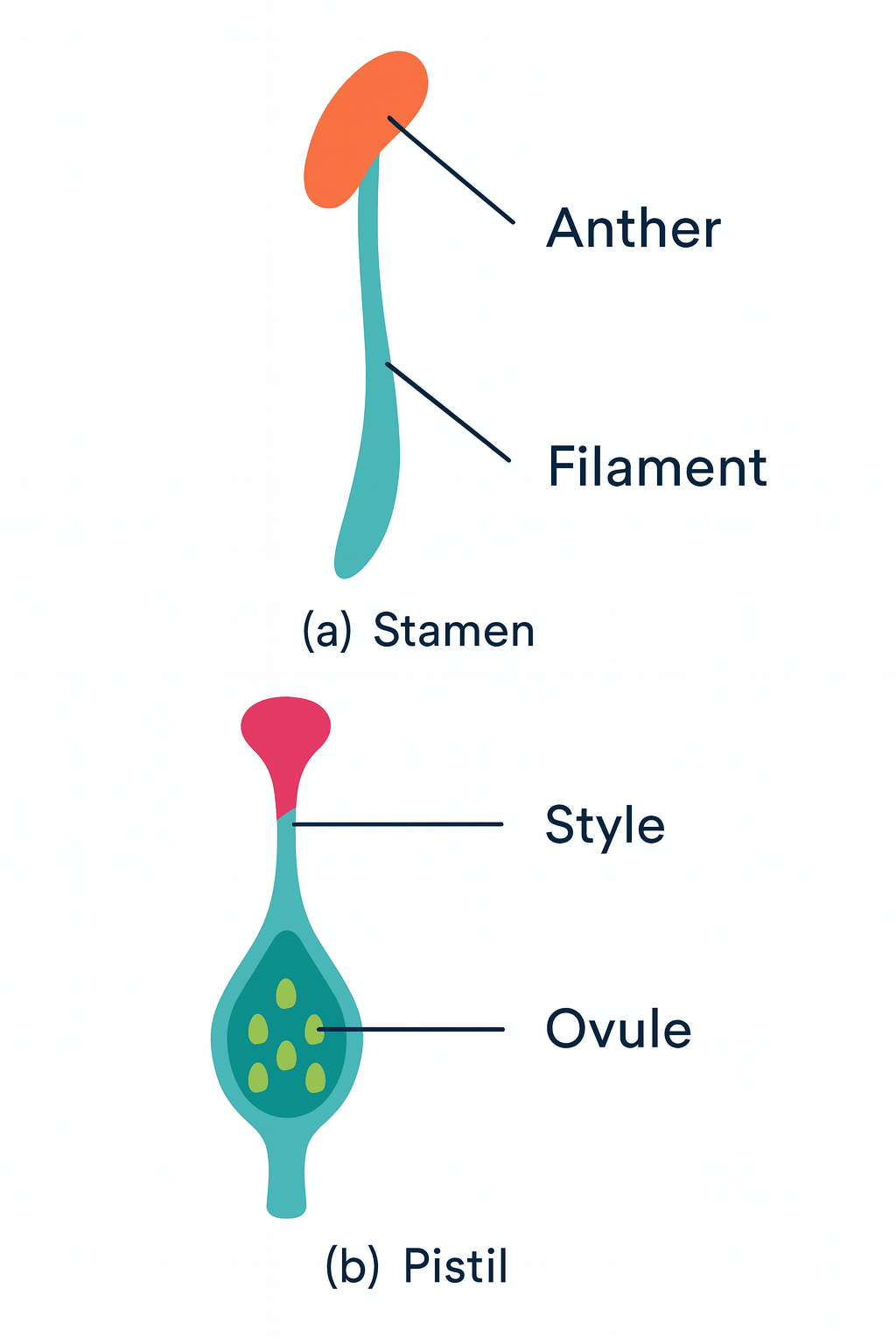
Ans: To sketch the reproductive parts of a flower, you should include the following key components:
- Stamen: This is the male reproductive part of the flower, which consists of two main parts:
- Anther: The part of the stamen that produces pollen grains, which contain the male gametes.
- Filament: A slender stalk that supports the anther.
- Pistil: This is the female reproductive part of the flower, which consists of three main parts:
- Stigma: The top part of the pistil that receives pollen during pollination.
- Style: The tube-like structure that connects the stigma to the ovary.
- Ovary: The swollen base of the pistil that contains ovules, which develop into seeds after fertilization.
- Ovule: Located within the ovary, ovules are the structures that develop into seeds after fertilization.
- Petals: While not directly involved in reproduction, petals attract pollinators with their color and fragrance.
- Sepals: These are the outer parts of the flower that protect the developing bud.
To create a sketch:
- Draw a vertical line for the stem.
- At the top, draw a circle for the flower.
- Inside the flower, label the stamen (with anther and filament) and the pistil (with stigma, style, and ovary).
- Add ovules inside the ovary.
- Optionally, include petals and sepals around the flower.
Q6. Explain the difference between self-pollination and cross-pollination.
Q7. How does the process of fertilisation take place in flowers?
Q8. Describe the various ways by which seeds are dispersed.
Q9. Match items in Column I with those in Column II:
| Column I | Column II |
| (a) Bud | (i) Maple |
| (b) Eyes | (ii) Spirogyra |
| (c) Fragmentation | (iii) Yeast |
| (d) Wings | (iv) Bread mould |
| (e) Spores | (v) Potato |
| (vi) Rose |
Q10. Tick () the correct answer:
(a) The reproductive part of a plant is the
(i) leaf (ii) stem (iii) root (iv) flower
(b) The process of fusion of the male and the female gametes is called
(i) fertilisation (ii) pollination
(iii) reproduction (iv) seed formation
(c) Mature ovary forms the
(i) seed (ii) stamen
(iii) pistil (iv) fruit
(d) A spore producing organism is
(i) rose (ii) bread mould
(iii) potato (iv) ginger
(e) Bryophyllum can reproduce by its
(i) stem (ii) leaves
(iii) roots (iv) flower
Extended Learning—Activities and Projects
1. Make your own cactus garden by collecting pieces cut from different
kinds of cacti. Grow the variety in one single flat container or in
separate pots.
2. Visit a fruit market and collect as many local fruits as possible. If many
fruits are not available, you can collect tomatoes and cucumbers (these
are fruits, though we use them as vegetables). Make drawings of the
different fruits. Split the fruits and examine the seeds within. Look for
any special characteristics in the fruits and their seeds.
You can visit a library also to learn about this.
3. Think of ten different fruit-bearing plants. Remember that many
vegetables are also fruits of the plants. Discuss with your teacher,
parents, farmers, fruit growers and agricultural experts (if available
nearby) and find out the manner of their dispersal. Present your data
in the form of a table as shown below:
| S. No. | Name of the Fruit bearing plant | Agent through which seeds are dispersed | Part of or seed which helps in dispersal |
| 1. | |||
| 2. | |||
| 3. |
4. Suppose there is one member of a particular kind of organism in a culture dish, which doubles itself in one hour through asexual reproduction. Work out the number of members of that kind of organism which will be present in the culture dish after ten hours. Such a colony of individuals arising from one parent is called a “clone”.